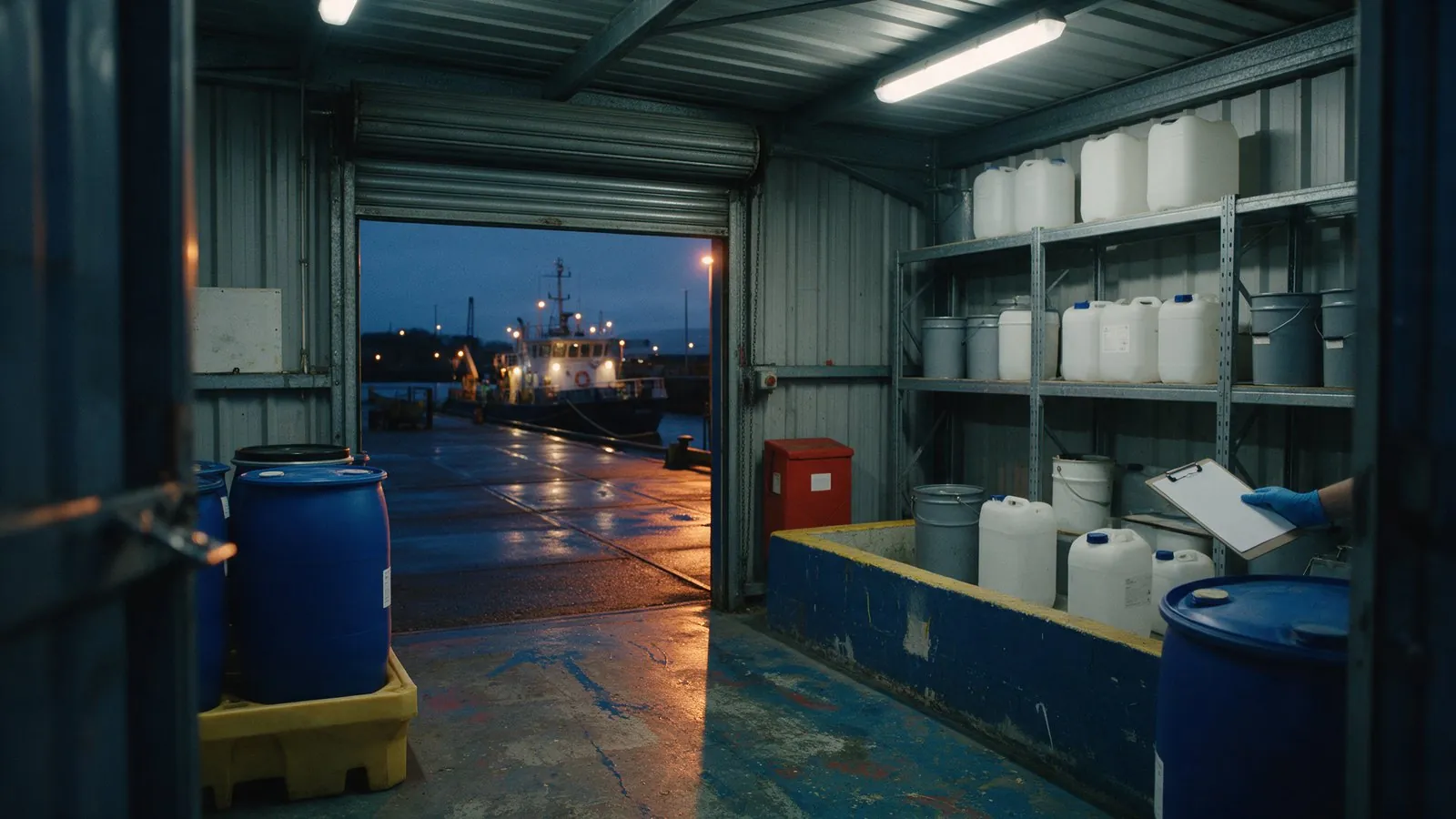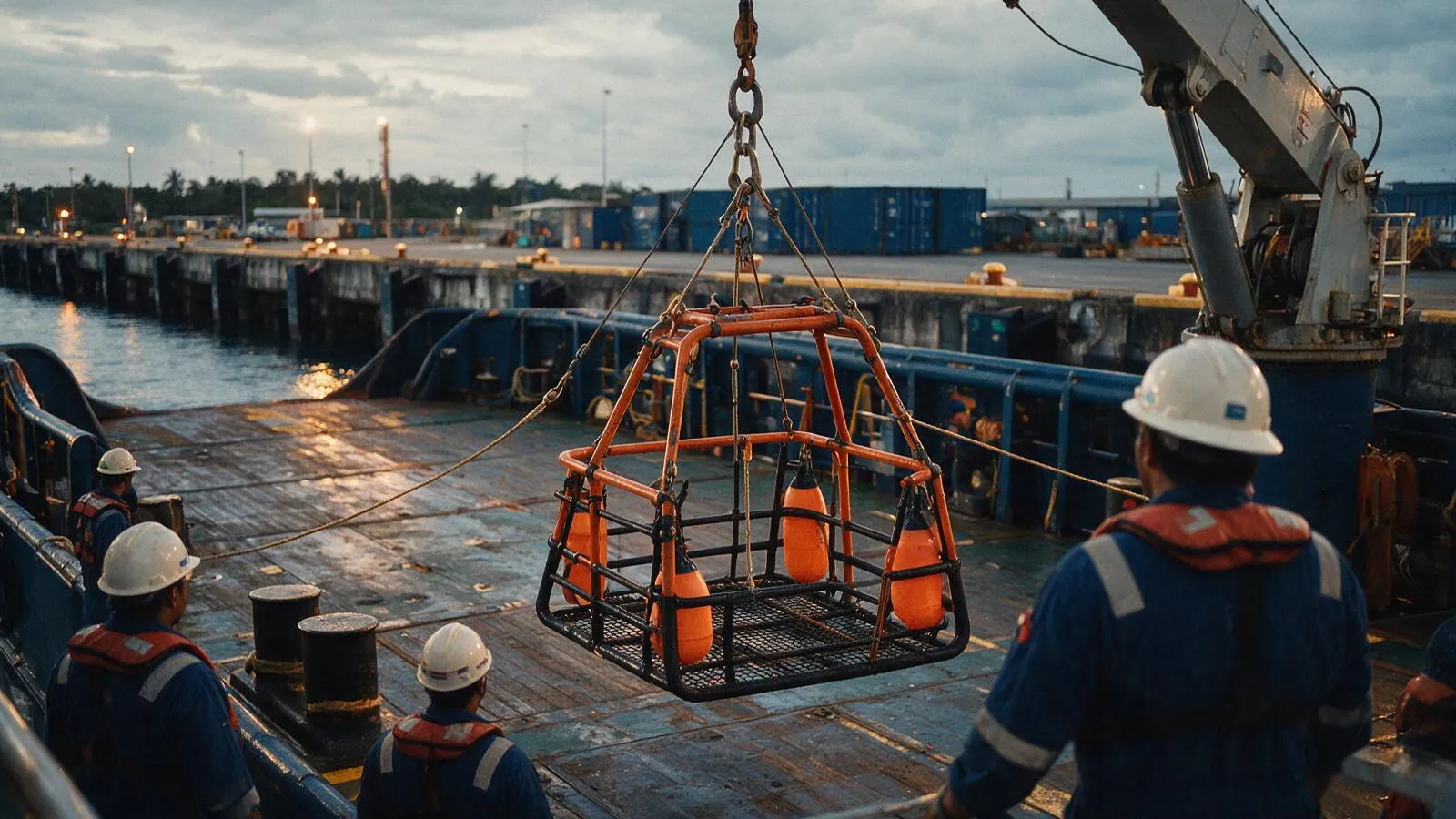
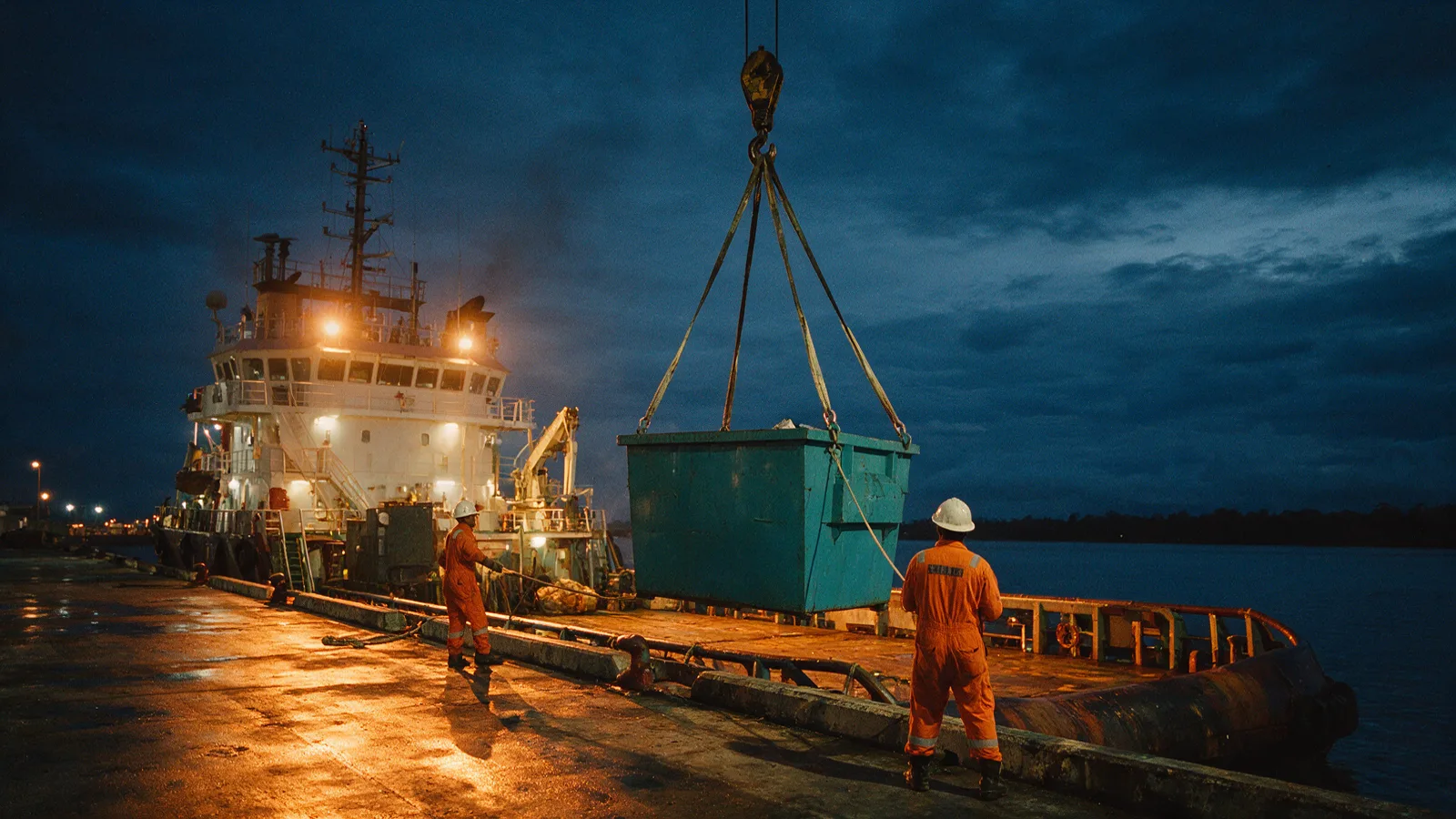
Ship operators at Bintulu keep garbage on board, sorted into MARPOL Annex V categories, and deliver it ashore to a port reception facility. The master should send Bintulu Port Authority's waste-delivery notification at least 24 hours before arrival, the garbage leaves the ship in bags or a lifted skip, and the delivery is logged in the Garbage Record Book, with the receipt kept for two years.
Key takeaways
- MARPOL Annex V generally prohibits discharging garbage into the sea; plastics, cooking oil and incinerator ash may never go overboard (IMO).
- Bintulu Port Authority's waste-delivery form should reach the designated authority at least 24 hours before arrival and declares garbage by type in cubic metres.
- After delivery, the master should get a Waste Delivery Receipt; ships that carry a Garbage Record Book keep it with the book for two years (IMO; Ships Classification Malaysia).
- Apart from ground food waste, garbage from a platform more than 12 nautical miles from land, or from a ship within 500 metres of one, may not go into the sea (IMO).
- Under section 29 of the Environmental Quality Act 1974, discharging wastes into Malaysian waters without a licence, in breach of conditions set under section 21, carries a fine of RM50,000 to RM10 million, up to five years' jail, or both.
On this page9
What rules apply to vessel garbage at Bintulu Port?
Two main layers of rules apply to vessel garbage at Bintulu Port. Internationally, MARPOL Annex V, in force since 31 December 1988 and revised from 1 January 2013, generally prohibits discharging garbage into the sea. Nationally, Malaysia's Environmental Quality Act 1974 makes unlicensed discharge of wastes into Malaysian waters, in breach of set conditions, an offence. On top of both, Bintulu Port Authority's waste-delivery form, organised around the MARPOL annexes, sets the local notice procedure.
In the International Maritime Organization (IMO) summary of Annex V, garbage "includes all kinds of food, domestic and operational waste, all plastics, cargo residues, incinerator ashes, cooking oil, fishing gear, and animal carcasses generated during the normal operation of the ship and liable to be disposed of continuously or periodically".
Under section 29 of the Environmental Quality Act 1974 (Act 127), discharging wastes into Malaysian waters, unless licensed, in breach of the acceptable conditions set under section 21, carries a fine of not less than RM50,000 and up to RM10 million, imprisonment of up to five years, or both. Oil is covered separately by section 27, where the minimum fine rises to RM100,000.
Can a ship discharge any garbage at sea off Sarawak?
Almost nothing can go overboard off Sarawak. MARPOL Annex V allows only food waste, some cargo residues, harmless cleaning agents and animal carcasses to be discharged, each under stated conditions. Plastics, cooking oil, incinerator ash, packing material and ordinary refuse may never be discharged. A vessel alongside at Bintulu is inside 3 nautical miles of land, so apart from washwater carrying only harmless cleaning agents or additives, all garbage stays on board for delivery ashore.
The waters off Sarawak are not among the eight Annex V special areas that IMO lists (the Mediterranean, Baltic, Black Sea, Red Sea, Gulfs, North Sea, Wider Caribbean and Antarctic), so the general rules apply. Offshore supply vessels face a stricter rule: IMO's simplified overview of the Annex V discharge provisions treats a ship alongside or within 500 metres of an offshore platform more than 12 nautical miles from land the same as the platform itself.
| Garbage type | All other ships, outside special areas | Offshore platform more than 12 nm from land, or a ship within 500 m of it |
|---|---|---|
| Food waste ground to pass a 25 mm screen | More than 3 nm from nearest land, en route | Permitted |
| Food waste not ground | More than 12 nm from nearest land, en route | Prohibited |
| Cargo residues not harmful to the marine environment, not in washwater | More than 12 nm from nearest land, en route | Prohibited |
| Cleaning agents and additives in cargo hold washwater, not harmful to the marine environment | Permitted | Prohibited |
| Cleaning agents and additives in deck and external surfaces washwater, not harmful to the marine environment | Permitted | Prohibited |
| Animal carcasses | En route, as far from land as possible; should be more than 100 nm | Prohibited |
| Plastics, synthetic ropes, fishing gear, cooking oil, incinerator ash, packing material, paper, rags, glass, metal, bottles, crockery | Prohibited | Prohibited |
IMO's table is a summary, and the Annex text prevails. One IMO footnote matters in practice: when garbage is mixed with or contaminated by another harmful substance, the more stringent requirement applies. In practice, that is a good reason to keep oil-soaked rags out of the ordinary garbage bags.
What must a master do before arriving at Bintulu Port?
Before arriving at Bintulu Port, the master, or someone acting for the master, completes Bintulu Port Authority's notification form for waste delivery and sends it to the designated authority at least 24 hours ahead, or on leaving the previous port if the voyage is shorter than 24 hours. The form declares the garbage on board by type and volume, and what will stay on board.
The Bintulu Port Authority waste-delivery notification form asks for garbage in cubic metres across seven Annex V lines, from plastic to "other wastes". The form has a field (2.9) for a person submitting it other than the master, for example an agent acting for the master. The form goes to the designated authority and does not itself name a collector, so the ship or its agent books one. The sequence:
- Sort on board. Keep plastics, food waste, domestic waste, cooking oil, incinerator ash, operational waste, fishing gear and e-waste apart, following the Garbage Record Book categories, and keep any cargo residues or animal carcasses separate as well.
- Fill in the form. Give ship particulars, arrival and departure times, the last port where waste was delivered and the date of that delivery.
- Declare quantities. Enter cubic metres for plastic; floating dunnage, lining or packing; paper, rags, glass, metal, bottles and crockery; cargo residues; food waste; incinerator ash; and other wastes.
- State what stays on board. Either tick the box confirming all waste is being delivered, or give storage capacity, the amount retained and the next port of delivery.
- Send it at least 24 hours before arrival and keep a copy with the Garbage Record Book, as the form requires.
- Book the collection. The master or the ship's agent books a shore collector, such as a vessel waste collection service, giving the berth, time window, volumes and whether a skip is needed on deck or on the quay.
The Bintulu Port Authority form still uses the older garbage lines, so domestic waste, cooking oil, operational waste, animal carcasses, fishing gear and e-waste have no line of their own; the natural place for them is "Other wastes (specify)". The form is IMO's Advance Notification Form (ANF) in an older layout; the current IMO version in MEPC.1/Circ.834/Rev.1 uses the same eleven garbage categories as the Waste Delivery Receipt. The form also states that it "shall be retained on board the vessel along with the appropriate Oil RB, Cargo RB or Garbage RB", which makes the notice part of the ship's own garbage paper trail.
How is garbage handed over to the port reception facility and recorded?
At handover to the port reception facility, the garbage is lifted off the ship and the facility's representative should give the master a Waste Delivery Receipt in IMO's standard format, listing each category and the cubic metres received. The ship then records the delivery in its Garbage Record Book with the date, time, facility, category and estimated volume, and keeps the receipt with the book for two years.
IMO's consolidated guidance for port reception facility providers and users (MEPC.1/Circ.834/Rev.1) sets out the receipt. Its standard Waste Delivery Receipt lists eleven garbage categories, from plastics, food wastes and domestic wastes to e-waste and two classes of cargo residue, and ends with the facility's signature and company stamp. The guidance puts the master's side plainly:
"Following delivery, the master should request a Waste Delivery Receipt to document the type and quantity of MARPOL wastes/residues actually received by the facility."
IMO, MEPC.1/Circ.834/Rev.1
Under MARPOL Annex V, ships of 100 gross tonnage and above, ships certified to carry 15 or more persons on voyages to another Party's ports or offshore terminals, and every fixed or floating platform must keep a Garbage Record Book. The 100 gross tonnage threshold came in with IMO resolution MEPC.360(79), in force from 1 May 2024, according to the IMO amendment table. Before that, the line sat at 400 gross tonnage, the figure Ships Classification Malaysia's circular 06/2018 gave Malaysian owners. Ships between 100 and 400 gross tonnage, unless certified to carry 15 or more persons on voyages to another Party's ports or offshore terminals, have needed a Garbage Record Book only since 1 May 2024.
The same Ships Classification Malaysia circular states that record books "along with the receipts obtained from reception facilities are to be retained for two (2) years from the date of last entry". A ship not required to carry a Garbage Record Book makes the entry in its official log book instead. Annex V also requires placards on disposal rules on every ship of 12 metres or more in length, and a garbage management plan on every ship of 100 gross tonnage and above, every ship certified to carry 15 or more persons, and every fixed or floating platform.
Which vessel wastes need a different disposal route?
Garbage is only one of the vessel waste streams on Bintulu Port Authority's notification form. The same form lists oily bilge water, sludge and tank washings under MARPOL Annex I, noxious liquid substances under Annex II, sewage under Annex IV, and ozone-depleting substances and exhaust-gas-cleaning residues under Annex VI. Each of those streams follows its own rules and needs a handler qualified for that specific waste.
On land, Malaysia controls scheduled wastes under a separate part of the Environmental Quality Act 1974, Part IVA. Bintulu Port Holdings' subsidiary Borneo Oil & Gas Supply Base describes itself as a transit centre for offshore scheduled waste on its waste storage and disposal page. The practical rule for a ship's crew is simple: keep oily rags, used filters, chemical containers and anything else contaminated out of the garbage bags.
Era Harvest Supply & Engineering's vessel garbage collection service covers commercial and industrial garbage. For oily waste, sewage or scheduled waste, book a contractor licensed for that specific stream.
How many offshore vessels call at Bintulu Port, and why does the 500 m rule matter?
Offshore vessels made more than half of the vessel calls at Bintulu Port Holdings' two ports, Bintulu Port and Samalaju Industrial Port, in 2025: 4,098 of 7,717 calls, or 53.10%. That matters because, apart from ground food waste, MARPOL Annex V bars garbage discharge by a ship within 500 metres of an offshore platform more than 12 nautical miles from land, so garbage generated during offshore work has to be brought back for delivery ashore.
The figures come from Bintulu Port Holdings' fourth-quarter 2025 operational results. Total calls were down 3.85% from 8,026 in 2024, and the other calls were 3,153 non-LNG and 466 LNG vessel calls. The company attributed the full-year fall to reduced base support vessel activities and a slight dip in LNG vessel calls at Bintulu Port. Offshore vessel calls fell 10.37%, from 4,572. In the fourth quarter alone, total vessel calls rose 6.81% year on year, from 1,894 to 2,023, on "higher methanol vessel calls and base support vessel activities".
What should you give a contractor to get vessel waste collected in Bintulu?
A waste contractor needs five things to quote and schedule a vessel garbage collection in Bintulu: the waste types by Annex V category, the estimated volume in cubic metres, the vessel name and berth or supply-base location, the collection window, and whether skips should sit on deck or on the quay. Most of those figures already appear on the Bintulu Port Authority notification form.
Charges depend on volume, waste category and whether a skip is hired, so send the figures from the notification form when asking for a quote.
Era Harvest Supply & Engineering Sdn Bhd, incorporated in 2014 and based in Bintulu, provides rubbish disposal for vessels and lists a 2024 to 2028 contract with Petra Marine Sdn Bhd for commercial and industrial waste disposal for vessels, described on the Petra Marine vessel waste project page and listed with Era Harvest's other named contracts. Rubbish skids and waste bins are part of Era Harvest's equipment rental fleet, alongside gensets, air compressors and open top baskets.
To arrange a collection, send the vessel, location, waste types and volumes on WhatsApp at 017-351 0071, call 086-313311 or email inquiry@eraharvest.com.
Sources
- IMO: Prevention of Pollution by Garbage from Ships (MARPOL Annex V)
- IMO: Simplified overview of the discharge provisions of the revised MARPOL Annex V
- IMO: MEPC.1/Circ.834/Rev.1, Consolidated guidance for port reception facility providers and users
- Bintulu Port Authority: Notification form for waste delivery to Bintulu Port
- Ships Classification Malaysia: SCM Circular 06/2018, Amendments to MARPOL Annex V
- Laws of Malaysia: Environmental Quality Act 1974 (Act 127), online reprint
- Bintulu Port Holdings Berhad: Operational and financial results, 4th quarter 2025
- Bintulu Port Holdings Berhad: Borneo Oil & Gas Supply Base, waste storage and disposal management