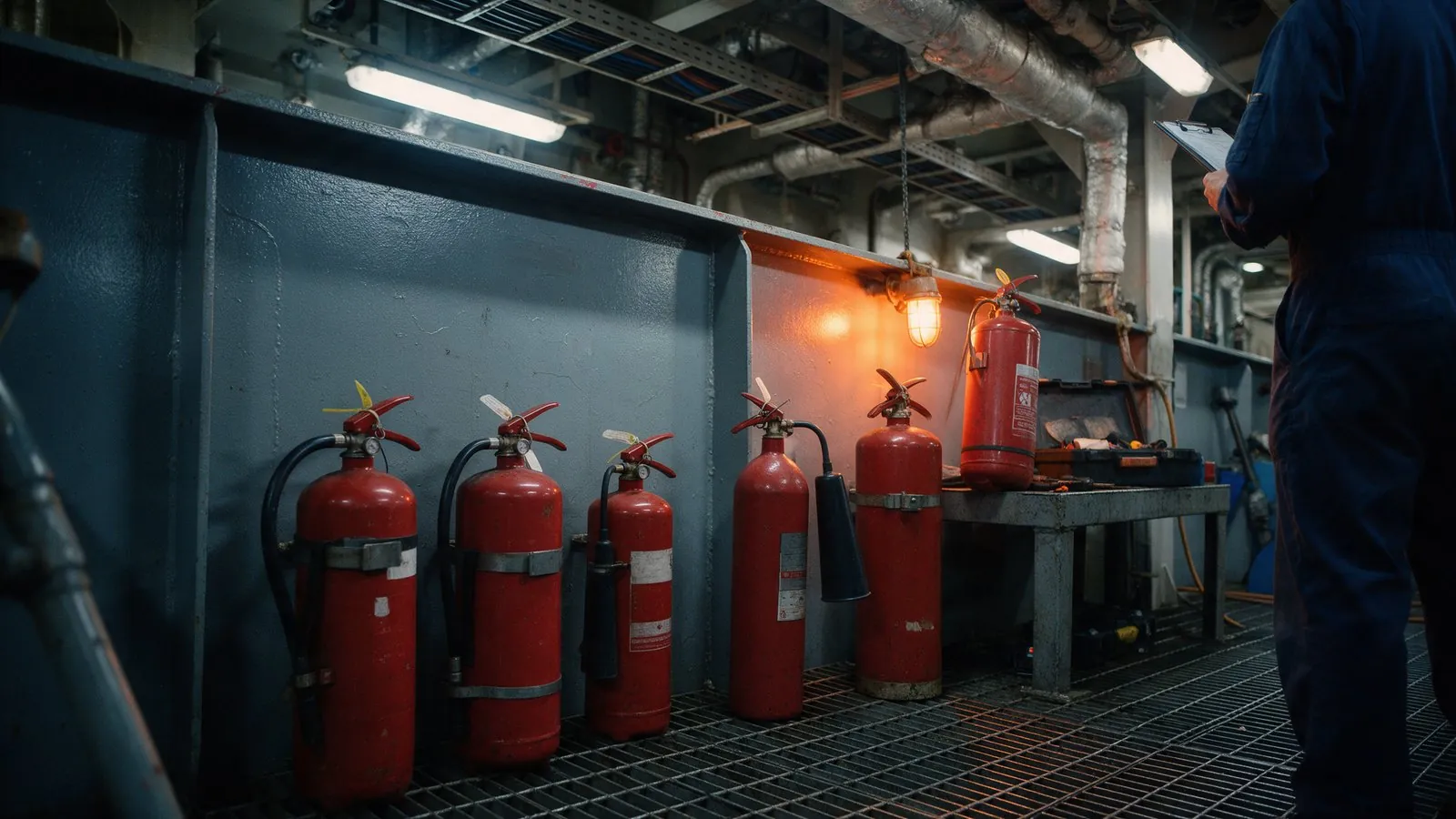
In Malaysia, a contractor registered with the Fire and Rescue Department (Bomba) services each portable fire extinguisher on business premises once a year and books it for Bomba inspection in the electronic Fire Extinguisher Inspection System (eFEIS), while site staff check it monthly. On ships covered by SOLAS, IMO Resolution A.951(23) recommends yearly service, a five-yearly sample test discharge, and a hydraulic test of every unit at least every ten years.
Key takeaways
- eFEIS covers portable dry powder, carbon dioxide, water, foam and wet chemical extinguishers holding no more than 20 kg of extinguishing medium, and every extinguisher kept on premises must be registered in it, according to the Fire and Rescue Department of Malaysia (Jabatan Bomba dan Penyelamat Malaysia, JBPM).
- JBPM charges RM5 to inspect each registered extinguisher, and a contractor whose workshop is registered in Sarawak may service extinguishers only in Sarawak (JBPM eFEIS FAQ).
- JBPM sets a maximum life of 10 years for red-cylinder extinguishers, counted from the month and year of manufacture, and approves a unit only if at least six months of that life remain (JBPM eFEIS FAQ; JBPM circular, May 2014).
- Extinguishers on ships, boats and ferries do not go through eFEIS; for ships covered by SOLAS, IMO Resolution A.951(23) recommends yearly service, a five-yearly test discharge of at least one extinguisher of each type and year of manufacture, and a hydraulic test of every unit at least every ten years.
- MSC.1/Circ.1432, which Marine Department Malaysia applied to Malaysian-registered ships through MSN 05/2023, covers wheeled extinguishers but refers portable extinguishers to A.951(23).
On this page10
How often must fire extinguishers be serviced on land sites in Malaysia?
On land sites and premises in Malaysia, portable fire extinguishers (alat pemadam api mudah alih, or APA) run on a yearly cycle. A contractor registered with JBPM services each unit and books it for Bomba inspection in eFEIS, and the JBPM certificate for each registered unit is renewed every year. Site staff check every unit monthly.
JBPM's director-general, Datuk Nor Hisham Mohammad, told The Star in May 2025:
"The inspection needs to be done annually."
Datuk Nor Hisham Mohammad, JBPM director-general (The Star, 15 May 2025)
JBPM's eFEIS FAQ says every extinguisher kept on premises must be registered in eFEIS. Universiti Tun Hussein Onn Malaysia's 2026 safe work procedure shows the yearly cycle in practice and gives this monthly visual checklist, citing the Guide to Fire Protection in Malaysia (2006):
- red cylinder in good condition (MS 1539 Part 1:2002 colour code);
- white label text and pictograms, easy to see;
- SIRIM product certification mark on the label;
- a valid JBPM H13 certificate;
- gauge needle in the green zone;
- no rust on the cylinder or valve;
- safety pin in place;
- discharge hose in good condition.
Is there a five-year service for fire extinguishers on land?
Bomba's yearly inspection is not an extended service. MS 1539 Part 4:2004 sets a basic service and an extended service, with maximum intervals in its Table A1, "Maximum maintenance intervals". The public preview omits those numbers, so the five-yearly land figure in suppliers' guides cannot be checked; A.951(23)'s five-yearly test is for ships. Ask your contractor to show you Table A1 and quote each unit's extended-service due date.
What does the fire certificate add for designated premises?
Designated premises, meaning premises designated under section 27 of the Fire Services Act 1988 (Act 341) for a fire certificate, carry a second annual check:
"Every designated premises shall require a fire certificate. (2) A fire certificate shall be renewable annually."
Fire Services Act 1988 (Act 341), section 28(1) and (2)
Section 29 ties extinguishers to the certificate: JBPM issues it only when an inspection shows adequate fire-fighting equipment (section 29(4)), and otherwise serves a notice listing what must be done first (section 29(5)). Under section 33, as printed in the 2018 reprint, the owner of designated premises without a fire certificate faces a fine of up to RM50,000, up to five years' imprisonment, or both. Employers everywhere also owe the general duty in section 15 of the Occupational Safety and Health Act 1994, which covers "the provision and maintenance of plant", including any equipment or appliance.
Who may service an extinguisher that needs a Bomba sticker?
An extinguisher that needs a Bomba sticker must be serviced by a maintenance contractor registered with JBPM in eFEIS. Buyers often ask for a "Bomba licence"; in eFEIS it is a contractor registration, issued by extinguisher type and by state. A contractor registered only for dry powder may not service carbon dioxide units, and one with a Sarawak workshop works only in Sarawak.
The eFEIS FAQ's minimum conditions are a registered company, at least one full-time Competent Person registered with JBPM, a workshop and maintenance equipment. A contractor may not pass units to a partner workshop under a memorandum of understanding, because the registered contractor that maintains a unit is responsible for it.
Bomba charges RM5 to inspect each extinguisher, JBPM's eFEIS FAQ says, and the contractor pays again for every re-inspection. The fee comes under the Fire Services (Special Duty Fees) Regulations 2021, in force since 2 January 2023, says a JBPM notice.
Each JBPM certificate carries a tracking QR code, but "some errant people have been falsifying this certificate," Nor Hisham told The Star, urging business owners to scan the code before paying. Before signing a servicing contract, ask for the contractor's eFEIS registration and check that:
- its categories match your extinguisher types;
- its registered workshop is in Sarawak;
- it is within its two-year registration period;
- you scan the QR code on each new Bomba sticker, and check the contractor's details on efeis.bomba.gov.my, before you pay.
How often must fire extinguishers be serviced on vessels?
Ships covered by SOLAS carry portable fire extinguishers under SOLAS chapter II-2 and the Fire Safety Systems (FSS) Code, supplemented by IMO Resolution A.951(23), which recommends service at intervals not exceeding one year, a test discharge every five years of at least one extinguisher of each type and year of manufacture, and a hydraulic test of every extinguisher at intervals not exceeding ten years.
Resolution A.951(23) puts it this way:
"All extinguishers together with propellant cartridges should be hydraulically tested in accordance with the recognized standard or the manufacturer's instruction at intervals not exceeding ten years. Service and inspection should only be undertaken by, or under the supervision of, a person with demonstrable competence, based on the inspection guide in table 9.1.3."
IMO Resolution A.951(23), paragraphs 9.1.2 and 9.1.3
A.951(23) calls its own status "advisory"; flag Administrations give it force. The Bahamas Maritime Authority's Marine Notice 79 states that "the requirements for portable fire extinguishers are contained within IMO Resolution A.951(23)" and restates SOLAS chapter II-2's spare charges: 100% for the first ten extinguishers, 50% for the rest up to sixty, and extra extinguishers for any that cannot be recharged on board.
For Malaysian-registered ships, Marine Department Malaysia brought in MSC.1/Circ.1432 through Malaysia Shipping Notice MSN 05/2023, dated 22 March 2023. The circular's text does "not address maintenance and inspection of fixed carbon dioxide systems or portable fire extinguishers" and refers portable units to A.951(23). For wheeled extinguishers it sets a monthly check, an annual check of each cylinder's hydrostatic test date, and a ten-yearly hydrostatic test "by specially trained persons".
Bomba's eFEIS does not apply on board: its FAQ answers "Tidak perlu" (not required) for ships, boats and ferries. For domestic boats and ferries outside SOLAS, ask Marine Department Malaysia which rules apply.
How do Malaysia's land and vessel fire extinguisher rules compare?
Malaysia's land and vessel fire extinguisher rules share a yearly service but differ in who services the units and what proves it. On land, a registered eFEIS contractor and a Bomba sticker prove compliance. On a ship covered by SOLAS, a competent person and the maintenance records do.
| Question | Land site or premises | Vessel |
|---|---|---|
| Routine checks | Site staff, monthly | Crew |
| Who services | JBPM-registered eFEIS contractor with a registered Competent Person | A person with demonstrable competence, or someone under their supervision |
| Service interval | Yearly, with the unit's JBPM certificate renewed | Not exceeding one year |
| Longer tests | Extended service at MS 1539 Part 4 Table A1 intervals (not in the public preview) | Test discharge every five years (one per type and year of manufacture); hydraulic test of every unit at least every ten years |
| Maximum life | 10 years for red cylinders, from the month of manufacture | No age limit in A.951(23); condition and the hydraulic test decide |
| Proof of service | Bomba QR or barcode sticker or H13 receipt, plus the eFEIS record | Maintenance label with full weight; records of date, maintenance type and pressure test |
What does a fire extinguisher service actually include?
A fire extinguisher service checks whether the unit has been operated, whether its pressure and weight are within limits, and whether the body, hose and nozzle are sound, then records the result on the maintenance label. At recharge, and at the five- and ten-year points, the technician also opens the unit, examines the charge and the inside of the body, and checks the seals.
Resolution A.951(23)'s inspection guide lists the steps. Untrained site staff and crew do only the outside checks; opening a pressurised extinguisher is work for a competent technician, or someone under their supervision.
- Safety clip and indicators: has the extinguisher been operated?
- Pressure indicator: pressure within limits, dust covers in place.
- External examination: corrosion, dents or damage that may affect safe operation.
- Weight: compared with the fully charged mass.
- Hose, nozzle and instructions: clear, undamaged and legible.
- At recharge: powder free flowing, without caking; gas cartridges free of damage and corrosion.
- At five and ten years: vent passages, operating mechanism, cartridge weight, O-rings, and the body's interior for corrosion.
- Finish: reassembly to the manufacturer's instructions, the maintenance label filled in with full weight, and a report.
UTHM's procedure has any used or damaged extinguisher reported at once to be recharged (refilled) or repaired.
When does a fire extinguisher expire, and when should it be replaced?
A fire extinguisher should be replaced, rather than serviced, when it reaches the end of its life, fails its pressure test, or shows corrosion, dents or damage that may affect safe operation. On land, JBPM's eFEIS FAQ sets a maximum life of 10 years for red-cylinder extinguishers, counted from the month and year of manufacture, and JBPM will not approve a unit with under six months left.
A JBPM circular dated 6 May 2014 adds the six-month rule and gives older blue-cylinder dry powder units built to MS 1179:1990 a 12-year limit. In its example, a blue unit made in November 2002 could still be approved at a May 2014 inspection; one made in October 2002 could not. An attached 2005 circular stopped MS 1179 sales from 15 January 2005, so any blue unit still in use is past its limit.
What records should you keep for fire extinguishers?
Keep one register that ties each extinguisher's serial number to its exact location, type, year of manufacture, last service, last pressure test and next due date. On ships, IMO Resolution A.951(23) says records should show the date of inspection, the type of maintenance and whether a pressure test was done. On land, the eFEIS record, the Bomba sticker and JBPM's H13 inspection receipt are the proof.
Register the full location, down to room, floor and postcode: a JBPM notice says no address change can be made once the barcode sticker is printed. The eFEIS contractor manual registers spare and temporary replacement units to the contractor's workshop, so ask how loan units are covered while yours are away. Lifting gear needs the same register discipline; see how often lifting slings need inspection and recertification in Malaysia.
How does Era Harvest help with fire extinguishers in Bintulu?
Era Harvest Supply & Engineering Sdn Bhd, incorporated in December 2014 and based at Town Square Bintulu, supplies fire extinguishers, extinguisher boxes and fire hose to marine and industrial customers and services extinguishers. Its company profile also lists fire detection and alarm, suppression, and hydrant and hose reel systems.
Era Harvest's range is set out under fire extinguisher supply and servicing in Bintulu and in the fire-fighting equipment catalogue; brands it supplies include Eversafe and Unitor. Era Harvest's project record lists a KLCC Urusharta Sdn Bhd contract, 2023 to 2026, for service and maintenance of air conditioning, the fire alarm system, fire extinguishers and electrical systems at an office in Bintulu.
For premises extinguishers that need a Bomba sticker, ask any servicing contractor for its eFEIS registration covering your extinguisher types. Buying extinguishers together with liferafts or other vessel safety items? Era Harvest's guide to one supply contractor versus separate specialists explains when to split the order.
Send the extinguisher list, with types and manufacture dates, to Era Harvest on WhatsApp at 017-351 0071, call 086-313311, email inquiry@eraharvest.com, or use the contact page.
Sources
- Jabatan Bomba dan Penyelamat Malaysia, eFEIS Soalan Lazim (FAQ) (2024)
- The Star, 'Do not play with fire', Nelson Benjamin (2025)
- Jabatan Bomba dan Penyelamat Malaysia, eFEIS 2.0 Manual Pengguna Kontraktor (2023)
- Jabatan Bomba dan Penyelamat Malaysia, Jangka Hayat Maksima Alat Pemadam Api (APA) Mudahalih, with the 2005 MS 1539 circular (2014)
- Jabatan Bomba dan Penyelamat Malaysia, Penepian Fi Perkhidmatan bagi Perakuan Alat Pemadam Api Mudah Alih Milik Kerajaan (2024)
- Jabatan Bomba dan Penyelamat Malaysia, Penukaran Alamat pada Sistem dan Barcode Sticker selepas Pemeriksaan Alat Pemadam Api (2013)
- Laws of Malaysia, Fire Services Act 1988 (Act 341), reprint as at 1 October 2018
- Department of Standards Malaysia, MS 1539: Part 4:2004 Maintenance of portable fire extinguishers, preview (2004)
- Universiti Tun Hussein Onn Malaysia, Prosedur Kerja Selamat Penyediaan Alat Pemadam Api, SWP.002 Rev.3 (2026)
- DOSH, Occupational Safety and Health Act 1994 (Act 514), reprint as at 1 June 2024
- IMO, Resolution A.951(23): Improved Guidelines for Marine Portable Fire Extinguishers (2003)
- IMO, MSC.1/Circ.1432 Revised Guidelines for the Maintenance and Inspection of Fire Protection Systems and Appliances, annexed to Cayman Islands Shipping Notice 01/2014 Rev 2 (2022)
- Marine Department Malaysia, MSN 05/2023 Maintenance and Inspection of Fire Protection Systems and Appliances, in Ships Classification Malaysia Technical Circular 001/2023 (2023)
- Bahamas Maritime Authority, Marine Notice 79: Firefighting Equipment, version 2.2 (2025)