For most offshore and marine operators in Sarawak, the practical answer is a hybrid. Give routine supply and services (PPE, chemicals, lifting gear, fire-fighting equipment, rental items and vessel waste collection) to one local one-stop supplier, and contract separately wherever a regulation, a manufacturer or your own procedures decide who may do the work. One supplier saves coordination. Specialists win where an approval, not convenience, is the deciding factor.
Key takeaways
- A one-stop offshore supplier suits routine, repeat work: fewer purchase orders, one contact and one consolidated delivery, which matters at a busy port such as Bintulu, where Bintulu Port handled 7,281 vessel calls of all types in 2025 (Bintulu Port Holdings).
- SOLAS regulation III/20.8 requires inflatable liferafts to be serviced at an approved servicing station, normally every 12 months (Lloyd's Register), so liferaft servicing belongs with an approved specialist.
- Marine Department Malaysia lists 21 approved life raft service stations (updated 31 March 2026); the seven in Sarawak are at Miri and Sibu addresses.
- PETRONAS approves vendors category by category; each category records a mode of operation, such as self-operated or dealer, and a minimum Bumiputera requirement of 100%, 51%, 30% or 0% (PETRONAS licensing guidelines, April 2026).
- Most Sarawak operators are best served by a hybrid: one local supplier for routine supply and maintenance, named specialists for approval-gated scopes, and a contract that names subcontractors and states mark-ups.
On this page9
- Choose one supplier for routine, repeat, multi-item supply and scheduled maintenance, where one delivery and one point of contact matter most.
- Choose a specialist where a regulator or manufacturer approves named providers, or where your procedures require inspection independent of the supplier.
When does a one-stop offshore supplier make sense in Sarawak?
A one-stop offshore supplier makes sense when the work is routine, repeated and spread across many small orders: consumables for a vessel call, PPE top-ups, chemicals, wire rope, slings and shackles, equipment rental and periodic maintenance. The operator raises fewer purchase orders, deals with one contact and one safety system, and gets one consolidated delivery to the quay, supply base or platform instead of several.
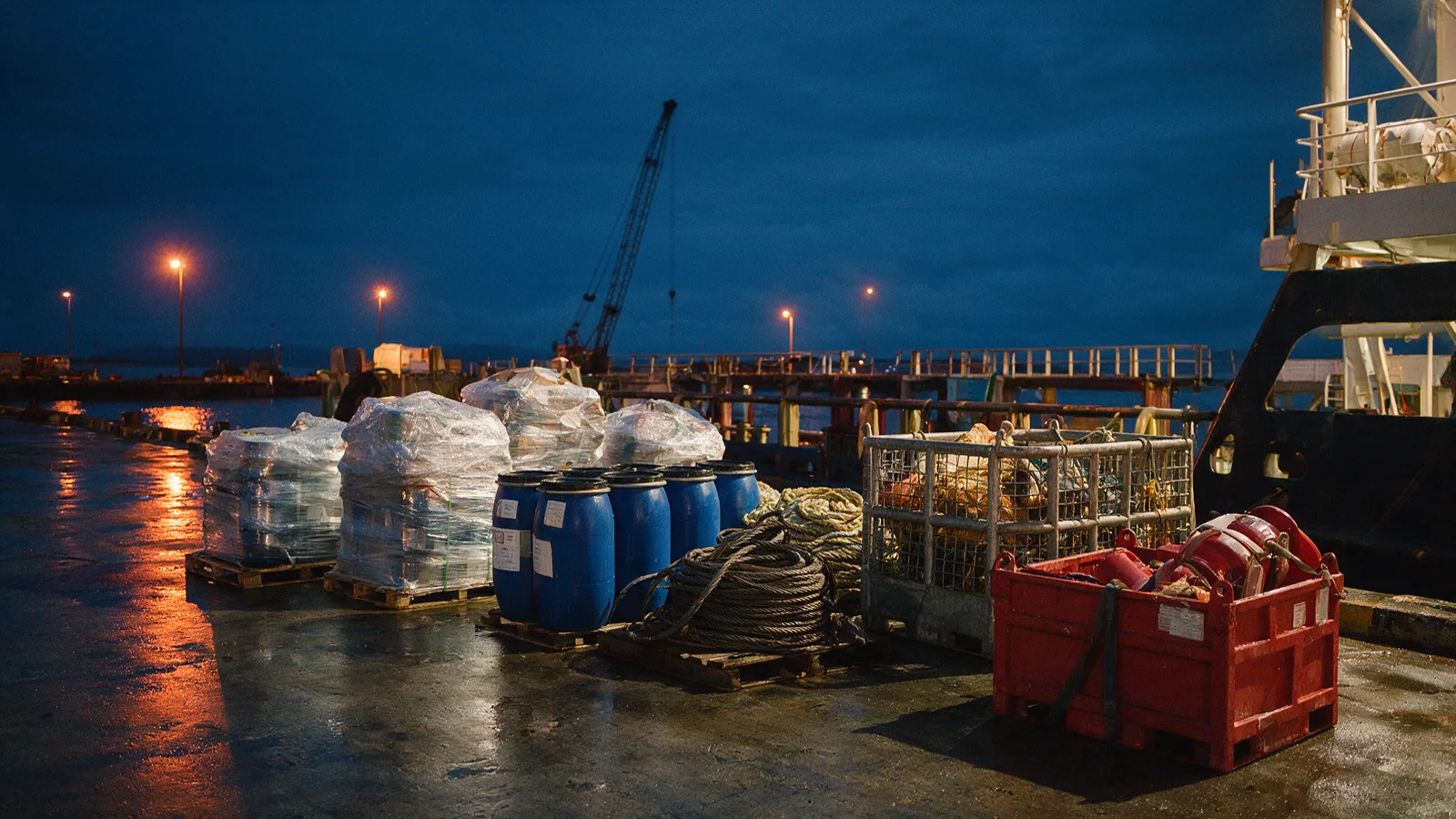
Consolidation matters at a busy port. Bintulu Port Sdn Bhd handled 7,281 vessel calls of all types in 2025, according to Bintulu Port Holdings' 2025 integrated annual report, which also states that its subsidiary Borneo Oil & Gas Supply Base "holds the sole supply base licence in Sarawak." One supplier that consolidates deliveries to the quay spares the operator from coordinating several vendors against the same delivery slot.
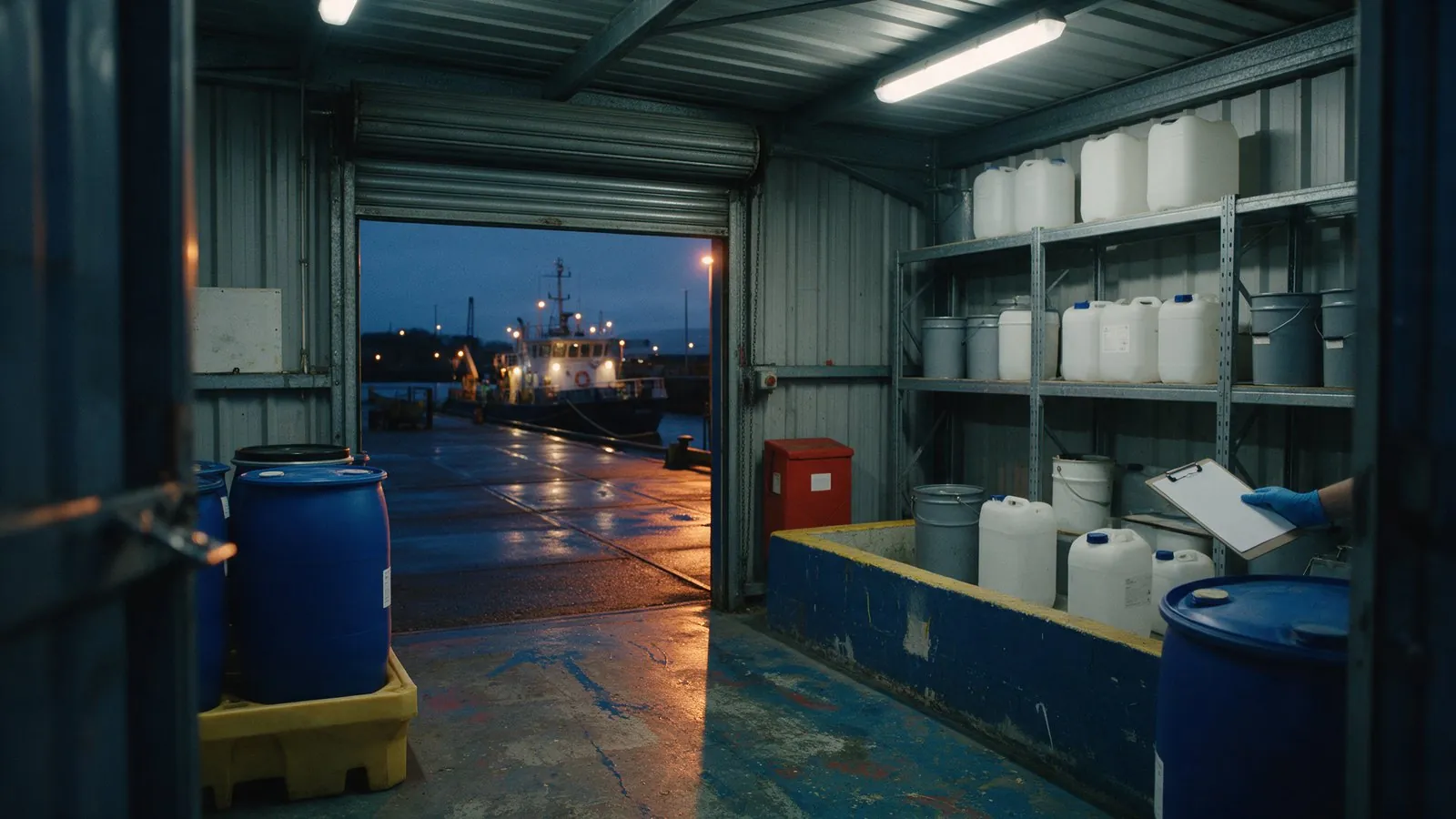
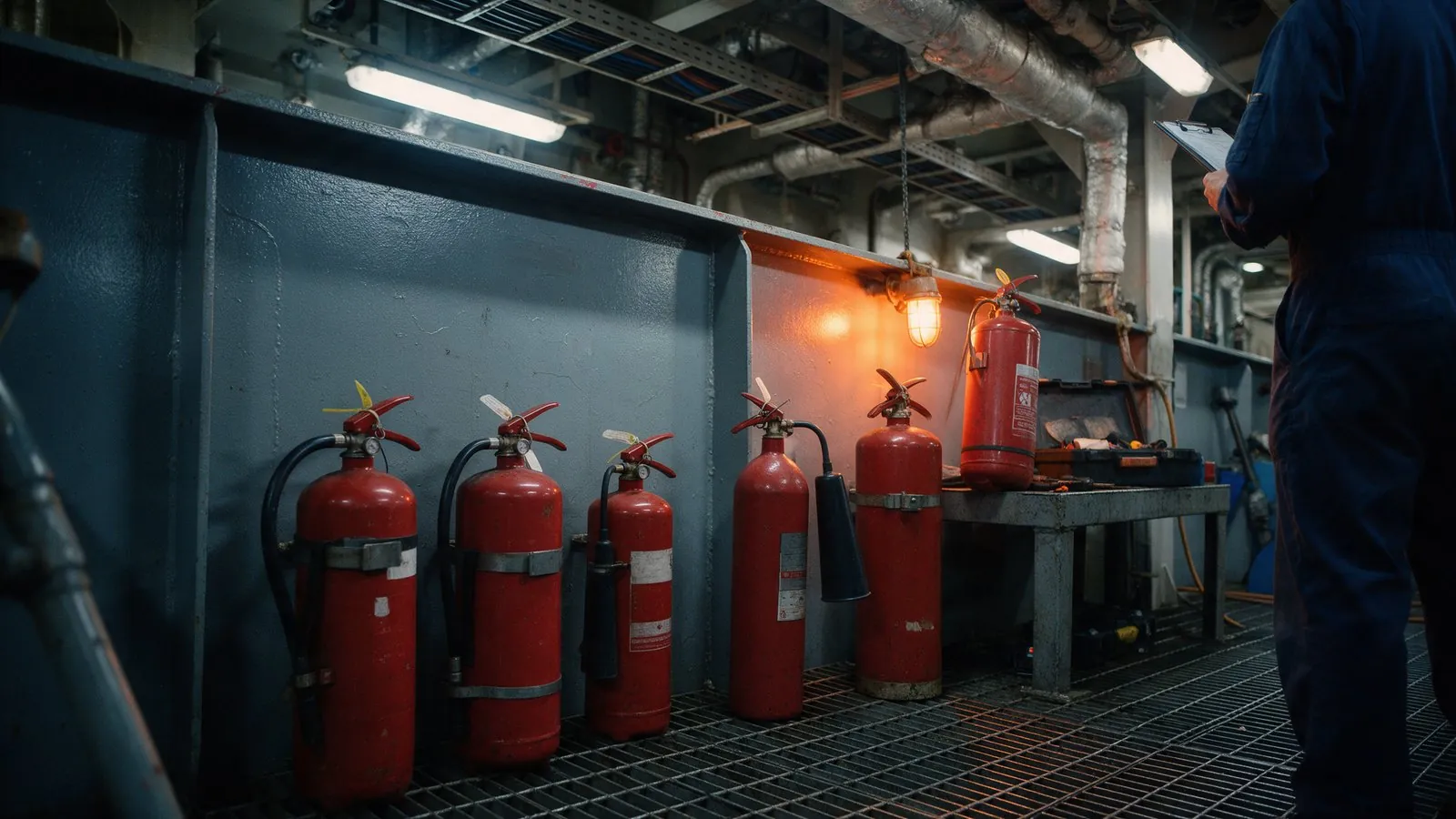
A single supply-and-services contractor also means one set of inductions, one permit-to-work interface and one HSE system to audit. Typical bundled scopes are marine and cleaning chemicals (see what to specify when ordering marine chemicals), fire-fighting equipment supply, gensets, compressors and other rentals, and vessel rubbish collection (see how vessel waste is handled at Bintulu).
When are separate specialists the better choice?
Separate specialists are the better choice whenever a regulator, a manufacturer or an independence requirement decides who may do the work. Inflatable liferaft servicing is the clearest case in Malaysia: SOLAS requires it at an approved servicing station, and Marine Department Malaysia publishes the list of approved stations. Manufacturer-certified refurbishment, class-accepted underwater surveys and independent inspection also belong with a specialist, whatever the convenience of a bundle.
The liferaft rule is precise. Lloyd's Register's 2015 class news summarises it: "SOLAS regulation III/20.8 requires inflatable liferafts to be serviced at intervals not exceeding 12 months," at "an approved servicing station which is competent to service them, maintains proper servicing facilities and uses only properly trained personnel." Under SOLAS III/20.8.1.1, as Indian Register of Shipping's maintenance annex notes, the flag Administration may extend that interval to 17 months. Marine Department Malaysia's list, updated 31 March 2026, names 21 approved life raft service stations, each marked against the liferaft makes it may service. Confirm the approval covers whichever branch will actually do the work.
Three more situations favour a specialist:
- Manufacturer-certified work. If your contract or the equipment documentation calls for a manufacturer-certified refurbisher or service centre, ask the manufacturer for its current list and contract a provider on it.
- Class-accepted underwater work. If a classification society has to accept the result of an underwater survey, confirm with that society which diving contractors it accepts before bundling the job.
- Independent examination. If your procedures say the company that supplies or rents lifting gear must not be the only company that examines it, buy the gear from one company and the sling inspection and recertification from another.
How do one supplier and separate specialists compare?
One supplier and separate specialists trade off predictably. Vendor consolidation reduces paperwork, delivery runs and safety interfaces, but single-sourcing concentrates supply risk in one company and can blur what each item costs. Separate specialists bring deeper approvals and clearer pricing per scope, but multiply purchase orders and handovers, and can leave gaps between scopes that no single company owns.
| Factor | One-stop supplier | Separate specialists |
|---|---|---|
| Purchase orders and invoices | Fewer; routine items consolidated | One stream per specialist |
| Total landed cost | Fewer delivery runs and less admin; possible mark-up on bought-in items | Lower unit prices possible; more handling and coordination cost |
| Accountability for a late or wrong item | One party answers for the whole list | Each answers for its own scope; gaps between scopes need an owner |
| HSE management | One HSE system for self-performed work; subcontractors still bring their own | Several systems to audit and align |
| Depth in an approval-gated scope | Only as deep as the supplier's own approvals | Approved or certified provider by design |
| Supply-risk concentration | High; one failure affects many items | Spread across several companies |
| Best fit | Routine, repeat, multi-item supply and maintenance | Approval-gated, high-consequence or one-off technical work |
The specialist model's weak point is the space between contracts. When five vendors ship to one vessel call, someone still has to coordinate the quay, the paperwork and the lift plan, and in a split model that someone is usually the operator. The one-stop model's weak point is the reverse: a single late supplier delays every item on the list.
What should you check on a PETRONAS licence before bundling scopes?
Before bundling scopes under one supplier, check which PETRONAS work categories the vendor holds and how it operates in each, not only that it holds a licence. PETRONAS states that a licence allows supply to "both upstream and downstream" sectors, while a registration covers the downstream sector, "serving PETRONAS subsidiaries only." Category checks matter most when the work sits under a contract with PETRONAS or a Petroleum Arrangement Contractor.
PETRONAS groups work into Standardised Work and Equipment Categories (SWEC), divided into product and service categories. Its licensing guidelines, effective April 2026, mark each category with a Mode of Operation. A "Self-operated" vendor is one "that carries-out works using its internal resources such as internal expertise, workforce, facilities and equipment"; a "Dealer" is "a Vendor that supplies products sourced from any supplier, manufacturer, and/or the Principal." Both are legitimate modes; they simply describe different things.
Local content also varies by category. The same guidelines state that "the SWEC's minimum Bumiputera requirement is set at 100% or 51% or 30% or 0%," measured at four levels: equity, board of directors, management and employment. A bundle therefore has to meet the requirement of each category it covers, which is one reason a single supplier may not be eligible for every scope on a PETRONAS-related list. A licence is also not a contract: a vendor licensed for the relevant SWEC is eligible for tenders "(subject to procurement strategy)," not assured of an award.
Is the Sarawak supplier base deep enough to split the work?
The Sarawak supplier base is large overall but thinner for approval-gated work. PETRONAS counted "715 active registered companies in Sarawak" in July 2026, without saying how many cover any one scope, and PETRONAS and the Sarawak Government recognised 82 local vendors at the 2026 Sarawak Commemoration Day. For liferaft servicing, the approval-gated scope with a public national list, approved stations are fewer: seven in Sarawak.
PETRONAS frames local growth in terms of capability. "PETRONAS will continue to strengthen local industry capabilities to enable competitive and capable vendors to participate, grow and contribute to the energy value chain," said Datuk Ir. (Dr) Bacho Pilong, Senior Vice President of Malaysia Petroleum Management, in the July 2026 PETRONAS release. That is a statement of intent. For a Bintulu buyer, it is the liferaft and category evidence above that points to a hybrid: a local main supplier for routine items, with named specialists, wherever their approved stations are, for approval-gated scopes.
How do you set up a hybrid supply model without losing control?
A hybrid supply model works when the split is decided scope by scope and written into the contract before the first order. List every recurring need, mark the scopes a regulator or manufacturer ties to approved providers, give the rest to one main supplier, and require that supplier to state which work it performs itself and which it buys in. Then keep one certificate register for every supplier.
- List the scopes. Consumables, PPE, chemicals, lifting gear, fire-fighting equipment, rentals, waste collection, maintenance, underwater work, inspection and recertification.
- Mark the approval-gated scopes. Liferaft servicing at a Marine Department-approved station, manufacturer-certified refurbishment, class-accepted underwater surveys and any independent examination.
- Give routine scopes to one supplier under the contract controls below.
- Ask what is self-performed. Per scope, the supplier states whether it uses its own people and equipment or sources the work elsewhere.
- Consolidate delivery. One delivery schedule to the vessel, base or platform, even where several companies supply the items.
- Keep one certificate register. Test certificates, service dates and next-due dates for every item, whoever supplied it.
- Keep a second source for critical items and review the split once a year.
Procurement chiefs across industries back the second-source step. In Deloitte's 2025 Global Chief Procurement Officer Survey, which spans industries rather than offshore supply alone, 74% of respondents "identified finding alternative supply sources as the most effective mitigation strategy" amid rising cost pressures, geopolitical complexity and regulatory issues.
What should a contract with a one-stop offshore supplier require?
A contract with a one-stop offshore supplier stays transparent when it requires four things:
- Named subcontractors for any scope the supplier does not perform itself.
- Line-item pricing, with any mark-up on bought-in items stated.
- No substitution of supplier or brand without the operator's written approval.
- Test or service certificates delivered with the goods.
Without these controls, a one-stop bundle can hide which company actually does each job and what it adds to the price.
What does Era Harvest cover from Bintulu?
Era Harvest Supply & Engineering Sdn Bhd, incorporated in December 2014 and based at Town Square Bintulu, covers the routine side of a hybrid model: supply of marine, safety, fire-fighting, lifting and PPE items, chemicals and industrial gas; equipment rental; facility maintenance; and vessel rubbish disposal. It is the authorised agent for WSS Wilhelmsen Ships Service chemicals, and the full list is on the services overview.
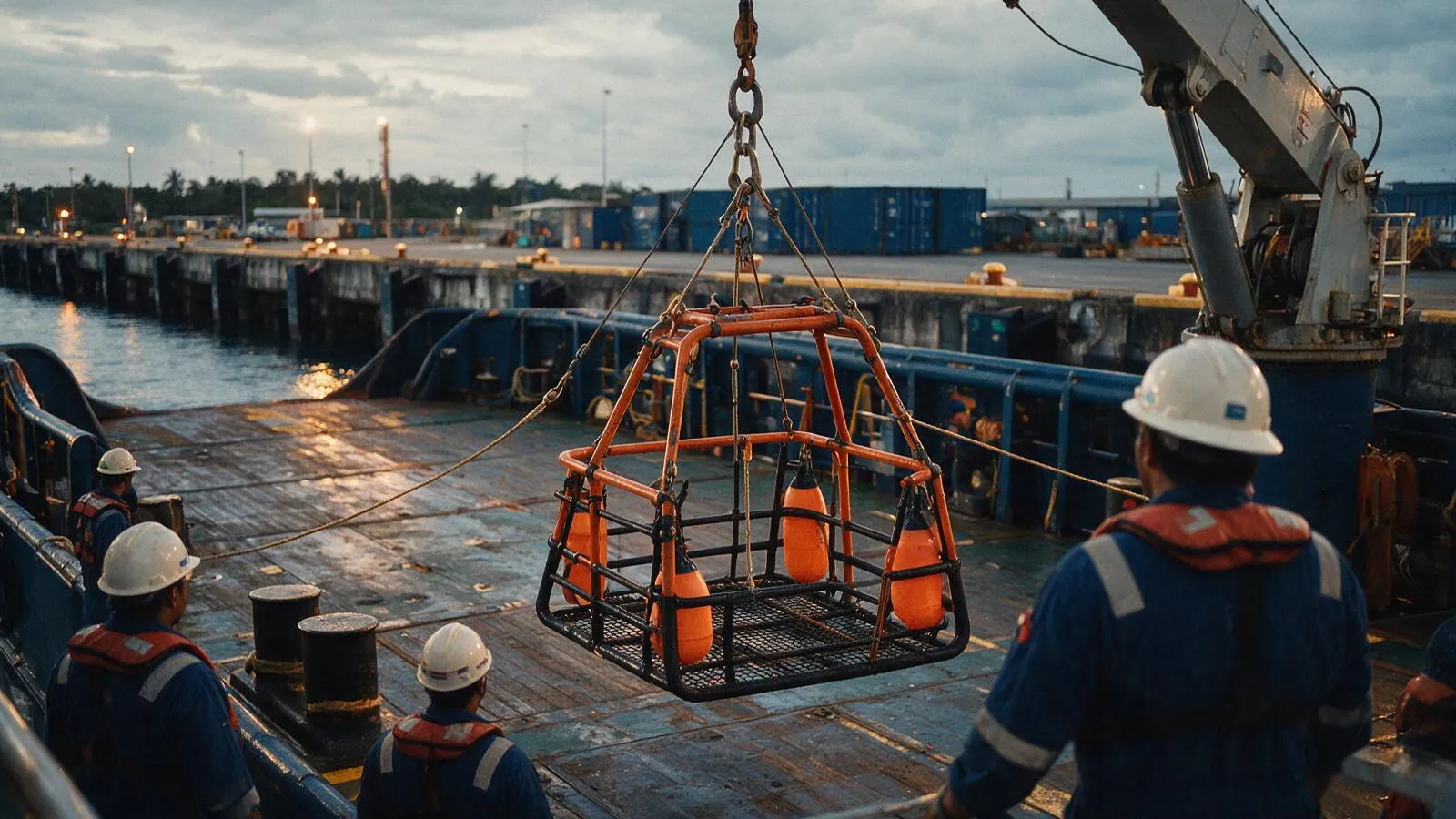
Era Harvest also offers two technical services: underwater services, such as inspection, cutting, welding and anode installation, and personnel transfer basket supply, rental, inspection, maintenance and refurbishment (see the transfer basket inspection guide). The work record on our projects includes transfer basket supply, rental and maintenance for PETRONAS Carigali Sdn Bhd (2023–2026); air-conditioning, fire alarm, extinguisher and electrical maintenance for KLCC Urusharta Sdn Bhd in Bintulu (2023–2026); vessel waste disposal for Petra Marine Sdn Bhd (2024–2028); and underwater welding and sheet-pile cutting at the Sarawak Methanol jetty for China Communications Construction Company (M) Sdn Bhd in 2024.
The same balance applies to Era Harvest as to any supplier. Where a contract calls for a manufacturer-certified refurbisher, a classification society must accept an underwater survey, or a liferaft needs an approved station, confirm the provider's standing first and use the specialist where needed. Where your procedures require independent examination, a basket or sling that Era Harvest supplies or rents should be examined by another firm.
Era Harvest Supply & Engineering Sdn Bhd is licensed by PETRONAS.
For a quotation on your routine supply and maintenance list, message WhatsApp 017-351 0071, call 086-313311, email inquiry@eraharvest.com or use the enquiry cart. More buying guides for Bintulu operators are in the resources section.
Sources
- Lloyd's Register, Class News 05/15 (2015): servicing of inflatable liferafts, SOLAS III/20.8
- Indian Register of Shipping, Annex 3: Maintenance Requirements of Life Saving Appliances
- Marine Department Malaysia, Approved Life Raft Service Stations (updated 31 March 2026)
- Bintulu Port Holdings Berhad, Integrated Annual Report 2025
- PETRONAS, Licensing & Procurement in Malaysia
- PETRONAS, General Guidelines: PETRONAS License and Registration (effective April 2026)
- PETRONAS, PETRONAS, Sarawak Government Honour Local Vendors, Spurring Growth of Local OGSE Ecosystem, 21 July 2026
- Deloitte, 2025 Global Chief Procurement Officer Survey