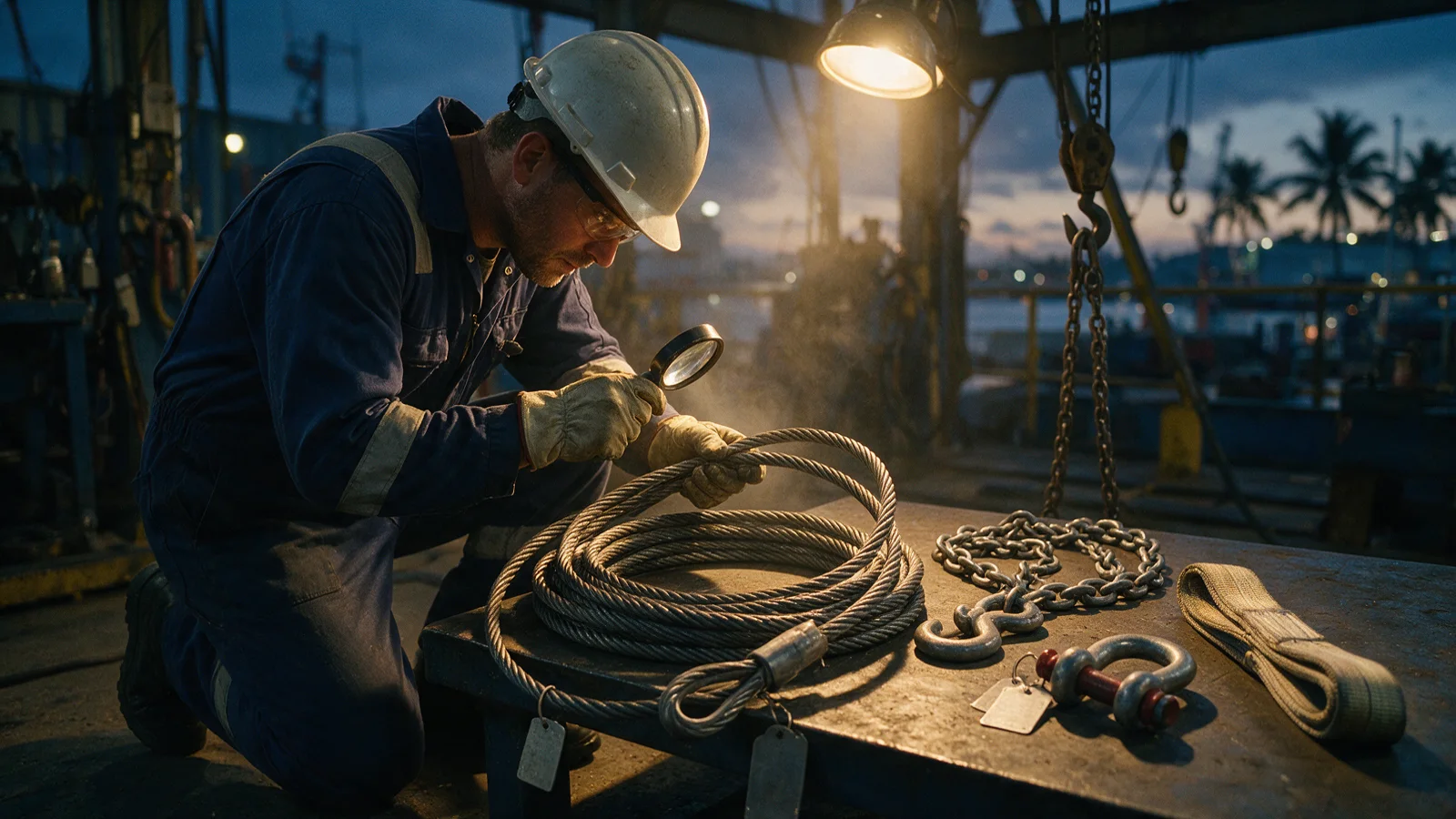
Neither the OSH Act 1994 (Act 514) nor P.U.(A) 99/2024 sets a fixed interval for lifting slings. Since 1 June 2024, regulation 16 of P.U.(A) 99/2024 requires slings to be built to a recognised standard and, so far as is practicable, in good condition before use. Published benchmarks set a pre-use check plus a documented examination every 6 to 12 months, or monthly to quarterly in severe service.
Key takeaways
- Neither Act 514 nor P.U.(A) 99/2024 sets a month count for lifting slings: regulation 16, in force since 1 June 2024, requires a recognised standard and, so far as is practicable, good condition before use.
- The 6-month sling recertification figure often quoted for Malaysia is not in Act 514 or P.U.(A) 99/2024; it matches UK LOLER for accessories exposed to deterioration, which client procedures may adopt.
- A DOSH certificate of fitness, valid for fifteen months, covers prescribed lifting machinery such as cranes, not the slings used with it.
- ASME B30.9 sets yearly periodic sling inspection in normal service and monthly to quarterly in severe service; US OSHA sets 12 months for alloy steel chain slings, and DNVGL-ST-E271 (2017) a 12-month visual for offshore container lifting sets.
- A breach of regulation 16 falls under Act 514's general penalty in section 51: a fine of up to RM100,000, up to one year's imprisonment, or both.
On this page10
What does Malaysian law require for lifting slings in 2026?
Malaysian law governs lifting slings through the Occupational Safety and Health Act 1994 (Act 514) and P.U.(A) 99/2024, in force from 1 June 2024. The Regulations call slings "lifting tackle" and impose two duties: no one may use a sling on lifting machinery unless its design and construction meet a recognised standard, and the owner or occupier must, "so far as is practicable", keep it in good condition before use.
The P.U.(A) 99/2024 definition of lifting tackle is wide: "any device used directly or indirectly to connect a load to lifting machinery but not permanently attached to the load, including a chain sling or rope, shackle, link, hook, swivel, eye bolt, chain, rope, pulley block and chain block" (P.U.(A) 99/2024, regulation 2).
You will often read that DOSH (JKKP) requires slings to be recertified every 6 months; neither Act 514 nor P.U.(A) 99/2024 says so. Six months is the UK LOLER interval for lifting accessories exposed to conditions causing deterioration (LOLER reg. 9(3)(a)), which a client procedure may adopt. Some Malaysian guides also say slings must be "inspected and colour-coded quarterly" (Get Foundation); that too is site or client practice, not a statutory interval. In practice, set the frequency from the manufacturer's instructions and your client's procedure. The closest statutory link is the risk assessment that section 18B of Act 514 requires, and section 18B(2) obliges employers to implement the controls it shows are needed (Act 514, reprint as at 1 June 2024).
Act 514 defines "plant" to include "any machinery, equipment, appliance, implement or tool", so a sling is plant, and the employer's general duty in section 15(2)(a) covers:
"the provision and maintenance of plant and systems of work that are, so far as is practicable, safe and without risks to health" Occupational Safety and Health Act 1994, section 15(2)(a)
Breaching section 15 carries a fine of up to RM500,000, up to two years' imprisonment, or both, under section 19 of Act 514. Regulation 16 carries no penalty of its own, so a breach of it falls under the general penalty in section 51: a fine of up to RM100,000, up to one year's imprisonment, or both (Act 514, sections 19 and 51).
Does a lifting sling need a DOSH certificate of fitness?
A lifting sling does not carry its own DOSH certificate of fitness (CF, Perakuan Kelayakan). Under P.U.(A) 99/2024, certificates of fitness are issued for prescribed plant, namely steam boilers, pressure vessels and lifting machinery such as cranes, and each certificate is valid for fifteen months from the date of inspection (regs 3 and 5(6)). Slings are treated separately, as lifting tackle under regulation 16.
The split is written into the definitions: P.U.(A) 99/2024 defines a crane as "a lifting machinery, not including lifting tackle" (P.U.(A) 99/2024, regulation 2). A crane's certificate of fitness, which replaced the pre-2024 PMA according to Get Foundation (Perakuan Mesin Angkat) (Get Foundation), therefore says nothing about the slings on its hook. DOSH's lifting-work guidance says crane inspection and test records "must always be available for review by DOSH officers" (DOSH, Lifting Work).
What changed when the Factories and Machinery Act was repealed?
The Factories and Machinery Act 1967 was repealed by the Factories and Machinery (Repeal) Act 2022 (Act 835), in force from 1 June 2024 alongside the Occupational Safety and Health (Amendment) Act 2022. Machinery inspection moved into the amended Act 514 and two new instruments: the Plant Requiring Certificate of Fitness Regulations 2024 and the Licensed Person Order 2024 (Bernama, 4 April 2024).
Certificates of fitness issued under the Factories and Machinery Act 1967 did not lapse. Section 4 of Act 835 provides that they "shall, on the coming into operation of this Act, be dealt with under the Occupational Safety and Health Act 1994" (Act 835, section 4). Lifting procedures that still cite the 1967 Act should now cite Act 514 and P.U.(A) 99/2024.
Which standards set the sling inspection interval?
The working interval comes from published benchmarks that client procedures adopt, not from P.U.(A) 99/2024. UK LOLER sets at least every 6 months; ASME B30.9 yearly in normal service and monthly to quarterly in severe service; US OSHA 12 months for alloy chain slings; DNV a 12-month visual for offshore lifting sets. LOLER and OSHA are foreign laws, ASME and DNV are standards; none is Malaysian law.
| Benchmark | Before use | Periodic examination | Status |
|---|---|---|---|
| Malaysia: P.U.(A) 99/2024, regulation 16 | Good condition before use, so far as is practicable | No interval stated | Malaysian law |
| UK LOLER 1998, regulation 9 | Pre-use checks by the user | At least every 6 months for lifting accessories exposed to conditions causing deterioration (reg. 9(3)(a)), unless a written examination scheme sets other intervals | Law in Great Britain |
| ASME B30.9 (slings), per Mazzella | Initial inspection on receipt; frequent (daily or per shift) visual check | Yearly in normal service; monthly to quarterly in severe service; as a qualified person decides in special service. Records kept. | US consensus standard |
| US OSHA 29 CFR 1910.184 | Each day before use, by a competent person | Alloy steel chain slings at intervals of no more than 12 months, with records kept | Law in US general industry |
| DNVGL-ST-E271, 2017 edition | — | Offshore container lifting sets: visual at intervals not exceeding 12 months; NDT or load test of chain legs and components at intervals not exceeding 48 months | Classification standard (offshore container lifting sets) |
ASME B30.9 applies the same service bands to wire rope and synthetic web slings, according to US rigging supplier Mazzella's summaries of the standard (wire rope; synthetic web).
For design and construction under regulation 16(1), the Fourth Schedule of P.U.(A) 99/2024 lists 17 families of recognised standards, including British Standards, ISO, ASME, CEN and Malaysian Standards (P.U.(A) 99/2024, Fourth Schedule). In-service inspection is a separate matter: DNVGL-ST-E271 section 9.3.5 requires chain and wire rope slings to be inspected to EN 818-6 and EN 13414-2 "as applicable" (DNVGL-ST-E271, 2017).
These DNV figures are from the August 2017 edition; DNV lists the current standard as DNV-ST-E271 "Edition 2023-03 - Amended 2024-12" (DNV), so confirm the edition your operator specifies. Where a client procedure, the manufacturer's instructions and a standard disagree, follow the shortest interval that applies to the sling.
What is the difference between inspection, thorough examination, load testing and recertification?
A pre-use inspection is a quick visual check by the rigger before each lift. A thorough examination is a detailed, recorded examination by a qualified examiner. A proof load test applies a controlled load above the working load limit (WLL, often still called SWL), and non-destructive testing (NDT) looks for cracks without damaging the part. Recertification is the new report issued once the sling passes.
The UK Health and Safety Executive defines a thorough examination as "a systematic and detailed examination of the equipment and safety-critical parts, carried out at specified intervals by a competent person" (HSE, thorough examinations). On load testing, the HSE adds:
"Most lifting equipment does not need routine testing as part of the thorough examination—in fact some overload tests can cause damage to lifting equipment." UK Health and Safety Executive
Offshore standards also prescribe how the test is done. DNVGL-ST-E271 (2017) specifies a load test on chain sling legs of 2 × the working load limit of a single leg, held for at least 2.5 minutes, with magnetic particle inspection as the NDT method (DNVGL-ST-E271, section 9.3). The sling tag is then marked with the date, the inspector's mark and a suffix: V for visual only, VN for NDT plus visual, T for proof load test plus NDT and visual.
Who counts as a "competent person" in Malaysia?
In Act 514, a "competent person" is one registered under section 31C. The Fifth Schedule lists activities needing that registration, including to "test, inspect, maintain, repair or service any plant". Doing so without registration is an offence under section 31B(2), with a fine of up to RM100,000 (Act 514, s.31B and Fifth Schedule).
Act 514 does not say whether examining a sling is a Fifth Schedule activity, so ask your examiner for their registration and your client which qualification it accepts.
When must a sling be examined outside its normal cycle?
Take a lifting sling out of service and examine it early whenever something could have weakened it. The HSE lists the triggers as "damage or failure; being out of use for long periods; major changes, which are likely to affect the equipment's integrity" (HSE). In our view, a repair to a load-bearing component can be such a change.
Some damage means immediate removal, not re-examination. Under 29 CFR 1910.184, a wire rope sling must be removed for "ten randomly distributed broken wires in one rope lay, or five broken wires in one strand in one rope lay", a synthetic web sling for "acid or caustic burns", and alloy steel chain slings "with cracked or deformed master links, coupling links or other components" (29 CFR 1910.184). ASME B30.9's web-sling removal list also includes "missing or illegible sling identification", "melting or charring" and "broken or worn stitching in load-bearing splices" (Mazzella, ASME B30.9 guide).
What records should every lifting sling have?
Every lifting sling should be traceable from its tag to a current examination report. Published rules agree: US OSHA requires a record of the month each alloy chain sling was last inspected (29 CFR 1910.184), ASME B30.9 requires periodic inspections to be documented and treats illegible identification as grounds for removal (Mazzella), and DNV marks each examination on the sling tag (DNVGL-ST-E271, 9.3.7). We recommend this register:
- Identity. A unique ID on a durable tag, matched to the register.
- Rating. The WLL for each configuration used, and the standard the sling was made to.
- Origin. The manufacturer's certificate, kept for the life of the sling.
- Examination history. Every report, with examiner, method and result.
- Next due date. Set by the shortest interval among the standard, the manufacturer and the client's procedure.
- Disposal. A record of slings removed or destroyed, so a rejected sling cannot return to use.
How do you arrange sling inspection and recertification in Bintulu?
Era Harvest Supply & Engineering, incorporated in Malaysia in December 2014 and headquartered at Town Square Bintulu, Sarawak, tests, inspects and recertifies lifting slings; its testing work covers proof load testing, NDT and calibration. Its company profile names DNV, BS EN, ASME and ISO standards for this work, so name the one your operator specifies for each sling.
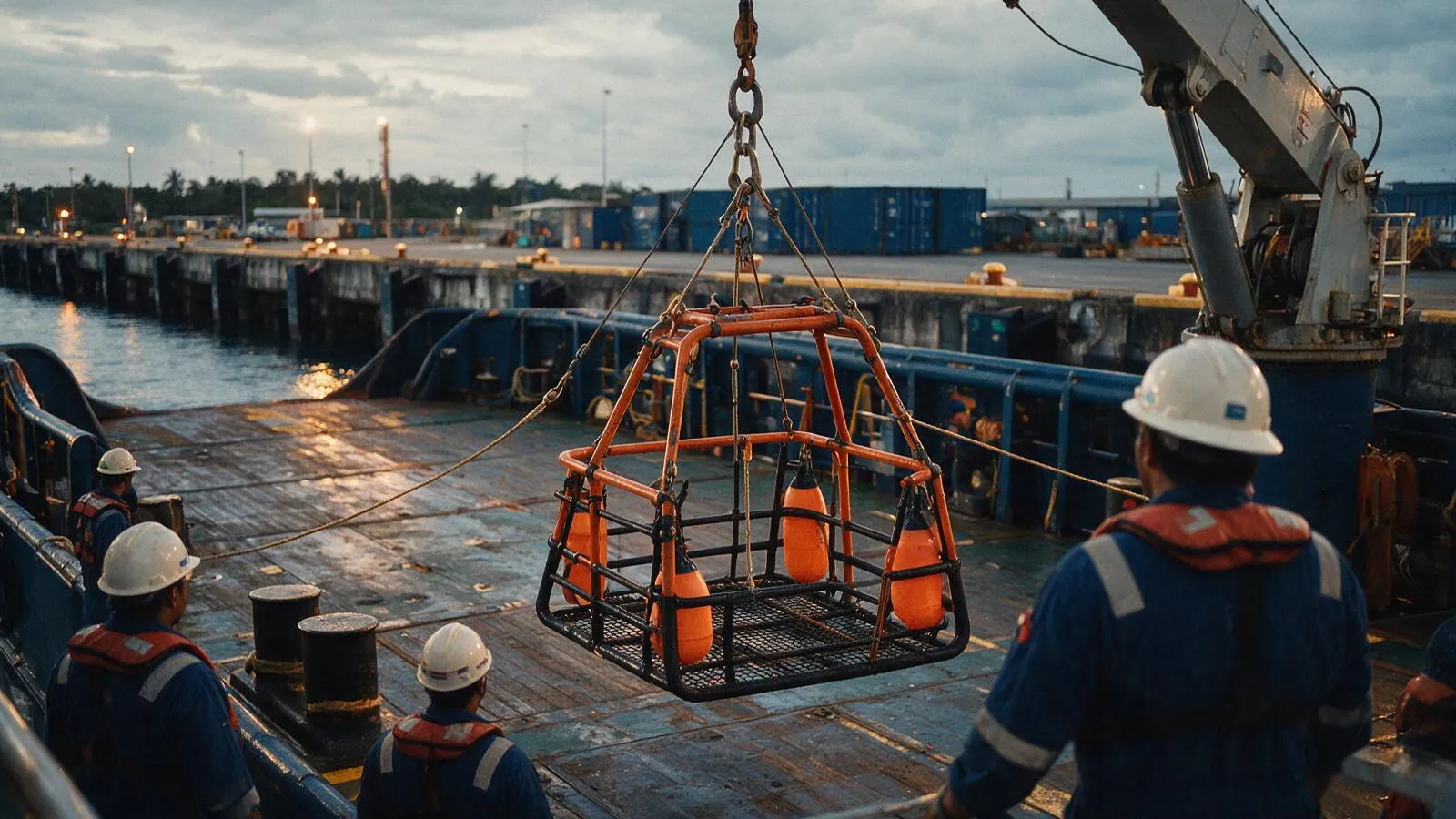
To quote, the sling testing and recertification team needs the sling type, ID, rated capacity and quantity, previous certificates, your client's standard and acceptance criteria, and the location and deadline. Replacement wire rope, webbing slings and shackles come from our lifting and rigging range, and rigging accessories can be hired through equipment rental. Personnel transfer baskets follow their own routine, set out in our transfer basket inspection guide, and our note on one supply contractor versus separate specialists explains how to combine these jobs.
Send the sling list on WhatsApp to 017-351 0071, call 086-313311, or email inquiry@eraharvest.com. Or use the enquiry basket for several items.
Sources
- Occupational Safety and Health (Plant Requiring Certificate of Fitness) Regulations 2024, P.U.(A) 99/2024 (DOSH)
- Occupational Safety and Health Act 1994 (Act 514), reprint as at 1 June 2024 (DOSH)
- Factories and Machinery (Repeal) Act 2022 (Act 835) (DOSH)
- Amended Occupational Safety and Health Act to come into force on June 1 (Bernama, 4 April 2024)
- Lifting Work (Department of Occupational Safety and Health Malaysia)
- Lifting Equipment Malaysia: CF, PMA & PMT Registration (Get Foundation)
- Lifting Operations and Lifting Equipment Regulations 1998, regulation 9 (legislation.gov.uk)
- Thorough examinations of lifting equipment (UK Health and Safety Executive)
- 29 CFR 1910.184 Slings (US Code of Federal Regulations, govinfo.gov)
- How to Inspect Wire Rope Slings According to ASME B30.9 Standards (Mazzella)
- How to Inspect Synthetic Web Slings to ASME B30.9 Standards (Mazzella)
- DNVGL-ST-E271 2.7-1 Offshore containers, August 2017 edition (DNV GL; copy hosted by MGS IceStorm)
- DNV-ST-E271 Offshore containers, current edition listing (DNV)