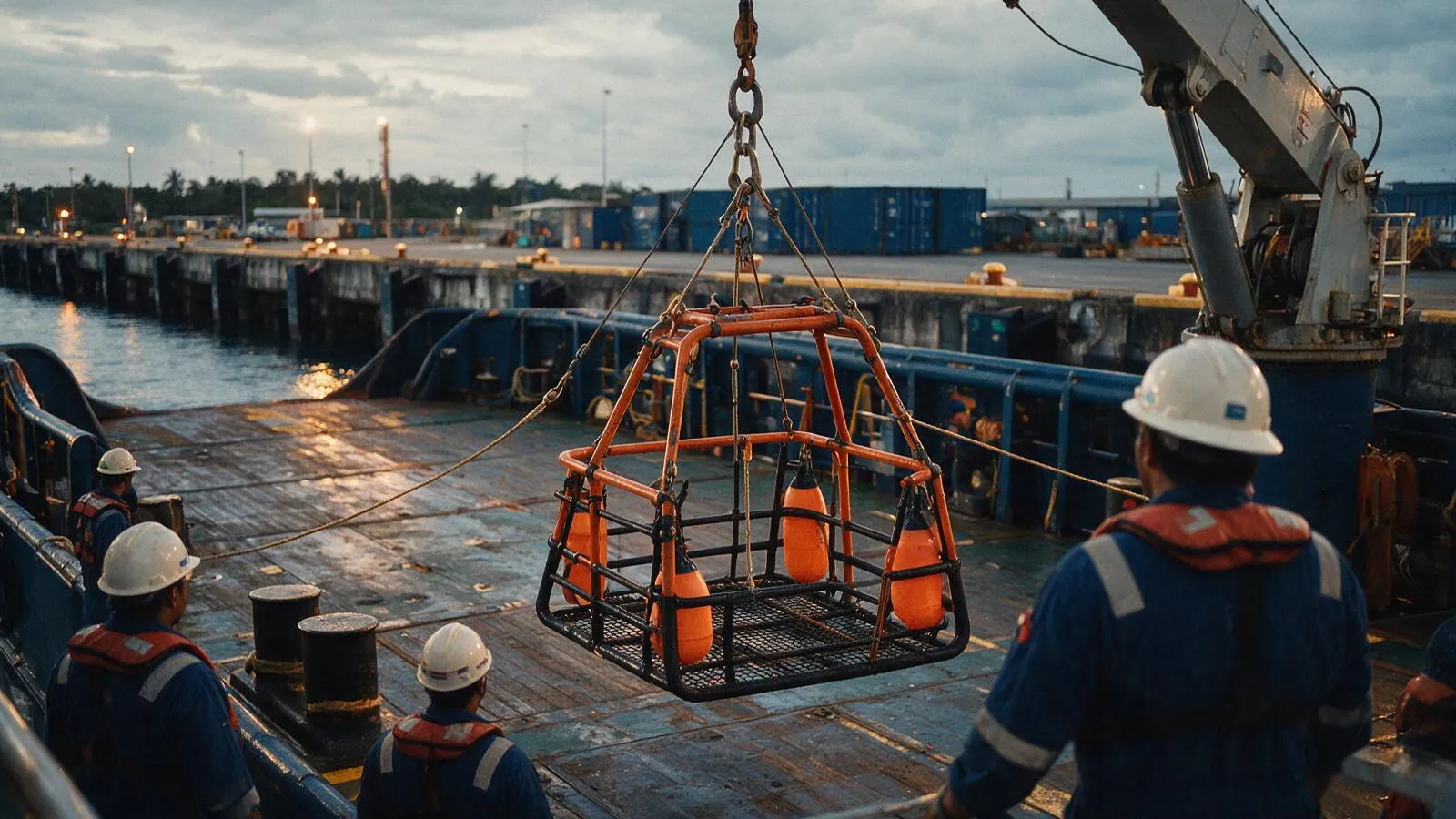
A crane personnel transfer — moving people by basket between a vessel and an offshore facility in Malaysia — is governed by up to three things at once, depending on the vessel. The vessel's duties under SOLAS Chapter XV and the IP Code; the crane's certification route, a DOSH certificate of fitness on an offshore floating facility; and a written procedure with a job safety analysis, trained people and an officer who signs it off.
Key takeaways
- SOLAS Chapter XV and the IP Code came into force on 1 July 2024. The Marine Department's own notice sets four conditions: 500 gross tonnage and above, more than 12 industrial personnel, an international voyage, and offshore industrial activities.
- DOSH treats a crane on an offshore floating facility as a hoisting machine needing a certificate of fitness, unless the exemption schedule covers it; where the plant is hired the certificate sits with the owner, not the hirer.
- A ship's crane needs man-riding certification from the vessel's class society. Many hose-handling cranes were never designed for it.
- The basket needs a valid certificate of test and inspection, a visual examination before each use, a permanent identification mark, and a record of use and maintenance kept on board.
- MS 2204:2008 is the Malaysian standard for crane-suspended baskets. Its scope note sends you to national regulations where the basket hangs from another crane, so it is not the governing document for a vessel-to-installation transfer.
On this page11
What counts as a personnel transfer under the IP Code?
The IP Code defines a personnel transfer as "the full sequence of the operation of transferring personnel and their equipment at sea to or from a ship to which this Code applies and from or to another ship or an offshore facility". The duty covers the deck preparation, the briefings, the lift and the landing, not just the seconds in the air.
SOLAS Chapter XV and the IP Code came into force on 1 July 2024. Malaysia's Marine Department set out the scope in its own notice: the requirements are mandatory for cargo ships and high-speed cargo craft that are 500 gross tonnage and above, carry more than 12 industrial personnel, are on an international voyage, and are engaged in offshore industrial activities. The four conditions are joined by "AND", so a vessel that misses one sits outside the Code. "Industrial personnel" means everyone carried on board for offshore industrial activities performed on another ship or offshore facility.
Which Malaysian rules reach the crane?
The Department of Occupational Safety and Health (DOSH) guideline for offshore floating facilities is direct about the crane. All hoisting machinery on an offshore floating facility, pedestal cranes and moveable platforms included, is classified as a hoisting machine, and its owner must obtain a certificate of fitness to operate it — unless the machine is one of the types the exemption schedule under P.U. (A) 179 Order 2015 takes out of that class.
Hired plant carries a twist: the owner of a rented hoisting machine must hold the valid certificate, so hiring the crane does not move that duty onto the hirer. On a PETRONAS-owned asset the route differs: P.U. (A) 106 Order 2013 lets PETRONAS self-manage its certificated machinery through OSRMS, an exemption that does not extend to rental machinery.
DOSH's construction-site lifting guidance sets the expectations a Malaysian duty holder is measured against more generally: planning must produce a written safe work system or method statement, and the lifting supervisor must be competent, appropriately trained and experienced, with the authority to stop dangerous work. Where the duty holder is an employer on the facility rather than a shipowner, section 15 of the Occupational Safety and Health Act 1994 makes information, instruction, training and supervision his own duty.
Does the ship's crane need man-riding certification?
A crane that lifts cargo is not automatically a crane that may lift people. Where a ship's crane is likely to be used for transfers, man-riding certification should be obtained from the vessel's class society, and the West of England P&I Club warns that many hose-handling cranes on tankers were never designed for man-riding and should not be used unless adapted and certified for it.
The same bulletin lists the modifications typically needed to make a crane suitable for man-riding, one of them a higher factor of safety on all loose gear — for example a safe working load equating to one tenth of the breaking load. The IP Code adds a design test: transfer arrangements must fail to a safe condition if they lose or reduce functionality. Reflex Marine notes that wind may affect the crane operator's ability to control the load, so the limits set for the crane and for the carrier both count.
What papers must the transfer basket carry?
A transfer basket should hold a valid certificate of test and inspection and a visual examination before each use. Under the IP Code it must be kept clean, properly maintained and regularly inspected; permanently marked, so each unit can be identified for survey, inspection and record-keeping; and carry a record of use and maintenance, kept on board.
It must not double as a work basket or a way of moving stores. Intervals and the parts replaced by date are in our guide to transfer basket inspection and maintenance.
Is MS 2204:2008 the standard for a transfer basket?
The standard is where the analysis goes wrong. MS 2204:2008, Cranes - Equipment for Lifting Persons - Part 1: Suspended Baskets, is 27 pages from the Department of Standards Malaysia at RM45.00. Its scope is limited to baskets suspended on cranes designed and built to the harmonised standards for lifting persons, and its own note says specific national regulations may apply where baskets hang from other cranes.
For a vessel-to-installation transfer the governing papers are SOLAS Chapter XV and the IP Code, and the limits set for the crane and the carrier.
Who has to be trained, and in what?
Four different people need training, and it is not the same training. The IP Code requires every industrial person to be familiarised in the ship's transfer procedures and arrangements before being transferred, the rigging and use of the arrangements to be supervised by a responsible officer, and the operation to be run by properly trained personnel.
- The passenger. Familiarisation reaches any additional safety measures or equipment for the transfer. Operators frequently ask for more: OPITO's Travel Safely by Boat supplementary unit for the personnel transfer basket at sea. It carries a prerequisite that catches crews out late — the learner must already hold a valid Travel Safely by Boat certificate — and the approved centre must confirm medical fitness first.
- The crane driver. Fully trained and experienced in transferring personnel by basket, not merely licensed to operate the crane.
- The supervising officer. "Competent person" decides who may sign what: someone with sufficient practical and theoretical knowledge and experience of the lifting equipment to perform their duties safely.
- The deck party. Reflex Marine puts familiarisation training across everyone involved: the pre-transfer inspection of the crane and carrier, the briefings, best practice and emergency operations. A banksman giving the signals must be clearly identifiable to the driver.
When is a transfer called off?
On written limits, not on judgement on the day. The IP Code makes a job safety analysis mandatory before every personnel transfer at sea. Two consents sit on top: the prior approval of the company and the master, and the consent of each person due to ride.
A job safety analysis shall be carried out when planning, and before executing, personnel transfer at sea. The analysis shall take into account environmental conditions, as well as operational and equipment limitations.
Reflex Marine's incident analysis puts the majority of crane-transfer incidents on or near the vessel rather than at the installation hosting the crane, and notes that the risk rises with sea state. The pre-transfer check is therefore a sign-off: where any answer is "no", the operation is changed before it continues, and if it cannot be the risk assessment records the mitigating action. The minimum kit is a hard hat with a chin strap, a working life vest with retro-reflective tape, a whistle, a light and, where possible, a personal locator beacon; life jacket rules and replacement are covered separately.
What paperwork is needed before the first lift?
Each line below is a document someone must produce before the first lift. Some belong to the equipment — the crane's certificate of fitness, its man-riding certification, the basket's certificate of test and inspection. The rest belong to the operation: the pre-use check, the method statement and job safety analysis, the basket's record of use and maintenance, and training records.
| Document | Who holds it | What it shows |
|---|---|---|
| Certificate of fitness for the crane | The crane's owner (or, on a PETRONAS-owned asset, OSRMS self-management) | DOSH accepts the machine for use on an offshore floating facility |
| Man-riding certification | The vessel | Class accepts the crane for lifting people |
| Certificate of test and inspection, basket | The basket's owner | The carrier has been tested and examined |
| Pre-use check record | The lift supervisor | Crane, carrier and rigging examined for this lift |
| Method statement and job safety analysis | The duty holder | The lift was planned, weather limits written down |
| Record of use and maintenance, basket | The ship (kept on board) | Each appliance identifiable, its history traceable |
| Training records | The individual and employer | Familiarisation and, where asked, the OPITO basket unit |
What should you ask the supplier for?
Most of that paperwork is not the project's to create. Section 20 of the Occupational Safety and Health Act 1994 puts a duty on anyone supplying plant for use at work to make available adequate information about the use for which it is designed and has been tested. So the test certificate and that information are the supplier's obligation, not a courtesy.
The permanent identification mark and the on-board record of use and maintenance are the ship's duty under the IP Code, so ask for a unit that already carries both. Era Harvest Supply & Engineering supplies, rents, inspects, maintains and refurbishes offshore personnel transfer baskets from Bintulu, and runs operational training on them, for Bintulu and the Sarawak coast — a supply, rental and maintenance scope on record for Petronas Carigali Sdn Bhd over 2023-2026, with Billy Pugh among the carriers supplied. The slings, shackles and wire rope that go with a basket are proof load tested and recertified through our lifting gear testing service, and the rental fleet in Bintulu comes with its own papers.
To scope one, send the make and model, the passenger capacity, purchase or hire, the period and the delivery location to the Bintulu office on 086-313311.
Sources
- Malaysia Marine Department, MSN 02/2024 — Implementation of SOLAS Chapter XV and the IP Code
- IMO Resolution MSC.527(106), International Code of Safety for Ships Carrying Industrial Personnel (IP Code)
- DOSH Malaysia, Guideline for Offshore Floating Facilities (GOFF)
- DOSH Malaysia, Lifting Work
- Occupational Safety and Health Act 1994 (Act 514)
- West of England P&I Club, Transfers By Personnel Basket
- Reflex Marine, Offshore Personnel Transfer by Crane: Best Practice Guidelines
- OPITO, Travel Safely by Boat Supplementary Training (Personnel Transfer Basket at Sea)
- Department of Standards Malaysia, MySOL catalogue entry for MS 2204:2008