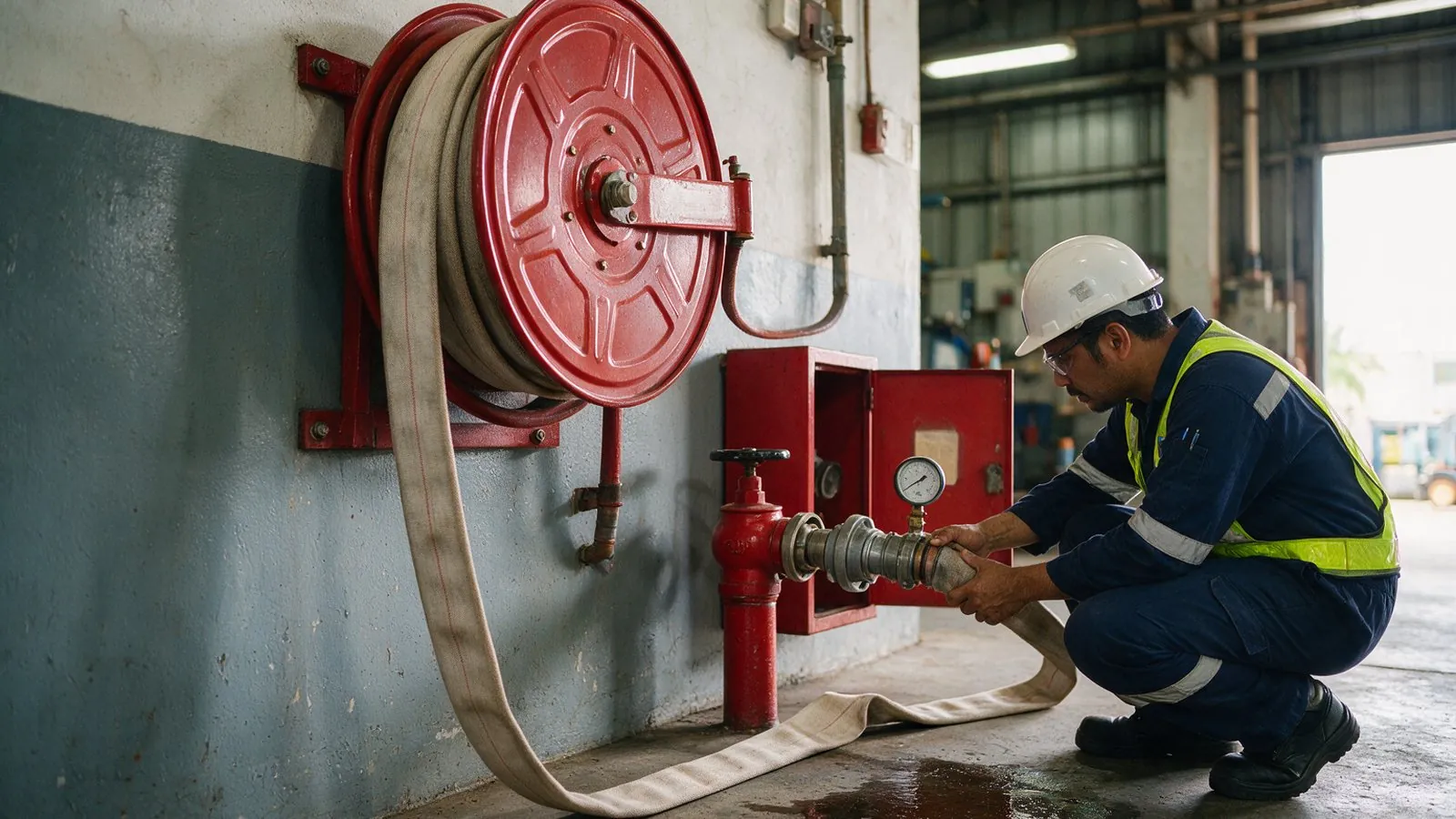
On land in Malaysia, hose reels and hydrants are checked weekly, inspected every six months and flow-tested once a year under insurer warranty wording such as Berjaya Sompo's; the Fire Services Act 1988 itself sets no interval, only a fire certificate renewed yearly. On a ship under SOLAS Chapter II-2, MSC.1/Circ.1432 calls for monthly checks and a yearly pressure test of sample fire hoses, all within five years.
Key takeaways
- Berjaya Sompo's fire-appliance warranty wording checks hose reels weekly, inspects valves, hoses and nozzles every six months, and runs an annual flow test of at least 24 litres per minute.
- Under the same wording, internal and external hydrants get an annual flow and pressure test, with the results recorded and any significant deterioration rectified promptly.
- The Fire Services Act 1988 sets no test interval itself: section 28 requires a fire certificate for designated premises, "renewable annually", and section 62 lets the Minister make regulations on testing and servicing.
- Item 7.1.4 of the annex to MSC.1/Circ.1432 calls for a yearly pressure test of sample fire hoses at the maximum fire main pressure, every hose within five years.
- Neither document sets a replacement age for a fire hose; the circular's ten-year replacement is for the flexible hoses of fixed gas systems (item 10.1.2).
On this page8
What does Malaysian law require for a building's hose reels and hydrants?
The Fire Services Act 1988 itself sets no test interval. It works through the fire certificate: designated premises require one, it is renewable every year, and before issuing it the Director General of the Fire and Rescue Department (Bomba) inspects the premises and must be satisfied that "there exists adequate fire-fighting equipment or fire safety installation" for the way they are used.
Which buildings count as designated premises is set by designation under section 27, by use, size or location, so a hose reel system does not by itself bring a building into the regime. The duty sits with whoever runs the building: section 29(6) names the applicant as "the owner, occupier or the person having the overall management of the designated premises", and section 32 lets the Director General inspect at any reasonable time while a certificate is in force. Era Harvest's fire fighting equipment and systems work covers the equipment side for sites in Bintulu and Sarawak.
The Act does leave room for a timetable elsewhere. Section 62 lets the Minister make regulations "regulating the manufacture, sale, installation, testing, servicing, and recharging of fire-fighting equipment", and section 2 says "this Act" includes subsidiary legislation, so by-laws and the conditions written on your own fire certificate can set a schedule this guide does not cover.
How often should hose reels and hydrants be checked and tested?
Berjaya Sompo's fire-appliance warranty wording sets a weekly, six-monthly and annual cycle, and makes it a condition of the premium allowance given for the installation: a weekly look to confirm nothing is blocking the equipment, a six-monthly check of valves, hoses and nozzles, and an annual test of flow and pressure with the results written down. That wording, filed 4 July 2025, is explicit on each one:
| Interval | Hose reels (Warranty II) | Internal hydrants (Warranty III) | External hydrants (Warranty VIII) |
|---|---|---|---|
| Weekly | Inspected to confirm they are "not obstructed, remain usable and readily accessible at all times", plus pump starting tests where stationary pumps are fitted | The same check, plus manual or automatic pump starting tests | Inspected for obstruction by parked vehicles, loading or stored goods, plus pump starting tests |
| Every six months | Inlet valves, hoses and shut-off nozzles free from leaks; nozzle outlets not choked | Hydrant valves, isolation valves and fire boxes in good condition | Hydrant valves, isolation valves, fire boxes and associated equipment in good condition |
| Annually | Hose run out fully under operational water pressure; flow test of at least 24 litres per minute, at the most remote reel if not all can be tested | Flow and pressure test at the most remote hydrant, results recorded | Flow and pressure tests of all external hydrants, results recorded; handwheels, glands, washers, pits, frames, covers and indicator plates checked |
The Malaysian Standards sit beside that wording as good practice rather than as the source of these intervals. MS 1489-1:2023 "gives recommendations for hose reels and foam inlet", covering "the design, installation, testing and maintenance of such systems" and leaving the reels themselves to MS 1447; MS 1489-2:2023 does that job for wet mains, dry mains and hydrant systems. Neither standard's public catalogue entry gives its intervals, so the figures above are the insurer's.
The recorded flow and pressure figures matter because the state of a hydrant and what it actually delivers are two different things. After a house fire at RPR Batu Kawa in 2023, Bomba Sarawak director Datu Khirudin Drahman said of the external pillar hydrant used:
"The physical condition of the pillar hydrant was unsatisfactory due to its missing cover and false spindle ... However, when it was used during the operation, it was able to dispense sufficient water."
Datu Khirudin Drahman, Bomba Sarawak director, quoted in The Borneo Post, 29 August 2023
Covers, handwheels, glands, washers, pits and indicator plates are all items in the annual external-hydrant check in Berjaya Sompo's wording, and the recorded flow and pressure figure is what tells you whether that hydrant will still deliver.
How often must a ship's fire hoses and hydrants be tested?
A ship works to its onboard maintenance plan under SOLAS regulation II-2/14, and the intervals in that plan follow IMO MSC.1/Circ.1432. Monthly, the crew verifies that all hydrants, hose and nozzles are in place, properly arranged and serviceable. Annually, a sample of hoses is pressure tested, covering the whole set within five years.
Item 7.1 of the annex puts seven yearly actions on fire mains, pumps, hydrants, hoses and nozzles, including a flow test of all fire pumps, a test of every hydrant valve, and:
"pressure test a sample of fire hoses at the maximum fire main pressure, so that all fire hoses are tested within five years"
MSC.1/Circ.1432 annex, item 7.1.4
Quarterly, the single item listed for the fire main is the international shore connection. The circular is guidance until a flag state applies it, and Marine Department Malaysia did exactly that: MSN 05/2023 applies it to all Malaysian registered ships "when performing maintenance, testing and inspections in accordance with SOLAS regulation II-2/14.2.2.1". The same circular sits behind the yearly extinguisher work in our guide to fire extinguisher servicing in Malaysia.
When should a fire hose be replaced rather than tested again?
Neither IMO MSC.1/Circ.1432 nor Berjaya Sompo's warranty wording sets a replacement age for a fire hose. The circular's fire-main items and the warranty's hose reel and hydrant clauses describe tests and inspections only, so a fire hose is replaced when it fails one of them rather than on a date.
One ten-year figure in MSC.1/Circ.1432 is often misread as a fire hose rule. Item 10.1.2 says flexible hoses "should be replaced at the intervals recommended by the manufacturer and not exceeding every 10 years", and it sits under the ten-year service of fixed gas fire-extinguishing systems, not under fire mains and hoses.
A fire hose's test result, not its age, decides replacement, and the manufacturer's own service-life guidance comes first: even for the flexible hoses it does cover, the circular defers to "the intervals recommended by the manufacturer". Berjaya Sompo's wording asks for the hydrant flow and pressure results to be recorded so that "any significant deterioration" in flow and pressure can be rectified promptly. A record that is actually usable carries:
- the date of the test and who carried it out;
- the reel or hydrant's own identifier and where it is;
- the flow in litres per minute and the pressure measured;
- any defect found, and what was repaired or replaced.
What should you specify when ordering fire hose, nozzles and hose reels?
Specify the bore, the length and the pressure the hose has to hold, and match the coupling to the valve or reel already installed. Those four things decide whether a new hose works with the system you have. For a building insured on a fire-appliance warranty, the insurer's own conditions are the easiest reference point; for a vessel, it is the ship's fire main pressure.
For hose reels and internal hydrants with small-bore hose, Berjaya Sompo's wording requires reinforced rubber hose on hydraulic hose reels and rubber-lined hose for internal hydrants, a bore of 19.05 mm to 31.75 mm, and a length not exceeding 45 m, sited so that no part of the floor is more than 6 m from a nozzle when the hose is fully extended. Internal hydrant mains and hose need a clear waterway of at least 63.5 mm, with a hose of at least 30 m and a nozzle permanently connected or kept under cover nearby. Those are insurance conditions, not a product standard: the reel itself is specified in MS 1447.
For a vessel, match the couplings to the ship's hydrants and to the international shore connection, and buy hose that will hold the maximum fire main pressure the yearly test applies. Era Harvest's fire fighting equipment range covers fire hose and extinguishers.
How does Era Harvest help with fire hose and hydrant equipment in Bintulu?
Era Harvest supplies fire fighting equipment, including fire hose and fire extinguishers, from Bintulu, Sarawak, and its work covers fire detection and alarm, suppression, hydrant and hose reel systems, and extinguisher servicing. For a vessel calling at Bintulu or a site in Sarawak, that puts the supply and the systems work with one supplier instead of two.
On record, Era Harvest held a contract with KLCC Urusharta Sdn Bhd from 2023 to 2026 at the Petronas office in Bintulu: the service and maintenance of air conditioning, the fire alarm system, fire extinguishers and electrical work, which is alarm and extinguisher maintenance rather than hose work. For the vessel side, our guide to lifebuoy and life jacket checks on vessels covers the other equipment an inspection looks at. For a quotation, contact the Bintulu office with the bore, length, coupling type and working pressure you run.
Sources
- Laws of Malaysia, Fire Services Act 1988 (Act 341), sections 27-33, reprint as at 1 October 2018
- IMO, MSC.1/Circ.1432 Revised Guidelines for the Maintenance and Inspection of Fire Protection Systems and Appliances (2012), annexed to Cayman Islands Shipping Notice 01/2014 Rev 2 (2022)
- Marine Department Malaysia, MSN 05/2023 Maintenance and Inspection of Fire Protection Systems and Appliances, in Ships Classification Malaysia Technical Circular 001/2023 (31 March 2023)
- Berjaya Sompo Insurance, Fire Section 9: Fire Extinguishing Appliances Warranties II, III, IV and VIII (4 July 2025)
- Department of Standards Malaysia, MS 1489-1:2023 Fire extinguishing installations and equipment - Part 1: Hose reels and foam inlets (Second revision), catalogue preview
- Department of Standards Malaysia, MS 1489-2:2023 Fire extinguishing installations and equipment - Part 2: Wet and dry firefighting mains (First revision), catalogue entry
- The Borneo Post, "RPR Batu Kawa fire: Unsatisfactory condition of fire hydrant did not hamper extinguishment, says Khirudin" (29 August 2023)