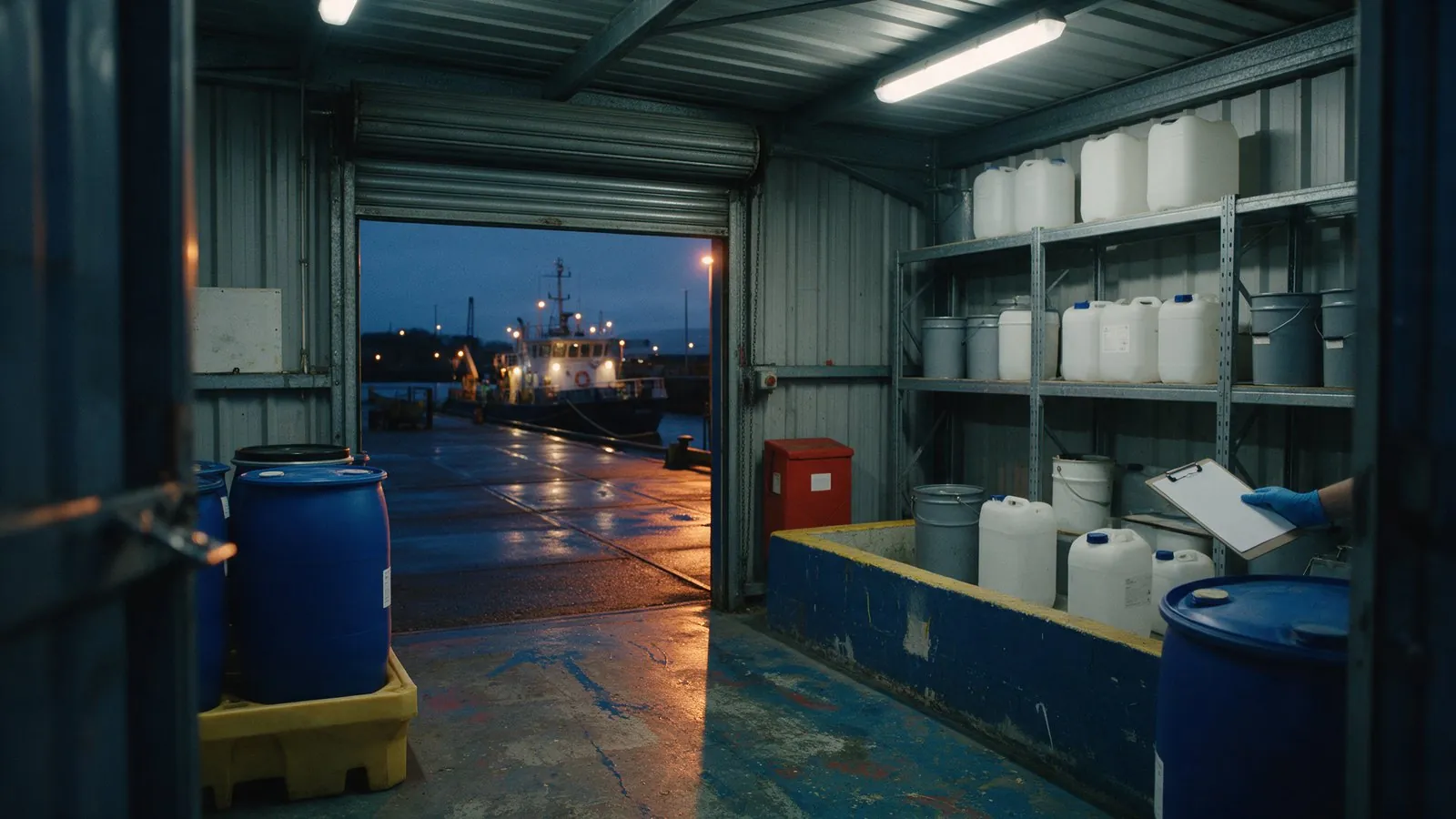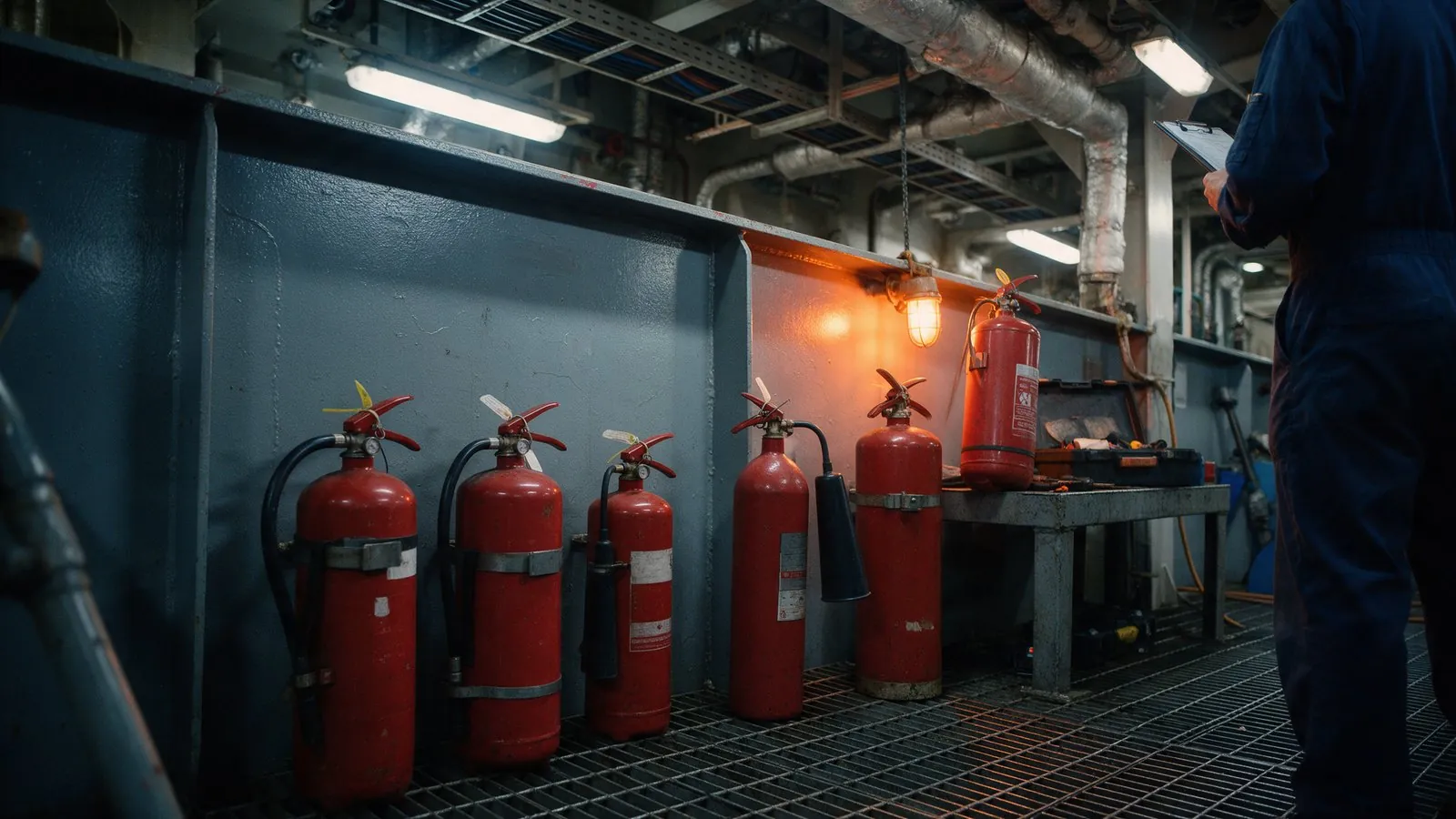
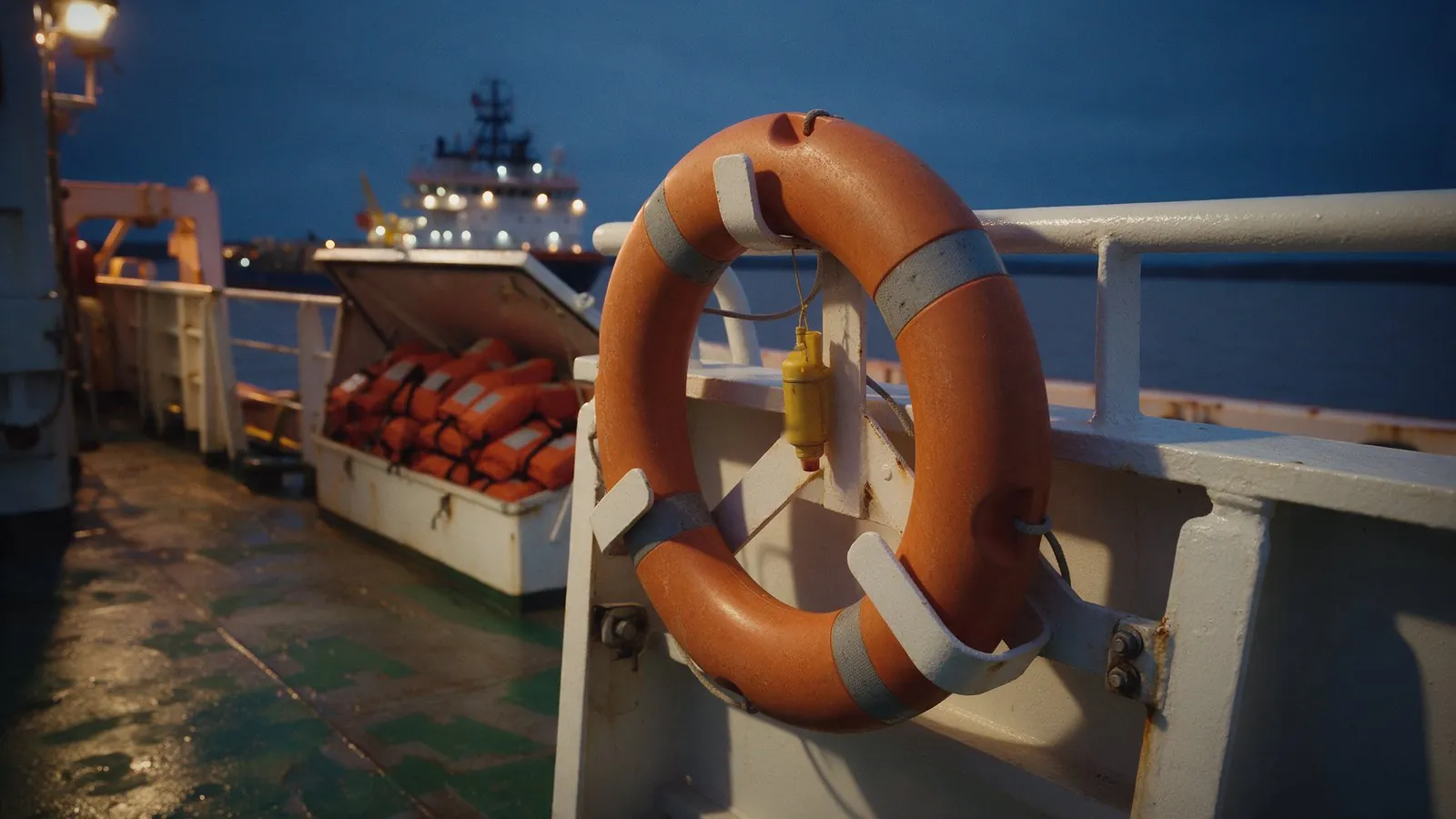
On the ships it covers, SOLAS chapter III, applied in Malaysia under the Merchant Shipping Ordinance 1952, requires a life jacket for every person aboard plus extras for children and watchkeepers, and a minimum number of lifebuoys by ship length, at least half with self-igniting lights. Crew inspect them monthly. Inflatable life jackets go to an approved servicing station at least every 12 months, and anything damaged or past its marked date is replaced.
Key takeaways
- SOLAS regulation III/7 requires a life jacket for every person on board, child life jackets for at least 10% of passengers, and extra life jackets for people on watch and at remote survival craft stations.
- A cargo ship under 100 m must carry at least 8 lifebuoys under SOLAS regulation III/32. At least half must have self-igniting lights and at least two of those must also have smoke signals; separately, at least one on each side must carry a buoyant lifeline of at least 30 m, and the lit lifebuoys must not be the lifeline ones.
- SOLAS regulation III/20 requires a monthly, logged inspection of all life-saving appliances, and servicing of inflatable life jackets at an approved servicing station at intervals not exceeding 12 months.
- Under the LSA Code, appliances that deteriorate with age must be marked with their age or replacement date, and batteries with no marked expiry date are replaced every year unless they are accumulators whose electrolyte can be checked.
- Malaysia's Merchant Shipping Ordinance 1952 requires the master to log every examination of life-saving appliances. A Surveyor of Ships can inspect any ship the rules apply to, and one found non-compliant is refused port clearance and detained until the Port Officer is satisfied.
On this page11
Watch: Lifebuoy and Life Jacket Rules in Malaysia: When to Replace Them?
On the ships it covers, SOLAS requires a life jacket for every person on board, extras for children and people on watch, and a minimum number of lifebuoys by ship length, at least half with self-igniting lights. Crew inspect them every month and log it. Inflatable life jackets are serviced at an approved station at least every 12 months, and anything damaged, failing a check or past its marked date is replaced.
Read the video transcript
What rules apply to lifebuoys and life jackets?
What rules apply to lifebuoys and life jackets on a ship, and when do they have to be replaced? In the next few minutes, you'll know both.
The short answer. SOLAS, the safety at sea convention, requires a life jacket for every person on board, and a minimum number of lifebuoys.
The crew inspect them every month. Inflatable life jackets go to an approved service station at least every twelve months. And anything damaged, or past its marked date, is replaced.
In Malaysia, these rules apply through the Merchant Shipping Ordinance 1952. Boats used only for fishing are left out.
If your vessel trades only in Sarawak waters, ask the Marine Department's Sarawak office which rules apply.
How many lifebuoys does a ship need?
So how many lifebuoys does a ship need, and how must they be fitted?
SOLAS sets a minimum by ship length. A cargo ship under one hundred metres must carry at least eight. Bigger ships carry more.
Fit them on both sides of the ship, with at least one near the stern. Stow them so they can be cast loose quickly. And mark each one with the ship's name and port of registry, in capitals.
Some lifebuoys carry extra gear. At least half need a self-igniting light, and at least two of those also carry a smoke signal. At least one on each side carries a floating lifeline of thirty metres or more. The lit ones are never the lifeline ones.
How many life jackets, and what must each carry?
Next, life jackets. How many do you need, and what must each one carry?
Every person on board needs one. Add child life jackets for passengers, plus extras for the people on watch, and at remote survival craft stations.
Each life jacket carries a whistle on a lanyard, a white light, and reflective patches placed high. An inflatable one also needs at least two separate chambers. It inflates by itself in the water, and can also be inflated by hand or by mouth.
How often must they be inspected and serviced?
So how often must they be checked and serviced?
Every month, the crew inspect all life-saving equipment against the ship's checklist, and the result goes in the log-book.
On a lifebuoy, look for cracks in the body. Check the name and reflective tape, that the bracket releases freely, the lifeline, and the expiry dates on its light and smoke signal.
On an inflatable life jacket, check the cover and straps, the bladder for wear, the service date, and the gas cylinder.
The cylinder check matters. A fisherman and a workboat crewman died when their inflatable life jackets failed to inflate. The UK coastguard suspected the gas cylinders had worked loose.
Inflatable life jackets also go ashore to an approved service station, at least every twelve months. Keep each service certificate with the log-book.
When must a lifebuoy or life jacket be replaced?
So when do you replace one, rather than service it?
Replace it when it is damaged, fails a check, or is past its marked date. Service an inflatable when its yearly service is due, or a check finds a loose cylinder or a worn bladder.
Foam life jackets and lifebuoys have no fixed shore service. They stay in use while they pass inspection and stay in date.
Batteries with no marked expiry date are replaced every year, unless they are a rechargeable type whose electrolyte can be checked. So keep a register of expiry dates for every light, smoke signal and battery.
This matters in port. A Surveyor of Ships can inspect any ship, and one found short can be refused port clearance and detained.
What should you ask for when ordering replacements?
Last, what should you ask for when you order replacements?
Start with approval. Each item must be marked with the authority that approved it, so ask for a type approval certificate. Then give the sizes and quantities, the light type, the lifeline length, and the ship's name and port of registry.
One trap to avoid. The wheel mark is European approval, not Malaysian approval. Ask the ship's surveyor which approvals your flag accepts.
Recap: a life jacket for each person, lifebuoys on both sides, a monthly logged check, yearly inflatable servicing, and replace anything damaged or expired.
Era Harvest Supply and Engineering, in Bintulu, Sarawak, supplies marine equipment, including lifebuoys and life jackets, to the marine, offshore, and oil and gas industries.
The full guide, with every table, is at eraharvest.com. Send Era Harvest your buying list for a quotation.
What are the SOLAS and Malaysian requirements for lifebuoys and life jackets?
Lifebuoys and life jackets on seagoing ships must meet SOLAS chapter III and the International Life-Saving Appliance (LSA) Code. In Malaysia, the Merchant Shipping Ordinance 1952 lets the Minister make life-saving appliance rules that implement SOLAS. Rules made under its section 257 do not apply to fishing boats used only for fishing, to what it calls "native sailing ships", or to boats licensed under a separate part of the Ordinance.
SOLAS "only applies to certain classes of ship engaged on international voyages", the International Maritime Organization notes. Under the Merchant Shipping Ordinance 1952, a Malaysian-registered ship outside those exclusions falls under the section 257 rules.
Sarawak holds certain powers over coastal shipping, such as Sibu to Bintulu, under its Merchant Shipping Ordinance 1960, the State Transport Minister said in September 2025 (Ministry of Transport Sarawak). For a vessel trading only in Sarawak waters, confirm with the Marine Department's Sarawak Region office which rules and surveys apply.
Smaller-craft standards can differ. The Marine Department's SOP for Langkawi International Yacht Registration, for example, asks commercial yachts carrying fewer than 12 passengers for adult life jackets for 105% of passengers and crew, child life jackets for 10% or at least 3, and at least 2 lifebuoys on an open boat or 4 on a cargo boat (Marine Department Malaysia, 2021). These figures do not apply to SOLAS ships.
How many lifebuoys must a vessel carry, and how must they be fitted?
SOLAS (IMO resolution MSC.47(66)) sets a minimum number of lifebuoys by ship length, from 8 on a cargo ship under 100 m to 30 on a passenger ship of 240 m and over. Lifebuoys go on both sides of the ship with at least one near the stern, stowed so they can be cast loose quickly and marked in block capitals with the ship's name and port of registry.
| Ship type | Length | Minimum lifebuoys |
|---|---|---|
| Cargo ship (III/32) | Under 100 m | 8 |
| Cargo ship (III/32) | 100 m to under 150 m | 10 |
| Cargo ship (III/32) | 150 m to under 200 m | 12 |
| Cargo ship (III/32) | 200 m and over | 14 |
| Passenger ship (III/22) | Under 60 m | 8 |
| Passenger ship (III/22) | 60 m to under 120 m | 12 |
| Passenger ship (III/22) | 120 m to under 180 m | 18 |
| Passenger ship (III/22) | 180 m to under 240 m | 24 |
| Passenger ship (III/22) | 240 m and over | 30 |
| Fitting | How many | What the rule requires |
|---|---|---|
| Buoyant lifeline | At least one lifebuoy each side | 30 m, or twice the stowage height above the lightest seagoing waterline if greater; non-kinking, 8 mm diameter and 5 kN breaking strength minimum |
| Self-igniting light | At least half of all lifebuoys | White, at least 2 cd (if flashing, 50 to 70 flashes a minute), lasts at least 2 h; split equally between both sides, never on the lifeline lifebuoys; battery type on tankers |
| Self-activating smoke signal | At least two of the lit lifebuoys | Highly visible smoke for at least 15 min; quick release from the navigation bridge |
| Retro-reflective material | Every lifebuoy | About 5 cm wide, at four evenly spaced points |
Under LSA Code paragraph 2.1.1 (MSC.48(66)), a lifebuoy measures at most 800 mm outside and at least 400 mm inside, supports 14.5 kg of iron in fresh water for 24 h, weighs at least 2.5 kg (4 kg if it operates a quick-release light and smoke signal, as amended by MSC.207(81)), and has a grabline at least 9.5 mm thick and four times its outside diameter long, secured at four points.
How many life jackets are needed, and what must each one carry?
SOLAS regulation III/7.2 requires a life jacket (written "lifejacket" in SOLAS and the LSA Code) for every person on board, child life jackets for at least 10% of passengers (or one per child if more), and extras for people on watch and at remote survival craft stations. Passenger ships also carry infant life jackets and spares for 5% of persons on board.
Since 1 July 2010 (MSC.201(81)), passenger ships carry infant life jackets for at least 2.5% of passengers on voyages under 24 h and one per infant on longer voyages. On every SOLAS ship, if adult life jackets do not fit persons up to 140 kg, suitable accessories must be on board.
The revised LSA Code section 2.2 (MSC.207(81)) sets these requirements for life jackets and their lights:
- a size marking by weight or height: infant under 15 kg or 100 cm, child 15 kg to under 43 kg or 100 cm to under 155 cm, adult 43 kg or 155 cm and over
- a whistle firmly secured by a lanyard, and a white light of at least 0.75 cd lasting at least 8 h
- at least 400 cm² of retro-reflective material, placed as high as possible (MSC.481(102))
- on an inflatable, two or more separate compartments, automatic inflation on immersion, single-motion manual inflation, and mouth inflation of each chamber
How often must lifebuoys and life jackets be inspected and serviced?
SOLAS regulation III/20 requires every life-saving appliance to be in working order before the ship leaves port and throughout the voyage, inspected monthly against the ship's checklist with a log-book entry, and maintained to written onboard instructions. Inflatable life jackets must also be serviced at an approved servicing station at intervals not exceeding 12 months, which the flag Administration may extend to 17 months where servicing within 12 months is impracticable.
"Inspection of the life-saving appliances, including lifeboat equipment, shall be carried out monthly using the checklist required by regulation 36.1 to ensure that they are complete and in good order. A report of the inspection shall be entered in the log-book."
SOLAS chapter III, regulation 20.7, as adopted by IMO resolution MSC.47(66)
BS ISO 18079-3:2018 sets provisions for stations servicing inflatable life jackets.
What records must be kept for lifebuoys and life jackets?
SOLAS regulation III/20.7 and section 259 of the Merchant Shipping Ordinance 1952 both require each inspection of life-saving appliances to be recorded in the log-book, and the master must produce that record when a Port Officer asks. IMCA (the International Marine Contractors Association) also advises recording servicing, inspection and user training for inflatables (IMCA Safety Flash 06/03). Good practice, beyond the law, is to keep with the log-book:
- the current servicing certificate for each inflatable life jacket
- the approval documents for each type carried
- a register of expiry dates for lights, smoke signals and batteries
What should the monthly check of a lifebuoy or life jacket cover?
At the monthly inspection, check a lifebuoy's body, marking, tape, stowage, lifeline, and the expiry dates of its light and smoke signal. Check each life jacket's cover, straps, whistle and light, and on an inflatable also the gas cylinder, automatic inflation system, service date and bladder.
| Item | What to check | Act when |
|---|---|---|
| Lifebuoy body | Cracks, cuts, deformation, water ingress | Replace if damaged |
| Marking and tape | Name and port of registry legible; reflective tape intact | Restore marking, renew tape |
| Stowage | Bracket releases freely; not tied down; lit and lifeline lifebuoys separate, on both sides | Fix before sailing |
| Buoyant lifeline | Coiled, untangled, no cuts, long enough | Replace if cut or short |
| Light and smoke signal | Fitted where required; marked expiry date | Replace at expiry or if damaged |
| Foam life jacket | Cover, straps, buckles; whistle; light expiry; reflective patches; approval marking | Replace if buoyancy, straps or marking fail |
| Inflatable life jacket | Cover, straps, stitching; bladder abrasion; gas cylinder corrosion and tightness; automatic inflation; service date | Send for servicing when due or any check fails |
Sources: VIKING lifebuoy inspection procedure, MGN 254 and the LSA Code.
A 2003 alert passed on in IMCA Safety Flash 06/03 shows why the cylinder check matters:
"Recently a fisherman and a workboat crewman died when the inflatable lifejackets they were wearing failed to inflate. We suspect that the gas cylinders may have worked loose since the lifejackets were last inspected."
UK Maritime and Coastguard Agency, in IMCA Safety Flash 06/03 (2003)
When should a lifebuoy or life jacket be replaced rather than serviced?
Replace a lifebuoy or life jacket when it is damaged, fails a check or is past a marked expiry date, and service an inflatable when its 12-month service is due or a check finds a fault. Foam life jackets and lifebuoys have no fixed shore-service interval: they stay in service while they pass inspection and are within any period of acceptability the flag Administration sets or the maker marks.
"The Administration shall determine the period of acceptability of life-saving appliances which are subject to deterioration with age. Such life-saving appliances shall be marked with a means for determining their age or the date by which they must be replaced."
LSA Code, paragraph 1.2.3, IMO resolution MSC.48(66)
- Replace: anything that fails the monthly check or is past its marked date, and batteries with no marked expiry date every year, unless they are accumulators whose electrolyte can be checked.
- Service: an inflatable life jacket at 12 months, or sooner if a check finds a loose or corroded cylinder or a worn bladder.
Section 260 of the Merchant Shipping Ordinance 1952 makes an owner or master at fault liable if appliances are not kept fit and ready for use, or if "the master wilfully neglects to replace or repair on the first opportunity any such appliances lost or injured in the course of the voyage or excursion". The Marine Department's online text prints fines of up to ten thousand dollars for the owner and five thousand for the master, per offence.
What should a buyer specify when ordering replacement lifebuoys and life jackets?
Specify the approval first: LSA Code paragraph 1.2.2.9 requires each appliance to be marked with the Administration that approved it, and the Marine Department requires equipment on Malaysian ships to be approved to IMO guidelines. Then list the lifebuoys and life jackets needed by size and number, with light type, lifebuoy mass, lifeline length, colour, and the ship's name and port of registry.
- Approval. The Marine Department's Recognised Organisation (RO) Instructions Rev 1.2020 state that "All equipment shall be approved in accordance with the relevant IMO Guidelines" and let the RO issue type approval certificates, so ask for one for each item. The wheel mark is EU approval for equipment placed on board EU ships (Directive 2014/90/EU), not Malaysian approval. Ask the ship's surveyor which approvals the flag accepts.
- Lifeline. Buoyant lifelines of at least 30 m, or twice the stowage height if that is more.
- Colour. International or vivid reddish orange, or a comparably highly visible colour (LSA Code 1.2.2.6, as amended by MSC.207(81)).
- Marking and dates. Name and port of registry, retro-reflective material, and expiry dates on lights and smoke signals checked on delivery.
How does Era Harvest supply lifebuoys and life jackets in Bintulu?
Era Harvest Supply & Engineering Sdn Bhd, based in Bintulu, Sarawak, since 2014, supplies marine equipment, including lifebuoys and life jackets, to the marine, offshore and oil and gas industries. Lalizas is one of the brands Era Harvest supplies, and a Lalizas buoyant lifeline is listed in its catalogue.
For a quotation, send the details from the buying list above: approval, sizes and quantities, the ship's name and port of registry, and the delivery point and date. Supply details are on Era Harvest's marine and fire fighting equipment supplies page. For a whole vessel requisition, read one offshore supply contractor or several specialists.
Call the Bintulu office on 086-313311, WhatsApp at 017-351 0071, or email inquiry@eraharvest.com.
Sources
- IMO, Resolution MSC.47(66), amendments to SOLAS including revised chapter III (1996)
- IMO, Resolution MSC.201(81), amendments to SOLAS (2006)
- IMO, Resolution MSC.48(66), International Life-Saving Appliance (LSA) Code (1996)
- IMO, Resolution MSC.207(81), amendments to the LSA Code (2006)
- IMO, Resolution MSC.481(102), revised recommendation on retro-reflective materials on life-saving appliances (2020)
- IMO, International Convention for the Safety of Life at Sea (SOLAS), 1974
- Marine Department Malaysia, Merchant Shipping Ordinance 1952, Part V Safety
- Marine Department Malaysia, SOP for Langkawi International Yacht Registration, Annex 1 with yacht inspection checklist (2021)
- Marine Department Malaysia, Recognised Organisation Instructions Rev 1.2020 (in SCM Technical Circular 016/2020)
- Ministry of Transport Sarawak, Sarawak to revise Merchant Shipping Ordinance to meet global standards (2025)
- UK Maritime and Coastguard Agency, MGN 254 (M+F) Guidance to users of inflatable lifejackets (2003)
- IMCA, Safety Flash 06/03, Inflatable lifejackets fail to inflate (2003)
- VIKING Life-Saving Equipment, Lifebuoy inspection procedure (2025)
- BSI, BS ISO 18079-3:2018 Servicing of inflatable life-saving appliances, inflatable lifejackets (2018)
- EUR-Lex, Directive 2014/90/EU on marine equipment (2014)