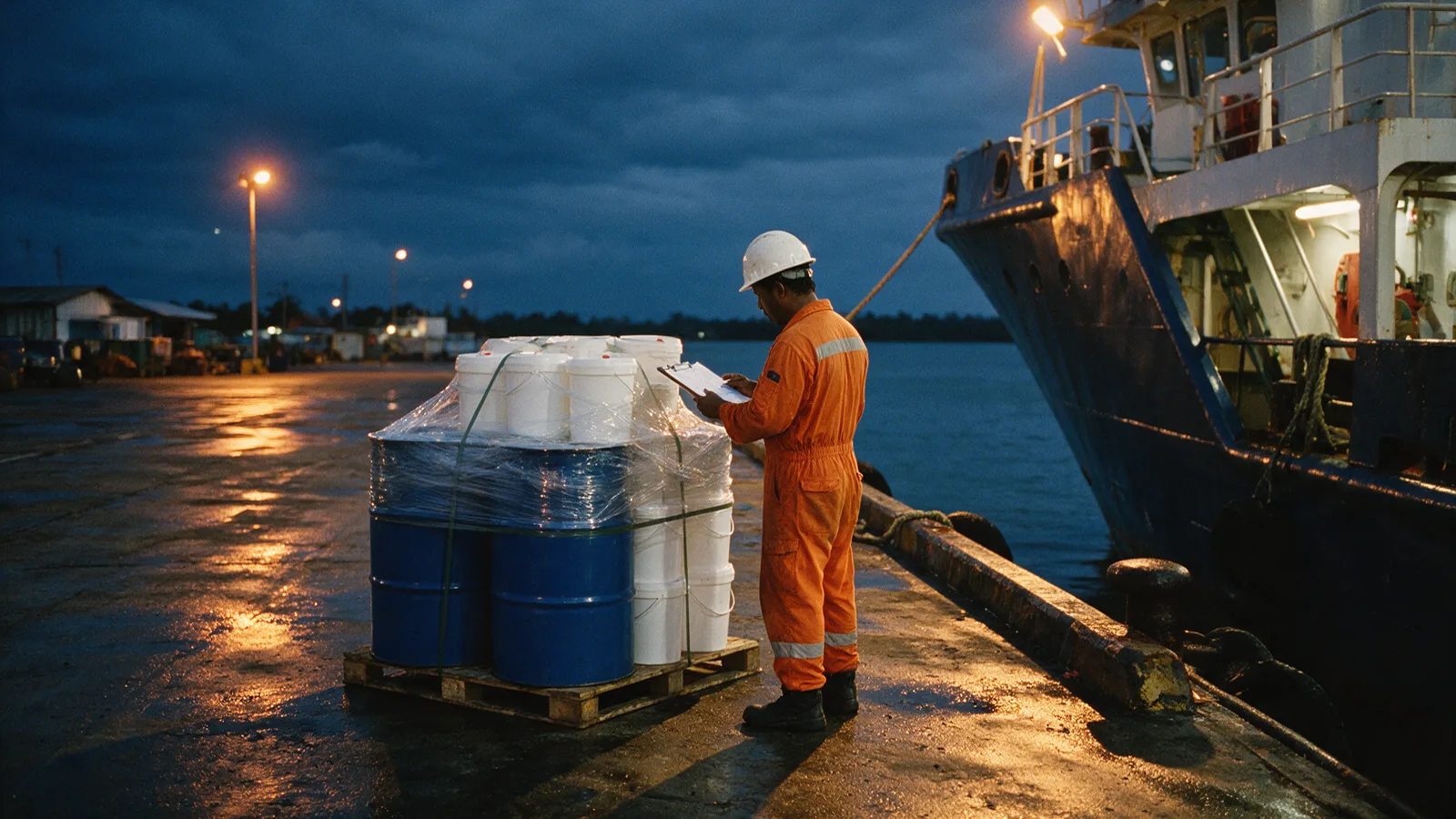
When you order marine chemicals for a vessel, specify seven things: the exact product and its use, the grade and shelf life, the safety data sheet (SDS) and technical data sheet, the transport data, the pack size, the delivery details, and the documents the vessel needs on receipt. Each item you leave out is a question the supplier must ask before it can quote, and time lost before a sailing.
Key takeaways
- A marine chemical order should cover seven items: product, grade and shelf life, SDS and technical data sheet, transport data, pack, delivery, and receiving documents.
- Under Malaysia's CLASS Regulations 2013 a supplier must provide an up-to-date, 16-section SDS for hazardous chemicals, and DOSH's code of practice requires it in both Bahasa Malaysia and English.
- SOLAS chapter VII states that its dangerous goods provisions do not apply to ships' stores; chemicals carried as cargo must meet the IMDG Code.
- Under MARPOL Annex V, deck, external-surface and cargo hold wash water may go overboard only if its cleaning agent is not classified as harmful to the marine environment.
On this page11
What should a marine chemical order include?
A supplier can price a marine chemical order only when it knows which exact product, what strength and how many packs of what size, and can plan the delivery only when it knows the vessel, berth and sailing time. An order that reads only "degreaser, 10 drums" answers none of those questions, so the quote waits on a round of follow-up messages.
| Item | What to specify | Why it matters |
|---|---|---|
| 1. Product | Product name, manufacturer, product number or IMPA code, intended use (for example boiler water treatment or deck cleaning), and whether an equivalent is acceptable | Two products with similar names can have different chemistry and different hazard classes |
| 2. Grade and shelf life | Concentration or active content, technical or laboratory grade, certificate of analysis if needed, minimum remaining shelf life on delivery, batch or lot number | The wrong strength can fail a test method; old stock may expire before it is used |
| 3. SDS and data sheet | Current SDS revision in Bahasa Malaysia and English naming the Malaysian supplier, plus the technical data sheet or dosing instructions | The SDS covers hazards; the data sheet covers how to use the product |
| 4. Transport data | UN number, proper shipping name, hazard class, packing group, marine pollutant (yes or no) | Decides packing and paperwork when the chemical travels as cargo |
| 5. Pack | Pail, drum or IBC; number of packs; palletised and shrink-wrapped or loose | Must suit the crane, the store room and manual handling on board |
| 6. Delivery | Vessel name, IMO number, berth, anchorage or supply base, arrival and sailing times, agent, receiving contact | Chemicals that arrive after the vessel sails go back to the warehouse |
| 7. Documents | Delivery order, SDS copies, certificate of analysis, and any paperwork your operator requires | The receiving officer may ask for them before accepting the delivery |
Filled in, this table is a complete request for quotation: send it on WhatsApp to Era Harvest at 017-351 0071.
What must the safety data sheet contain in Malaysia?
In Malaysia, a supplier of a hazardous chemical for use at work must give the recipient an up-to-date SDS in a fixed 16-section format, under the CLASS Regulations 2013 (Occupational Safety and Health (Classification, Labelling and Safety Data Sheet of Hazardous Chemicals) Regulations 2013). The Department of Occupational Safety and Health (DOSH) code of practice adds that the SDS must be written in both Bahasa Malaysia and English.
The CLASS Regulations were gazetted on 11 October 2013, according to the DOSH Industry Code of Practice on Chemicals Classification and Hazard Communication, which describes an SDS as:
"an up-to-date hand-out or information sheet containing relevant information pertaining to the hazardous chemicals which is vital for establishing arrangements in the safe use of the chemicals at work." (DOSH, Industry Code of Practice on Chemicals Classification and Hazard Communication, 2014)
These duties sit on the Malaysian supplier at the point of supply, not on the vessel. Section 1(3) of the Occupational Safety and Health Act 1994, under which the CLASS Regulations are made, excludes work on board ships governed by the Merchant Shipping Ordinances, an exclusion kept when the amended Act took effect on 1 June 2024, as Azmi & Associates notes. So ask the supplier for the SDS, and make three checks when it arrives:
- Language. The DOSH code of practice states that "the SDS shall be written both in national language and English language". An English-only SDS from an overseas manufacturer does not meet that on its own.
- Local supplier. DOSH's CLASS Regulations FAQ says the identification of the local supplier "is mandatory to be included in the label and SDS".
- Revision date. Section 16 of the SDS must show the date of preparation and revision. Compare it with the product you are receiving.
Do not assume an SDS has been checked by the authorities: DOSH's FAQ states that it "does not provide any approval or certification to SDS and labelling".
Does the IMDG Code apply to chemicals for the ship's own use?
No, not while they are ship's stores. SOLAS chapter VII, which makes the International Maritime Dangerous Goods (IMDG) Code mandatory, states that its dangerous goods provisions "do not apply to ships' stores and equipment". A degreaser delivered for the vessel's own use is a store. The same chemical carried as cargo, for example to an offshore installation, must meet the IMDG Code.
The ship's-stores exclusion is written into SOLAS chapter VII regulation 2, as amended by IMO resolution MSC.123(75). According to the International Maritime Organization, the IMDG Code has been mandatory under SOLAS since 1 January 2004; the current edition, Amendment 42-24, became mandatory on 1 January 2026, as TT Club notes.
Section 14 of the SDS, "Transportation information", is where the transport data sits. Under the DOSH code of practice it gives the UN number, the proper shipping name, the transport hazard class, the packing group where one applies, and whether the chemical is a marine pollutant under the IMDG Code. DOSH explains that "Packing Group I is the highest hazard and Packing Group III the lowest." Ask for it even for stores: it tells the crew how hazardous the product is.
When chemicals do travel as cargo, the paperwork is a legal document. TT Club, a mutual insurer for the transport and logistics industry, puts it plainly:
"The shipper's declaration is a binding legal statement – errors or omissions can result in rejection, delays, fines or worse." (TT Club, TT Talk on IMDG Code Amendment 42-24, November 2025)
How do you specify the grade of a marine chemical?
Specify grade by stating what the chemical is for, the concentration or active content you need, and whether a technical, laboratory or other grade is required. Add the manufacturer's product number or an IMPA code so the supplier matches one exact item. Say whether an equivalent from another brand is acceptable, and ask for a certificate of analysis when a laboratory or test method depends on it.
State the intended use on the order and check it against Section 1 of the SDS, which must list the "recommended use of the chemical and restrictions on use". A product whose SDS does not recommend it for your system is not the one to order.
IMPA codes remove guesswork across languages. The International Marine Purchasing Association's Marine Stores Guide gives each product "a unique six-digit code" and covers more than 50,000 products. For Wilhelmsen Ships Service (WSS) products, the product name and number are the simplest identifiers: the WSS safety data sheet portal finds an SDS by either, lets you choose a country and language, and states that "English is always available besides the local language of the selected country".
What else should you ask for before the chemical is loaded?
Before loading, ask the supplier to confirm that the product suits the system and the materials it will be dosed into, and for evidence of approval for potable water use where the chemical will touch drinking water. Then read three SDS sections, on storage, stability and physical properties, to plan where each product will sit on board and what it must be kept away from.
Three SDS sections carry the storage information, under the DOSH code of practice. Section 7, "Handling and storage", gives the conditions for safe storage "including any incompatibilities". Section 10, "Stability and reactivity", lists incompatible materials and conditions to avoid. Section 9 gives physical properties including the flash point. Together they tell the chief engineer which chemicals must not share a locker.
What pack size and packaging should you ask for?
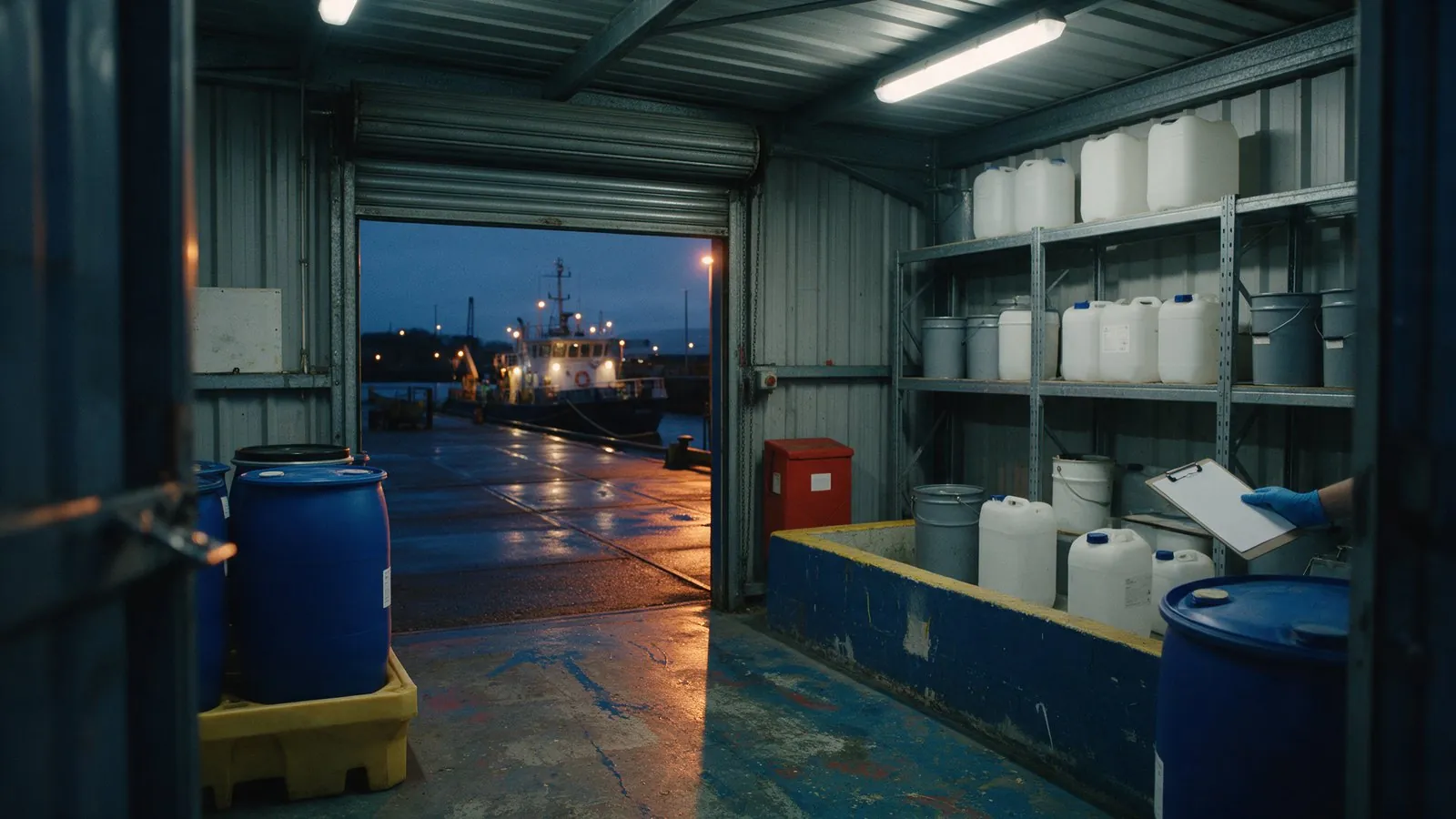
Ask for the pack size your crew can lift, store and dose from safely: pails for small consumables, 200-litre drums for regular use, and intermediate bulk containers (IBCs) for large volumes moved by crane. State the number of packs, whether they should be palletised and shrink-wrapped, and whether the chemical will travel as ship's stores or as dangerous goods cargo, because dangerous goods cargo normally needs UN-marked packaging.
UN-tested packaging carries a letter that shows the performance standard it passed. The UN packaging code, as written into US federal regulation 49 CFR 178.503, uses X for packagings meeting packing group I, II and III tests, Y for packing group II and III, and Z for packing group III only. Check that the mark on the drum or IBC covers the packing group in Section 14 of the SDS.
Labels are part of the pack: the DOSH code of practice says a label must be "firmly affixed" and readable when the container stands in its normal position. For larger volumes, Era Harvest also rents out chemical tote tanks through its equipment rental service.
Can deck wash water with a cleaning chemical go overboard?
Deck, external-surface and cargo hold wash water containing a cleaning agent can be discharged at sea only if the agent is not classified as harmful to the marine environment (HME) under MARPOL Annex V. Ask the supplier, before ordering, whether the product is a marine pollutant under the IMDG Code or meets the MARPOL Annex III criteria for harmful substances. SDS Sections 12 and 14 carry the evidence.
The International Maritime Organization lists cleaning agents and additives among the garbage covered by MARPOL Annex V. The Australian Maritime Safety Authority summarises the rule: agents in "cargo hold, deck and external surfaces wash water can be discharged into the sea, provided that they are not classified as HME", and HME agents are "those that are identified as marine pollutants in the International Maritime Dangerous Goods (IMDG) Code or which meet the criteria in the Appendix of MARPOL Annex III".
The Annex V wash-water test is written for cargo hold, deck and external-surface washing. A deck cleaner that cannot be discharged can cost more once the wash water has to be held and landed. For waste that must come ashore, see how ship operators dispose of vessel waste at Bintulu or Era Harvest's environmental and waste services.
What delivery details should the order give in Bintulu?
A chemical delivery order for a vessel at Bintulu should give the vessel name and IMO number, the exact delivery point (a Bintulu Port berth, the anchorage or the supply base), the vessel's arrival and sailing times, the ship's agent, and a named receiving contact with a phone number. Add any lifting limits and the documents the vessel will ask for at the gangway.
Offshore work out of Bintulu is served by a dedicated supply base. According to Bintulu Port, Borneo Oil & Gas Supply Base (BOGSB) is "the exclusive licensed supply base operator in Sarawak", serving the oil, gas and offshore energy sectors. Confirm its gate-entry requirements with your agent in advance.
How does Era Harvest handle marine chemical orders?
Era Harvest Supply & Engineering Sdn Bhd, incorporated in 2014 and based in Bintulu, Sarawak, supplies marine, industrial and laboratory chemicals, including degreasers and deck cleaning chemicals, and is an authorised agent for WSS Wilhelmsen Ships Service chemicals. Other brands it supplies include Nalco. From 2022 to 2023 it supplied FM-3000 emulsion sludge breaker for PTTEP Bintulu under a contract with Baker Hughes INTEQ (M) Sdn Bhd.
The fastest route to a quote is the seven-item table above. See the marine chemical supply service or browse chemicals and lubricants in the catalogue. Operators buying more than chemicals can read whether one supply-and-services contractor or separate specialists suits an offshore operation.
Send your list on WhatsApp at 017-351 0071, call 086-313311, or email inquiry@eraharvest.com.
Sources
- DOSH, Industry Code of Practice on Chemicals Classification and Hazard Communication 2014
- DOSH, Frequently Asked Questions for CLASS Regulations
- Occupational Safety and Health Act 1994 (Act 514)
- Azmi & Associates, Key changes to occupational safety and health law
- IMO, Resolution MSC.123(75): amendments to SOLAS chapter VII
- International Maritime Organization, Dangerous goods (IMDG Code)
- TT Club, TT Talk: IMDG Code Amendment 42-24 (November 2025)
- International Maritime Organization, Prevention of pollution by garbage from ships
- Australian Maritime Safety Authority, Marine Notice 2022/01: MARPOL Annex V (Garbage) Discharges
- IMPA, Marine Stores Guide
- Wilhelmsen Ships Service, Safety data sheets portal
- US Code of Federal Regulations, 49 CFR 178.503 Marking of packagings
- Bintulu Port, Borneo Oil & Gas Supply Base: About us