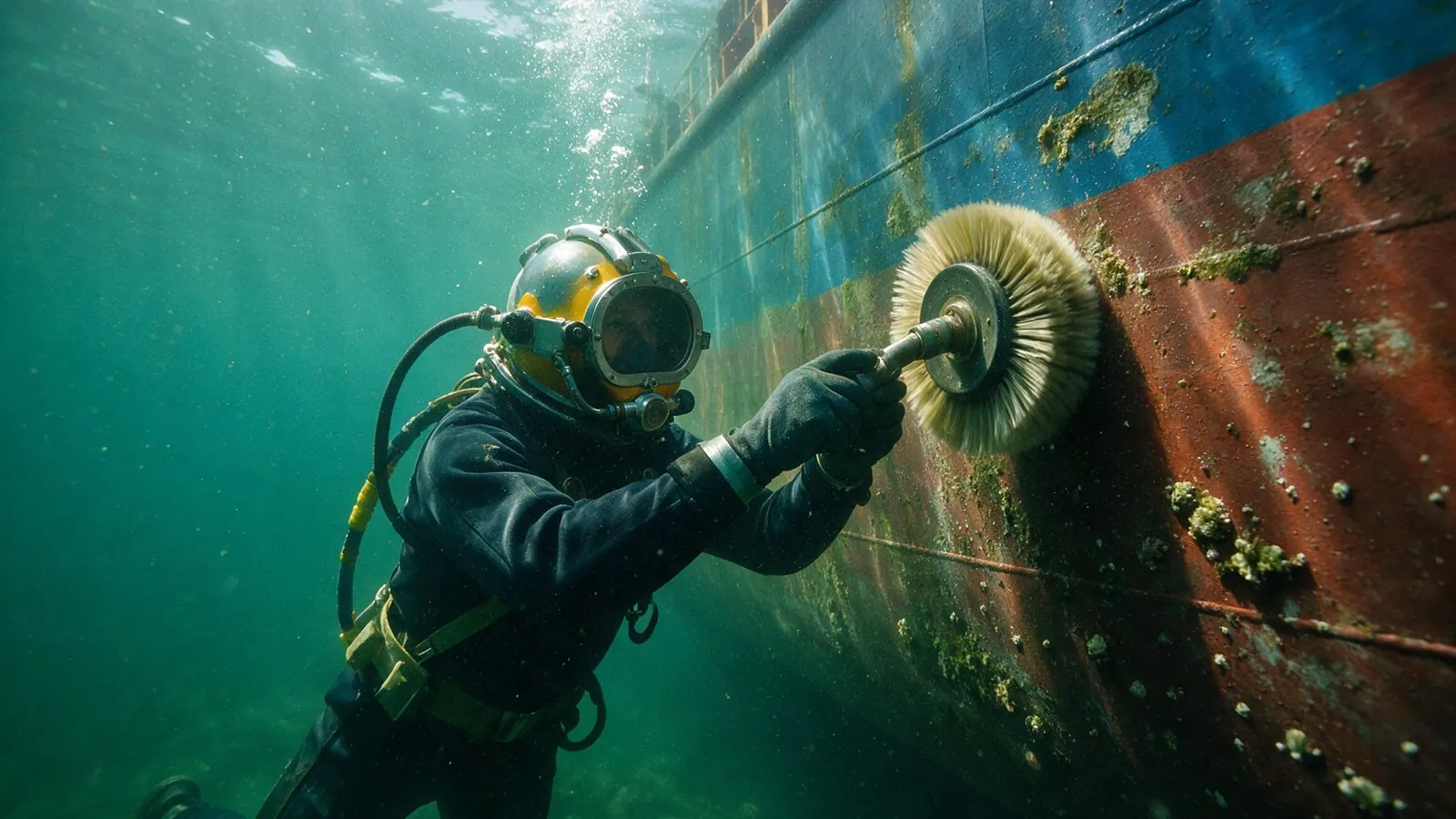
There is no fixed interval for cleaning a ship's hull underwater. The 2023 IMO Biofouling Guidelines set a target instead of a date: an effective biofouling management plan should keep every inspected area at a fouling rating of 1 or below. Cleaning with capture becomes the recommended action once an area reaches rating 2 on the 0 to 4 scale, and in-water inspections run at least every 12 to 18 months.
Key takeaways
- The target is a fouling rating of 1 or below for every inspected area — what the ship's biofouling management plan should aim to maintain (paragraph 10.2). In practice that means cleaning before an area reaches rating 2.
- Cleaning with capture becomes the recommended action once an area rates 2 on the 0 to 4 scale — light macrofouling over 1 to 15% of the area. At rating 1, slime, proactive cleaning may be recommended (table 1).
- Routine proactive cleaning has no IMO interval. Its procedures and frequency belong in the ship's own biofouling management plan, the BFMP (paragraph 9.6).
- In-water inspections should run at least every 12 to 18 months, more often where an area has no anti-fouling system, and each area is scored at the worst fouling found in it (paragraphs 8.6 and 8.8).
- For an in-water cleaning request, an inspection counts as recent for 28 days, and only if the ship has not stayed in one location for more than 7 days since (MEPC.1/Circ.918, paragraph 2.1.4).
On this page7
When does a ship's hull need cleaning?
When an inspection rates an area 2 or above on the 0 to 4 fouling scale. Table 1 of the 2023 IMO Biofouling Guidelines makes rating 2 — light macrofouling over 1 to 15% of the area — the point at which it recommends cleaning with capture, shortening the interval to the next inspection, and dry-docking with reapplication of the anti-fouling system if that system is significantly deteriorated.
| Rating | What the inspection finds | Macrofouling cover | Recommended action |
|---|---|---|---|
| 0 | No fouling — surface entirely clean | — | None |
| 1 | Microfouling — slime, with metal or paint possibly visible beneath | — | Proactive cleaning may be recommended |
| 2 | Light macrofouling — patches that cannot be easily wiped off by hand | 1–15% | Cleaning with capture; shorten the interval to the next inspection; dry-dock and reapply the anti-fouling system if it is significantly deteriorated |
| 3 | Medium macrofouling — multiple patches | 16–40% | |
| 4 | Heavy macrofouling — large patches or areas entirely covered | 41–100% |
Each area is rated on its own: paragraph 8.8 subdivides the inspected surface into the areas listed in appendix 2 and gives each the highest rating found in it.
The Guidelines answer "how often" with a condition rather than a date, and they state that condition three times. Paragraph 10.2 says an effective BFMP should contribute to the aim of maintaining a recommended fouling rating of 1 or below. Paragraph 9.9 asks reactive cleaning to be conducted with the aim of achieving a fouling rating of 1 or below for the cleaned area. Paragraph 9.4 bars proactive cleaning without capture on fouling rated 2 or above. Read together, they put the cleaning cycle before an area reaches rating 2, not after.
Only half of that cleaning is ever scheduled. Proactive cleaning — removing microfouling before macrofouling grows — has its frequency "described in the BFMP" under paragraph 9.6, the ship's own plan rather than an IMO number. Reactive cleaning follows the inspection results and table 1's contingency actions under paragraph 9.8.
Rating 1 is on that scale for a reason. IMO's preliminary report for the Global Industry Alliance for Marine Biosafety, drawing on published studies, gives slime as thin as 0.5 mm covering up to 50% of a hull — microfouling, not macrofouling — as able to trigger an increase in greenhouse gas emissions in the range of 20 to 25%, "depending on ship characteristics, speed and other prevailing conditions".
Era Harvest's underwater services in Bintulu cover underwater inspection, cleaning of ship hull, cutting and welding, anode installation and jetty works. If a hull is due a look before anyone decides whether to clean it, send the vessel, the berth or anchorage and the coating details on WhatsApp 017-351 0071, or call the Bintulu office on 086-313311.
How often should the hull be inspected in the water?
At least every 12 to 18 months. Paragraph 8.4 of the 2023 IMO Biofouling Guidelines puts the first inspection within 12 months of the anti-fouling system being applied, reapplied, installed or renewed, and paragraph 8.5 allows up to 18 months where performance monitoring shows adequate performance, "noting that such monitoring may not reflect the level of biofouling in all niche areas".
Paragraph 8.6 asks for subsequent inspections "at least every 12 to 18 months", rising with the age or damage of the anti-fouling system. Two situations tighten it. Where an area carries no anti-fouling system and no other measure such as in-water cleaning or propeller polishing, the same paragraph asks for inspections more often than every 12 months. Where an inspection finds high levels of biofouling and the system's effectiveness is in doubt, paragraph 8.7 asks for more frequent inspections — its own example is biannually — until the ship dry-docks and is recoated.
Paragraph 8.6 also asks that in-water inspections coincide with existing subsea operations, so one is worth scheduling against other dive work. What that dive covers is set out in our guide to an underwater hull or jetty inspection in Sarawak.
How recent must an inspection be before an in-water clean, and what does a lay-up change?
Twenty-eight days, for the purpose of a cleaning request. Paragraph 2.1.4 of MEPC.1/Circ.918 treats an inspection as reflecting the ship's current condition only where it was undertaken within the last 28 days and the ship has not since remained in one location, other than the waters where cleaning will occur, for more than 7 days. The 28-day test governs the cleaning request, not how often a hull needs an inspection.
Longer lay-ups change the picture. Appendix 1 of the Guidelines says biofouling accumulation starts immediately when a ship is idle, that idle time in charter party contracts typically ranges between 18 and 30 days, and that beyond the idle period the anti-fouling supplier accepts the risk "may be considered very high". For a vessel laid up that long, paragraph 3.5 says the inspection regime in paragraphs 8.4 to 8.6 may not be relevant at all, and that inspection and reactive cleaning may be needed before the ship is reactivated.
The water the ship sits in is the other variable. Sub-paragraph 6.3.4 of the Guidelines says biofouling pressure differs with temperature, salinity and nutrient conditions, and that biofouling "grows more slowly, but is not prevented, in low temperature waters". Reading that against a warm, coastal berth or anchorage off Bintulu is our own inference rather than theirs, and a reason to inspect earlier rather than a rule.
Is there a Malaysian rule on in-water hull cleaning?
No Malaysian cleaning interval appears in the IMO documents, and this guide found no published rule specific to Bintulu. What the documents are firm about is the place. Paragraph 3.1 of the 2023 IMO Biofouling Guidelines offers them as "useful recommendations for measures to minimize biofouling for all types of ships" rather than a binding rule, though resolution MEPC.378(80), which adopted them, "requests Member States to take urgent action in applying these Guidelines".
Paragraphs 9.4 and 9.9 both say proactive and reactive cleaning should be performed "in an area accepted by the relevant authority for this activity". Who that authority is varies. ICS and BIMCO, in a submission to IMO's Sub-Committee on Pollution Prevention and Response, described the landscape plainly:
"In some countries, the authorities, who are responsible for issuing permits, will be located in the port whilst others are a central authority of a country or a region."
ICS and BIMCO, "Before, during and after in-water cleaning", IMO document PPR 11/5, 30 October 2023
ICS and BIMCO put the shipowner's first move, once the decision to clean is taken, as requesting a list of cleaning companies from the port. For a vessel off Bintulu, that means establishing with the port or terminal which authority has jurisdiction over the berth or anchorage, and what is permitted there, before a contractor mobilises.
What should you ask an underwater hull cleaning contractor for?
Ask for four things before the dive, each an item MEPC.1/Circ.918 puts on the service provider: a pre-cleaning inspection, capture for anything rated above 1, time- and date-stamped colour images, and a cleaning report the ship keeps.
- A pre-cleaning inspection of the areas to be cleaned, to verify the condition of the hull and identify areas to avoid (paragraph 4.2.7).
- Capture for any area rated above 1, outside the narrow exception at paragraph 4.1.2.2 where the ship's records satisfy the relevant authority (paragraph 4.2.8).
- Time- and date-stamped colour images of at least 1280 x 720 pixels, with ship-specific markings such as draught marks in shot (paragraph 4.2.6).
- A cleaning report you can keep — paragraph 4.5.1 has the provider prepare one and give it to the ship. Where the job did not cover the whole planned area, paragraph 4.5.2 asks it to say where cleaning started, where it stopped and why, in enough detail for another provider to carry on.
The method matters as much as the paperwork. In their PPR 11/5 submission, ICS and BIMCO warned that certain cleaning procedures may damage the anti-fouling system "in such a way that is not immediately visible but could accelerate biofouling growth" — rough edges on the wheels of the cleaning unit being their example of how. MEPC.1/Circ.918 paragraph 4.2.2 accordingly asks the ship and the service provider to coordinate on the condition of the coating and its compatibility with the cleaning system.
For a hull cleaning enquiry off Bintulu, send the vessel, the berth or anchorage, the coating type and the date of the last inspection. Where a hull or a jetty needs steelwork rather than cleaning, our guide to underwater welding versus dry dock repair covers which repairs can be done wet.
Sources
- IMO resolution MEPC.378(80), 2023 Guidelines for the control and management of ships' biofouling to minimize the transfer of invasive aquatic species (adopted 7 July 2023, MEPC 80/17/Add.1 annex 17; text as published by the Hong Kong Marine Department)
- IMO, Guidance on in-water cleaning of ships' biofouling, MEPC.1/Circ.918, 29 April 2025
- ICS and BIMCO, Before, during and after in-water cleaning, IMO document PPR 11/5, 30 October 2023
- IMO, Impact of Ships' Biofouling on Greenhouse Gas Emissions - preliminary results, for the Global Industry Alliance for Marine Biosafety