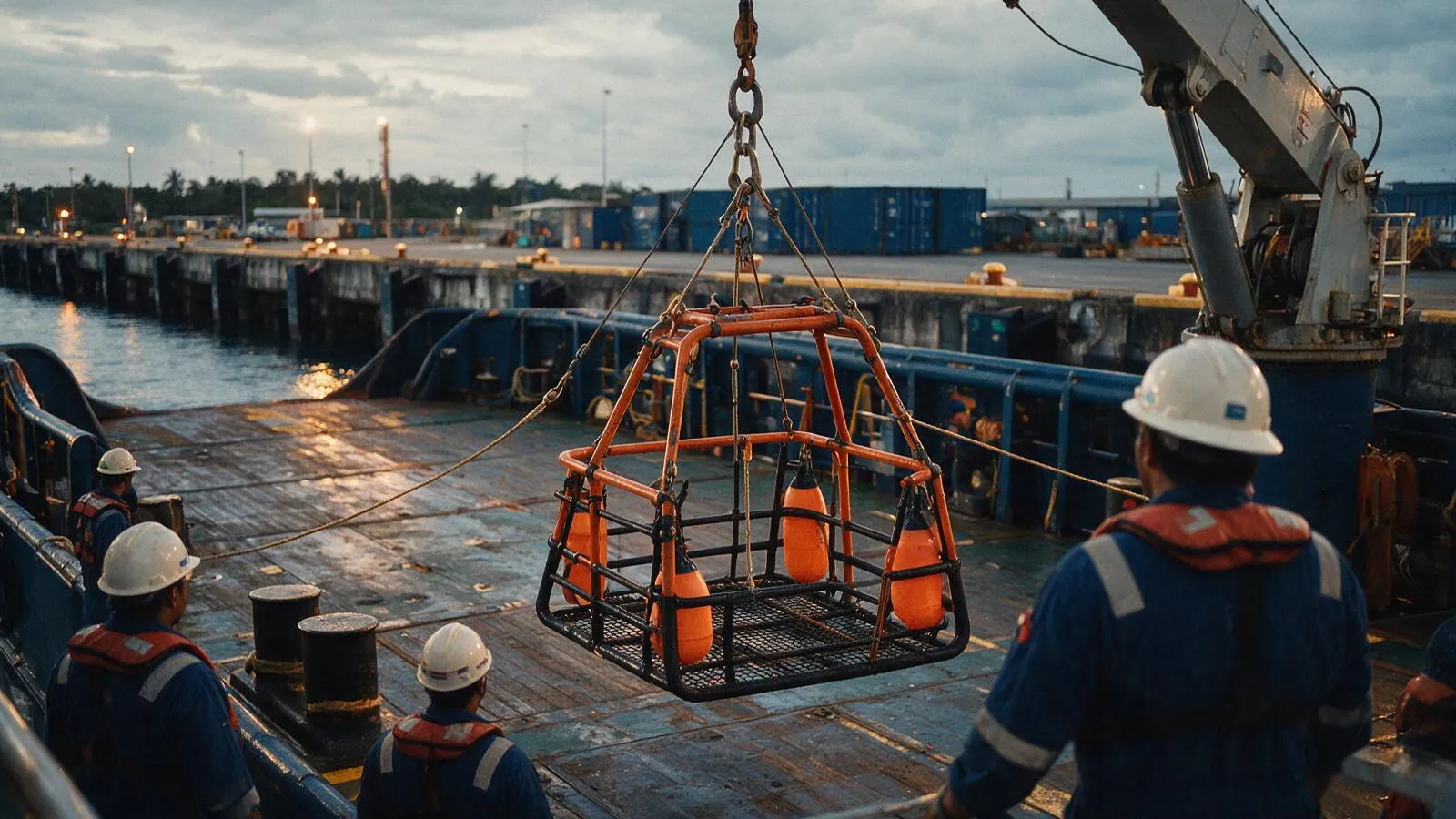
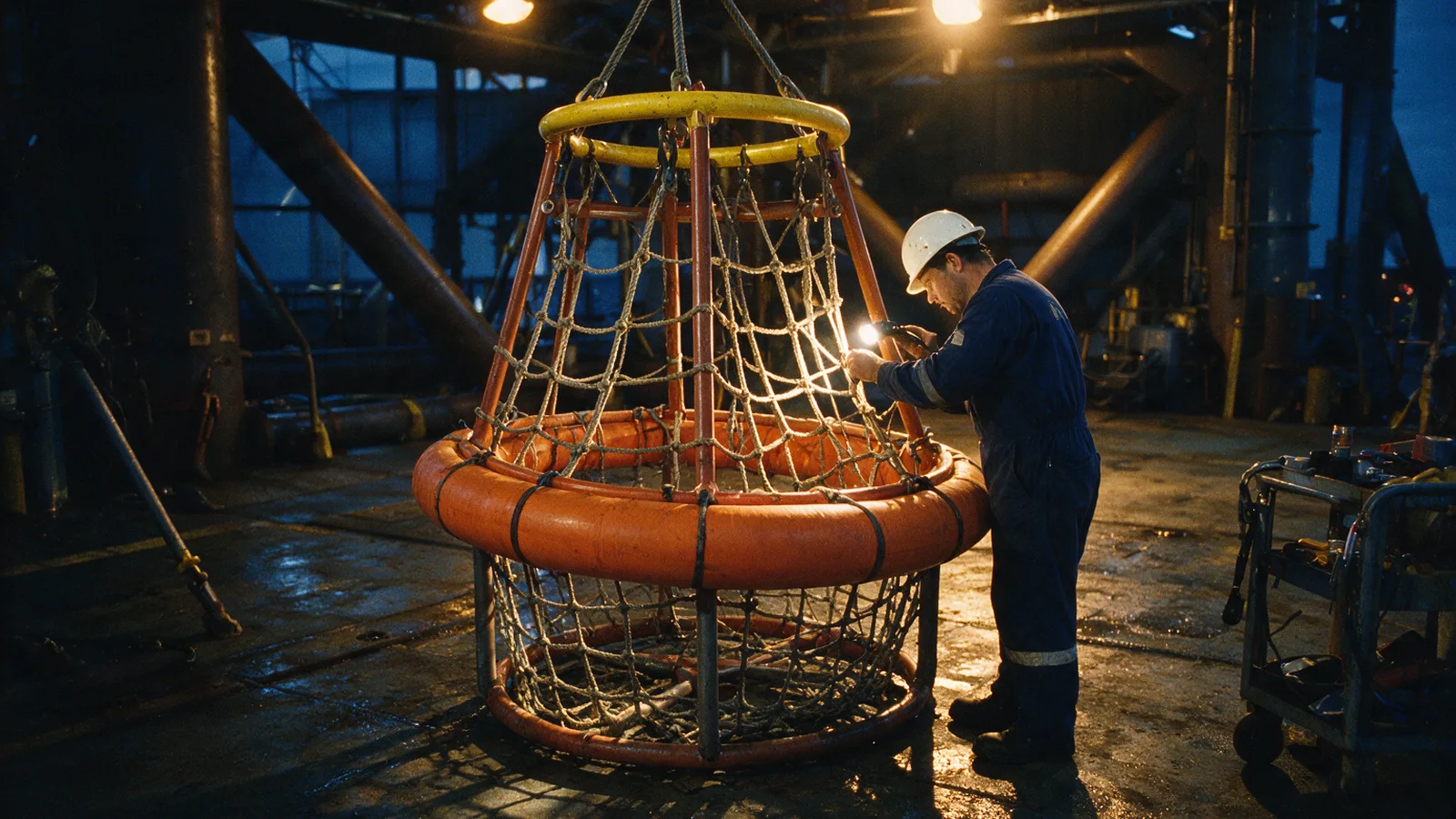
An offshore personnel transfer basket (also called a man basket) should get a visual check before every transfer and a thorough examination by a competent person at least every six months. Six months is the UK legal interval for equipment that lifts people, which Billy Pugh and Safe Transfer also use. On top of that come the manufacturer’s workshop inspections, fixed replacement dates for slings, compensators and nets, and a written record for each basket.
Key takeaways
- A personnel transfer basket gets a visual check before every transfer and a thorough examination by a competent person at least every six months.
- UK lifting law (LOLER) sets six months for equipment that lifts people, against 12 months for equipment that lifts only loads.
- Safe Transfer baskets need an annual workshop inspection and a five-year recertification with load test and NDT. The Billy Pugh X-904 is refurbished every two years and replaced after 8 years in the field.
- Some parts are replaced by date: Safe Transfer compensators every 12 months and lifting slings at least every five years.
- Manufacturers limit workshop-level refurbishment and recertification to repair shops they approve, so check the manual before booking.
On this page11
How often does a personnel transfer basket need to be inspected?
A personnel transfer basket is inspected at four levels. The deck crew checks it visually before every lift. A competent person examines it thoroughly at least every six months. It goes to a workshop at the interval its manufacturer sets, annually, every two years or every five years depending on the model. And it gets an extra examination after any damage, alteration or repair. The manual for your model sets the exact numbers.
The UK Health and Safety Executive states that lifting equipment must be thoroughly examined every 12 months, “or every 6 months if the equipment is used to lift people” (HSE, LOLER guidance). That is UK law (LOLER), not Malaysian law, but offshore guidance such as the Marine Transfer Forum’s names LOLER among the regulations for maintaining lifting equipment.
| Check | When | Who does it | What it covers |
|---|---|---|---|
| Pre-use visual check | Before every transfer | Platform supervisor, watch keeper or deck crew | Frame, nets and rope sections, fenders, sling, compensator, master link, closing straps |
| Thorough examination | At least every 6 months | A competent person (Safe Transfer requires one independent of line management) | The whole basket, the lifting sling and the compensator, logged with any defects |
| Annual workshop inspection | Every 12 months (Safe Transfer 1145-4-N) | A repair shop approved by Safe Transfer or by DNV GL | All parts of the basket and lifting sling, with worn parts replaced |
| Refurbishment or recertification | Every 2 years (Billy Pugh X-904); every 5 years with load test and NDT (Safe Transfer) | Whoever the manufacturer names | Strip-down, new certified parts, new certificate or nameplate stamp |
| Extra examination | After damage, alteration or repair of a stress-bearing part | Per the manufacturer and the operator’s lifting procedure | Return to service only once the basket passes |
Sources for the table: Safe Transfer 1145-4-N guidelines, Billy Pugh X-904 product information and HSE.
What is checked before every transfer?
The pre-use check is a quick visual inspection that confirms the basket, lifting sling and compensator are “fit and safe for use”, in the words of Safe Transfer’s guidelines. It is done before each transfer by the platform supervisor or watch keeper, who signs the checklist. If any listed part shows visible damage, the basket may not carry people until that part is repaired or replaced.
Safe Transfer’s daily checklist for its 1145-4-N sit-down basket has ten points (Safe Transfer):
- the steel frame, for bends and cracks
- the bumper fender
- the oval top fenders and round top buoy
- the lifting sling, compensator, master link and pad eyes
- all four rope sections
- the guide ropes and weak links
- the closing straps across the exits, which must work
- the side protection
- each seat, seatbelt and pedestal
- the buoyancy tank
What does the six-monthly thorough examination involve?
The six-monthly thorough examination is a detailed inspection of the whole basket and its lifting gear by a competent person. It is recorded in a log together with any defects found. Safe Transfer describes the competent person as someone with the practical and theoretical knowledge and experience to examine the equipment, who is independent of the line management responsible for it. That person can be in-house, such as HSE staff.
An IMCA safety flash from 2015 shows what a weak examination can miss (IMCA Safety Flash 11/15). During a six-monthly on-board lifting inspection, a chain link on the main sling of an empty personnel basket snapped as the crane took the load. Nobody was hurt. The investigation found that:
- water trapped inside the plastic sling cover had sped up corrosion, and the inspector never removed the cover
- the inspection contractor was not accredited by the basket’s manufacturer and used a procedure written for steel work baskets
- the last load test was 18 months old, when the manufacturer recommended one every six months
The lesson from the IMCA incident is that a thorough examination of a transfer basket must follow that model’s own manual, with covers off and the rigging fully seen.
What does routine maintenance of a transfer basket involve?
Routine maintenance keeps a personnel transfer basket clean, dry and complete between examinations. That means washing off salt and dirt, drying the rigging and storing it out of the weather, tightening or replacing rope sections and nets, and replacing damaged fenders, buoyancy, seats, belts and fasteners. It is planned work that follows the manufacturer’s schedule for that model.
“Personnel transfer appliances and arrangements shall be kept clean, properly maintained and regularly inspected to ensure that they are safe to use.”
International Maritime Organization, IP Code, Part III, regulation 2.1.1 (MSC.527(106))
Safe Transfer’s annual workshop inspection, done by an approved repair shop, shows what that maintenance covers in practice (Safe Transfer 1145-4-N):
- Clean the basket with a high-pressure cleaner and repaint the floor-plate markings if needed.
- Replace the top fenders and the top buoy.
- Check the top net and side net, and repair or replace them if damaged.
- Check the rope sections for cuts, tighten them with the turnbuckle, and replace them if damaged.
- Check the guide ropes and weak links, and the entrance rope, and replace them if damaged.
- Check the bottom fender, bottom frame, bolts and nuts, and replace any that are damaged.
- Check the seats, pedestals, seatbelts, head protection, closing straps and buoyancy, and replace anything damaged.
The lifting rigging deserves the most care. The Marine Transfer Forum’s best-practice guidance states: “The wire rope lifting assembly (rigging) is considered the most critical component on the carrier.” It advises storing rigging clean and dry, removing sling covers where condensation could build up, and discarding any sling that fails inspection (Marine Transfer Forum, Offshore Personnel Transfer by Crane, Rev 0). For a vessel that keeps its own basket, the West of England P&I Club advises building the manufacturer’s inspection and maintenance routines “into the SMS and Planned Maintenance System (PMS) as appropriate” (West P&I, Transfers by personnel basket).
Which basket parts are replaced on a fixed schedule?
Some parts of a transfer basket are replaced by date, whatever they look like. Safe Transfer requires the compensator on its 1145-4-N basket to be replaced every 12 months and a new certified lifting sling to be fitted at least every five years. Billy Pugh recommends replacing X-800 series personnel nets every year when they are used daily, for example on a jack-up drilling rig, and every other year where use is lighter.
| Basket | Item | Manufacturer’s interval |
|---|---|---|
| Safe Transfer 1145-4-N | Compensator | Replace every 12 months |
| Safe Transfer 1145-4-N | Complete certified lifting sling | Replace at least every 5 years |
| Billy Pugh X-904 | Whole unit | Refurbish every 2 years; replace after 8 years in the field (new plus 3 refurbishments) |
| Billy Pugh X-800 series net | Whole net | Replace annually with daily use, every other year otherwise; valid 2 years from In Service Date |
Billy Pugh states that X-904 units “need to be refurbished every two years unless they are damaged or do not pass the Daily or 6 Month inspection with a lifespan of 8 years total on the aluminum center section”, and recommends replacing them after 8 years in the field, which is new plus three refurbishments (Billy Pugh X-904). The X-800 net is not designed to be refurbished at all (Billy Pugh X-800 series).
Who is allowed to refurbish or recertify a transfer basket?
The basket’s manufacturer decides who may do its workshop-level work, so read the manual before you book. Safe Transfer states that its annual inspections and five-year recertifications must be done by a repair shop approved by Safe Transfer or by DNV GL. Billy Pugh says that, for safety reasons, it has certified refurbishment companies around the world, and it sends X-904 refurbishment to them.
Safe Transfer’s five-year recertification also includes a load test and non-destructive testing (NDT) to the basket’s type approval, under DNVGL-ST-0378 or NORSOK R-002 (Safe Transfer). Billy Pugh takes the opposite view for its own products: it does not recommend load testing its personnel nets and baskets because each individual part is certified (Billy Pugh). A basket owner should therefore follow the rule written for that exact model, not a general habit.
Before any workshop takes a basket for refurbishment or recertification, ask for the manufacturer’s written approval for that model and check it against the manufacturer’s own published list.
Which rules and guidance set the inspection interval?
No single rule sets the interval everywhere. The Marine Transfer Forum says personnel transfer equipment should be inspected and maintained according to the manufacturer’s recommendations, local regulations and the owner’s policies. A basket may count as lifting equipment, life-saving equipment, or both. For work in Malaysian waters, ask the operator for its lifting procedure and contract requirements at the start, then follow the strictest of those, the manual and any flag-state rule.
For vessels that fall under it, the IMO’s code for ships carrying industrial personnel (the IP Code), adopted in November 2022, requires personnel transfer arrangements to be clean, properly maintained, regularly inspected and permanently marked (IMO MSC.527(106)).
What records should be kept for each transfer basket?
Every personnel transfer basket should carry a permanent identification and have its own file covering use, inspection and maintenance. The IP Code requires each transfer appliance to be marked for survey, inspection and record-keeping. Safe Transfer requires six-monthly examinations to be logged with the defects found. Billy Pugh dates its inspections and replacements from each unit’s In Service Date.
A complete basket file usually holds:
- the asset identification, data plate details and In Service Date (Billy Pugh counts it from the day the unit comes out of its packaging)
- the certificate of conformity and the latest recertification certificate or nameplate stamp
- signed pre-use checklists and every six-monthly examination report
- sling and compensator certificates, with their replacement due dates
- a repair history, including every part replaced and who replaced it
A complete basket file lets an operator, a client or an inspector see the basket’s status in minutes, and it is the first document anyone will ask for if something goes wrong.
How can Era Harvest help with transfer basket inspection and maintenance?
Era Harvest Supply & Engineering, based in Bintulu, Sarawak, supplies, rents, inspects, maintains and refurbishes personnel transfer baskets for marine and offshore operators. It has held a Petronas Carigali Sdn Bhd contract for the supply, rental and maintenance of offshore personnel transfer baskets since 2023, running to 2026. A rental basket keeps transfers going while your own basket is away at its manufacturer’s workshop.
To scope inspection, maintenance or refurbishment, send the basket make and model, the asset identification, photographs of its current condition, and the last inspection report. Because manufacturers reserve some workshop work for repair shops they approve, we will tell you which work we can carry out on that model and which its manufacturer reserves for its own approved workshops. Details of each service are on our personnel transfer basket service page, and short-term hire is covered under equipment rental in Bintulu. For the slings, shackles and rigging that go with a basket, see our lifting gear testing and inspection service, the lifting and rigging products we supply and the guide to how often lifting slings need inspection and recertification in Malaysia. More guides are in our offshore supply resources.
Call the Bintulu office on 086-313311, WhatsApp 017-351 0071, or email inquiry@eraharvest.com.
Sources
- HSE: Equipment and machinery FAQs (LOLER thorough examination intervals)
- Billy Pugh: X-904 Offshore Transfer Device
- Billy Pugh: X-800 Series personnel nets
- Safe Transfer A/S: Guidelines, Offshore Personnel Basket 1145-4-N
- IMO: Resolution MSC.527(106), International Code of Safety for Ships Carrying Industrial Personnel (IP Code)
- Marine Transfer Forum: Offshore Personnel Transfer by Crane, Best Practice Guidelines, Rev 0 (May 2016)
- IMCA Safety Flash 11/15 (August 2015)
- West of England P&I Club: Transfers by personnel basket