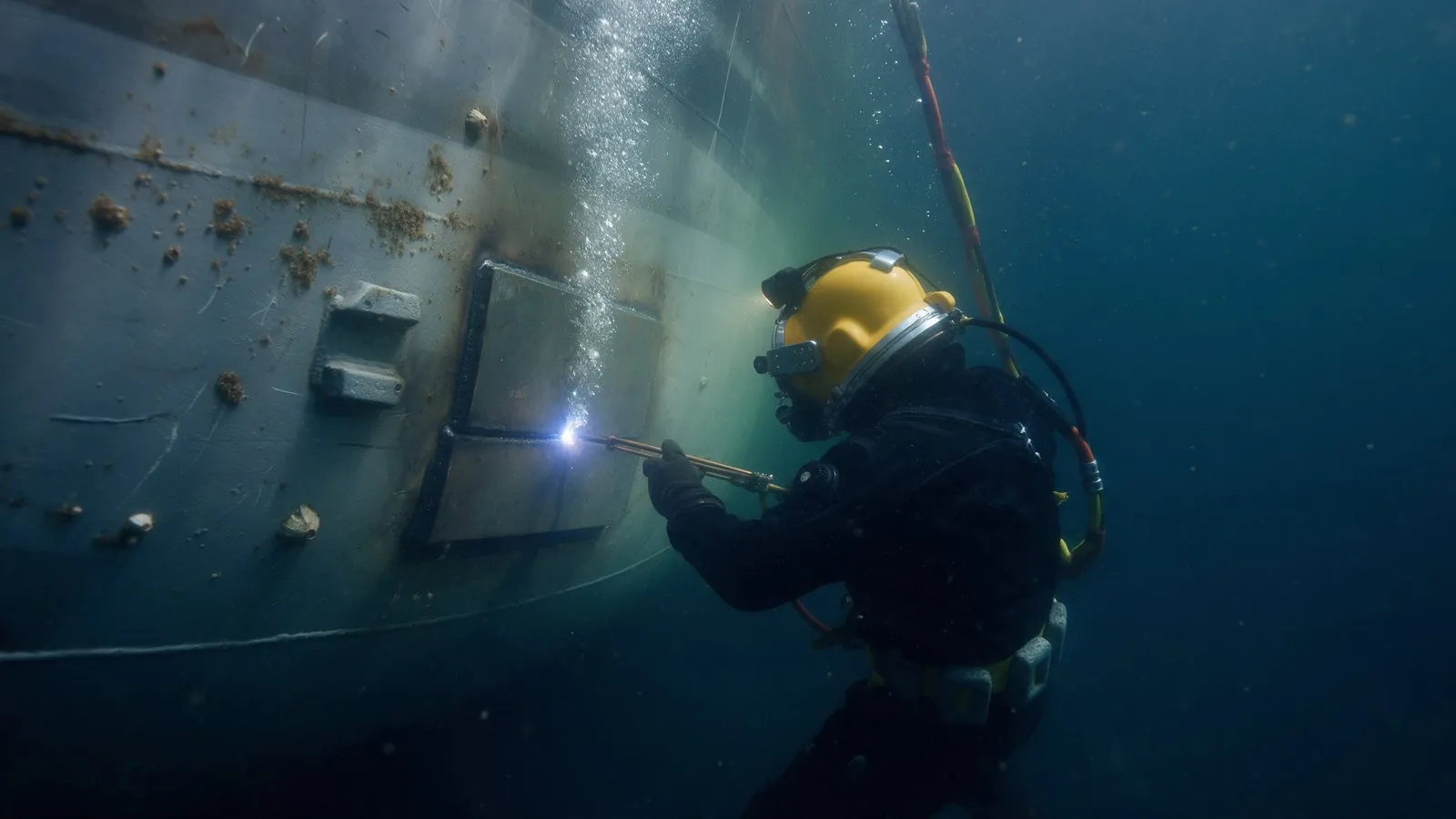
A hull or jetty repair can be welded underwater, in place, when the damage is local, the steel suits wet welding, divers can work safely, and whoever must accept the repair agrees first: the class surveyor for a classed ship, the owner's engineer for a jetty. Wet welding suits doubler plates, anodes and pile patches; a cofferdam or habitat keeps the joint dry; extensive damage to a ship's structure needs a dry dock.
Key takeaways
- AWS D3.6M:2017, the Underwater Welding Code, sets three weld classes: Class A, "comparable to above-water welding"; Class B, "for less critical applications"; and Class O, which must meet another designated code.
- Under IACS Unified Requirement Z7 (Rev.29 Corr.1, 2024), a surveyor may allow a temporary repair where damage is isolated and localised and does not affect structural integrity, with a condition of class and a specific time limit.
- TWI puts the widely accepted carbon-equivalent limit for avoiding heat-affected-zone cracking at 0.40, and calls permanent, high-quality wet welds "entirely possible in C-Mn steels of up to 0.4 carbon equivalent". Above that, or when the figure is unknown, price a cofferdam, habitat or dry dock as well.
- Cofferdam welding gives in-air weld quality but, according to TWI, is not usually used below 10 m, which suits jetty piles and shallow hull areas.
- Malaysia's Occupational Safety and Health Act 1994 applies to underwater work at a jetty (risk assessment under section 18B, fines up to RM500,000 under section 19), but its First Schedule excludes work on board ships governed by the Merchant Shipping Ordinances.
On this page10
What is the difference between wet welding, habitat welding, a cofferdam and a dry dock?
Wet welding is done by a diver with the arc in open water, shielded only by the gas the arc produces. Habitat (dry hyperbaric) welding seals a gas-filled chamber around the joint so the weld is made dry at depth pressure. A cofferdam open to the air lets welders work at normal pressure. A dry dock takes the whole hull out of the water.
The comparison below draws on a 2006 review by McKeown and Abson of TWI, the UK welding research organisation.
| Method | Where the weld is made | Weld quality | Depth and typical use | Main trade-off |
|---|---|---|---|---|
| Wet welding | Open water, arc shielded by its own gas | Class A welds reported, "the same as for welds deposited in air" | Diver depths; porosity rises with depth | Steel at or below 0.40 carbon equivalent; often accepted only as temporary |
| Habitat (dry hyperbaric) | Gas-filled chamber sealed around the joint, at depth pressure | Dry weld; "high integrity work" from a skilled welder | Preferred for deep water | "A high cost solution" |
| Cofferdam | Open to the air, at normal pressure | "As good as with a standard, non-marine procedure" | Not usually below 10 m; harbour works and ship repair | Often custom-built for the job, which adds cost |
| Dry dock | Whole hull out of the water | Normal yard welding, full access for inspection and coating | Any repair, including bearings and recoating | Vessel out of service for the yard slot |
Which hull and jetty repairs can be done in the water, and which need a dry dock?
Most in-water repairs are local: doubler plates over cracks or holes, insert plates fitted from a cofferdam, anodes, sea chest gratings, fouled lines, and patching or cutting steel piles at a jetty. A dry dock is needed when the damage affects the ship's structural integrity, covers a large area or sits where divers cannot work safely, or when class will not accept an afloat repair.
| Repair | In-water option | Needs a dry dock or a bigger job when | Who must accept it |
|---|---|---|---|
| Crack or hole in shell plating | Doubler plate welded in the water, usually temporary | Structural integrity is affected, or no permanent afloat repair is possible in time | Class surveyor and owner |
| Shell plate renewal | Insert plate from a cofferdam or habitat, or wet welded if class accepts | Large area, deep location, or steel unsuitable for wet welding | Class surveyor |
| Rudder, skeg or bilge keel | Wet welding to a qualified procedure | Bearings, pintles or the stock must come out | Class surveyor |
| Jetty piles and sheet piles | Patch plates welded underwater, underwater cutting, or a cofferdam | Heavy section loss needing jackets, new piles or redesign | The asset owner's structural engineer |
"The use of steel patch plates welded underwater over corrosion-damaged areas is one of the most common repair procedures for corroded submerged steel pipe and sheet piles," according to a 2008 conference paper by Kitane, Watanabe and Itoh. Era Harvest's 2024 work at the Sarawak Methanol jetty for China Communications Construction Company (M) Sdn Bhd included underwater welded steel plates and underwater cutting of sheet piles. Underwater inspection, which should come before and after any repair, is part of Era Harvest's underwater inspection, cutting and welding services.
What do AWS D3.6M weld classes A, B and O mean for a repair?
AWS D3.6M is the American Welding Society's Underwater Welding Code, current edition 2017, for dry and wet underwater welding. It sets three weld classes, each with its own qualification tests and weld quality requirements: Class A for work comparable to welding in air, Class B for less critical work, and Class O for welds that must also meet another code.
"Class A—Comparable to above-water welding. Class B—For less critical applications. Class O—To meet the requirements of another designated code or specification." American Welding Society, D3.6M:2017 Underwater Welding Code
"The selection of the class of weld to be provided is to be determined by the customer or regulatory body," notes Uwe Aschemeier of Subsea Global Solutions, an underwater repair contractor, in a 2024 article. For a classed vessel, ask the class surveyor which weld class or code they will accept.
Each welder-diver must also be qualified. ISO 15618-1:2016, confirmed as current in 2021, "specifies essential requirements, ranges of qualification, test conditions, acceptance requirements and certification for the qualification testing of welder-diver performance" in hyperbaric wet welding on steel.
Is an underwater weld a temporary or a permanent repair?
An underwater weld is temporary or permanent according to what the vessel's class or the asset owner accepts, not the method alone. DNV, for example, added acceptance of permanent underwater wet welding to its ship rules in July 2020, but a temporary repair still comes with a condition of class and a deadline for the permanent fix.
"Where the damage found on structure [...] is isolated and of a localised nature which does not affect the ship's structural integrity, consideration may be given by the surveyor to allow an appropriate temporary repair to restore watertight or weather tight integrity and impose a condition of class [...] with a specific time limit." IACS, Unified Requirement Z7 Hull Classification Surveys, Rev.29 Corr.1 (2024), para. 1.3.3
The rules have moved:
- 1995: Polski Rejestr Statków (PRS) Publication No. 34/P requires underwater welded joints on ships to have "a 100% radiographic or ultrasonic testing" at the nearest drydocking.
- 2006: TWI notes that wet welding was long seen as "useful only for temporary repairs".
- 2014: DNV GL approved one contractor's procedure, Subsea Global Solutions', for permanent wet-welded repairs, to be used "on a case by case basis", after test welds to AWS D3.6M:2010 Class A.
- 2020: DNV's summary of its July 2020 rule changes reads: "Included acceptance of permanent underwater wet-welding and repairs."
DNV's rule is one class's position; ask your vessel's own class what it accepts as permanent.
In a January 2026 release published by The Maritime Executive, the repair company Hydrex described its own class-approved temporary doubler plate, welded underwater on a grounded ro-ro ship. The work was "completed smoothly within a two-day operation window, allowing the vessel to remain at anchorage", the owner "avoided an unplanned drydocking", and the plate "will remain secure until a permanent repair can be carried out during the vessel's next planned drydock".
What limits an underwater weld: steel, depth and site conditions?
Four things limit an underwater weld: the steel, the depth, the site conditions and how critical the member is. Wet welds cool fast and pick up hydrogen, so higher-carbon-equivalent steels are prone to cracking. Depth adds porosity; poor visibility and current cut the diver's control; and a more critical member needs a higher weld class and more inspection.
"It is widely accepted that the upper limit of carbon equivalent to avoid HAZ cracking is 0.40," TWI states, adding that inspection after wet welding "is essential, as the risk of hydrogen-induced cracking is so much greater than in dry air."
Subsea Global Solutions puts the ideal at a carbon equivalent of 0.38% or less and notes that as depth increases "micropores increase and ductility decrease". It adds that visibility "has a direct impact on weld quality", and that swells, waves, currents or ship movement make it harder for the welder-diver to stay stable.
If nobody can confirm the steel grade and carbon equivalent from the ship's plans or the jetty drawings, price a dry method or a dry dock as the alternative.
What safety rules apply to underwater welding and cutting in Malaysia?
In Malaysia, underwater welding and cutting at a jetty fall under the Occupational Safety and Health Act 1994, which applies to all places of work but not, under its First Schedule, to work on board ships governed by the Merchant Shipping Ordinance 1952 or the Sarawak Merchant Shipping Ordinance 1960.
Section 15(1) of the OSH Act makes it "the duty of every employer to ensure, so far as is practicable, the safety, health and welfare at work of all his employees."
Section 18A puts a similar duty on the principal, such as a jetty operator who directs how the contractor works. Section 18B requires a risk assessment. Under section 19, a breach carries a fine of up to RM500,000, up to two years' imprisonment, or both. For hull work, ask your HSE adviser how the shipboard exclusion applies to the diving team.
The International Marine Contractors Association (IMCA) publishes codes buyers can write into a contract. IMCA D 014 (March 2025) is written for "diving contractors and clients working around the world, particularly in unregulated areas", and IMCA D 045 applies "to all electrical equipment used by divers or in their vicinity".
Cutting adds an explosion risk. IMCA Safety Flash 05/04 explains that "Oxy-arc cutting involves the use of large quantities of oxygen and generates hydrogen during the process," and recommends detailed risk assessments "specifically when there may be a potential of gas entrapment and/or residual traces of hydrocarbons." Port permission for diving and underwater hot work is set locally and can change, so confirm it with Bintulu Port and the ship's agent before mobilising.
What should you ask a contractor before an in-water repair?
Before an in-water repair, ask the contractor for eight things in writing: the weld procedure and code, welder-diver qualifications, steel data, the inspection plan, who will accept the repair, the dive plan, permits, and the records you will receive. A contractor who cannot answer these questions is not ready to weld on your hull or jetty.
- Procedure and code. The code and weld class, and whether the procedure was qualified for this depth and steel.
- Welder-diver qualification. A current underwater welding qualification, such as ISO 15618-1, for each welder-diver.
- Steel data. The grade and carbon equivalent of the plate or pile, and their source.
- Inspection. Visual and NDT methods, who witnesses them, and the acceptance criteria.
- Acceptance. The class surveyor's agreement, any condition of class and its time limit; for a jetty, the engineer's sign-off.
- Dive plan. Diving to IMCA D 014, electrical safety to IMCA D 045, gas entrapment assessed before cutting, and emergency cover.
- Permits and isolations. Port and master's permission, the ship's permit to work, and which ship systems are isolated during the dive.
- Records. Before and after video, a weld map and the NDT report.
Where class requires a contractor it has accepted, or the job needs a habitat or a dry dock, use that specialist (see one contractor versus specialists).
How does Era Harvest handle underwater cutting and welding in Bintulu?
Era Harvest Supply & Engineering Sdn Bhd, incorporated in December 2014 and based at Town Square Bintulu, offers underwater services that include underwater inspection, underwater cutting and welding, anode installation, jetty works and ship hull cleaning.
In 2025 Era Harvest supplied manpower for underwater visual recording work to Jiangsu Huaxicun Offshore Engineering Services Malaysia Sdn Bhd. Both jobs are listed on the Era Harvest projects page. Era Harvest also rents gensets, air compressors and welding sets.
For a classed vessel, agree the method with the class surveyor first, then send Era Harvest the drawings, the steel data and the surveyor's requirements, and ask how it would carry out, inspect and record the repair. For a hull or jetty repair in Bintulu or offshore Sarawak, message WhatsApp at 017-351 0071, call 086-313311, email inquiry@eraharvest.com or use the contact page.
Sources
- American Welding Society, D3.6M:2017 Underwater Welding Code (2017)
- ISO, ISO 15618-1:2016 Qualification testing of welders for underwater welding, Part 1: Hyperbaric wet welding (2016, confirmed 2021)
- IACS, Unified Requirement Z7 Hull Classification Surveys, Rev.29 Corr.1 (2024)
- TWI, Wet welding repairs, D. McKeown and D. Abson, Shipping World and Shipbuilder (2006)
- Subsea Global Solutions, Underwater weld repairs: requirements and execution, U. Aschemeier (2024)
- DNV, Permanent underwater wet welding repairs approved by DNV GL (2014)
- DNV, DNV GL publishes update of ship rules, July 2020 edition (2020)
- Polski Rejestr Statków (PRS), Publication No. 34/P Inspection of Underwater Welded Joints (1995)
- Kitane, Watanabe and Itoh, Evaluation of strength recovery of repaired steel pipe piles, EASEC-11 (2008)
- Hydrex, corporate release in The Maritime Executive, Temporary doubler plate installation saves owner costly emergency drydock (2026)
- DOSH, Occupational Safety and Health Act 1994 (Act 514), reprint as at 1 June 2024
- IMCA, D 014 International code of practice for offshore diving, Rev. 3.3 (2025)
- IMCA, D 045 Code of practice for the safe use of electricity under water, Rev. 1.1 (2024)
- IMCA, Safety Flash 05/04 Underwater explosions (2004)