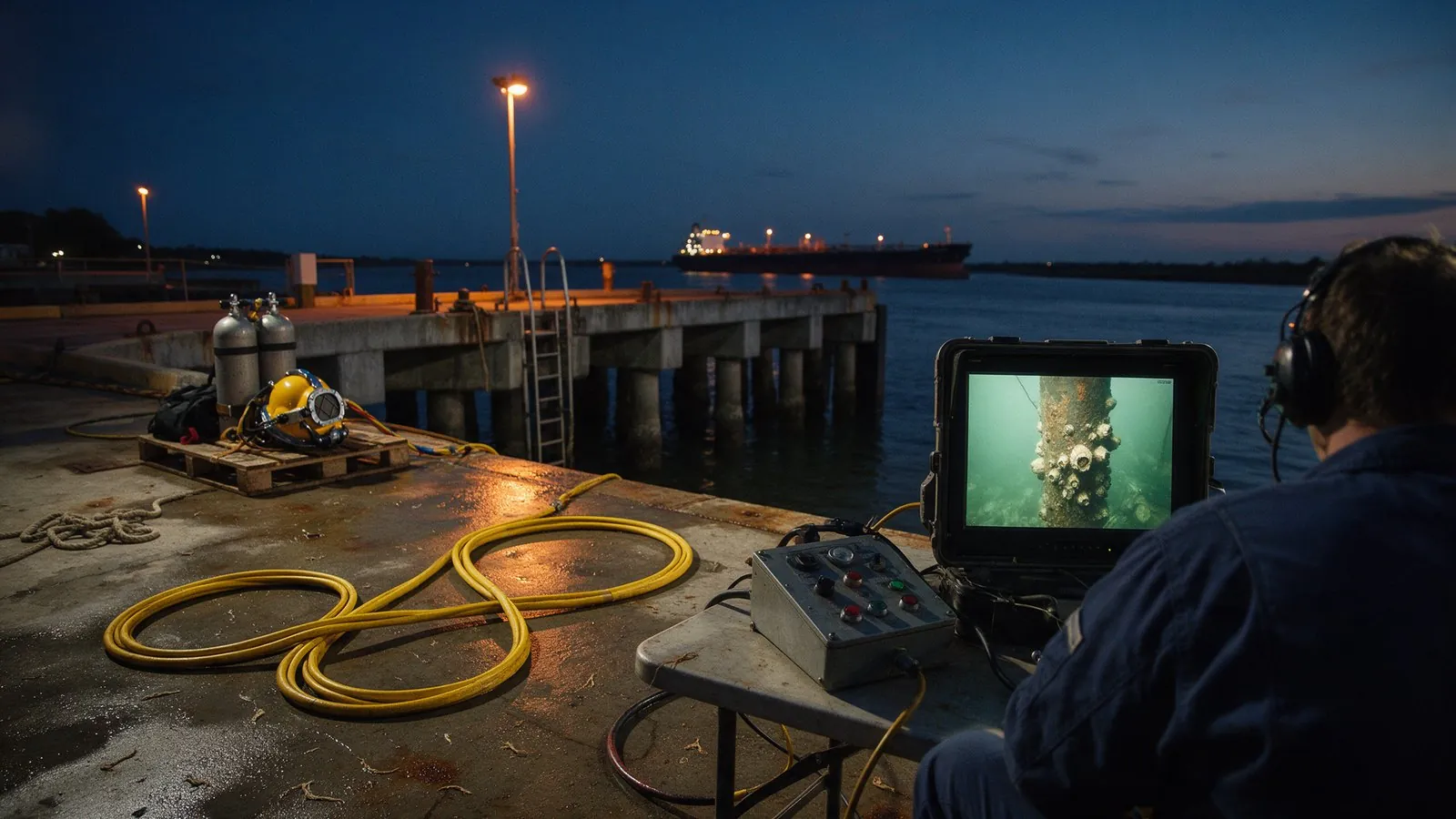
An underwater inspection of a ship's hull or a jetty in Sarawak is a planned dive in which a qualified diving team examines the submerged structure against an agreed scope. The team records dated video and stills tied to frame or pile numbers and, where the scope calls for it, measures cathodic protection potentials, steel thickness and marine growth, and grades each defect. The report should let an engineer find every defect again.
Key takeaways
- Malaysia's Occupational Safety and Health Act 1994, section 18B, in force since 1 June 2024, requires employers and principals to carry out a risk assessment and act on it.
- Under IMCA's guidance for diving on ships (IMCA D082), permits to work for diving normally come from both the port and the vessel.
- Under ASCE's MOP 130 and the US manual UFM 4-150-07, waterfront structures are inspected at three levels: a Level I swim-by, Level II cleaning and Level III testing.
- UFM 4-150-07's underwater checklist gives -0.80 to -0.90 volts against a silver/silver chloride reference cell as acceptable cathodic protection for steel structures; readings outside it go to a cathodic protection engineer.
- IMCA D082 says diving on a ship's hull should be surface-supplied, never scuba, with a dive team of at least five.
On this page10
What does an underwater inspection of a ship's hull cover?
An underwater hull inspection covers the flat bottom and side plating, the propeller and shaft, the rudder, sea chests and their gratings, the sacrificial anodes and the antifouling coating. The diver films each area, notes damage, corrosion, fouling and anode wastage, and measures plate thickness where the scope requires. IMO's biofouling guidelines treat sea chests, propellers and anodes as niche areas, which can be more prone to fouling.
IMO's 2023 Biofouling Guidelines (MEPC.378(80)) recommend an in-water inspection of the hull at least every 12 to 18 months, with a copy of each report kept on board. Each inspected area gets a fouling rating from 0 (no fouling) to 4 (heavy macrofouling over 41 to 100% of the surface).
IMCA, the International Marine Contractors Association, uses the term underwater ship husbandry for the in-water inspection, maintenance and repair of a ship. When the inspection is for a class or flag survey, IMCA's ship husbandry guidance (IMCA D082) says the diving contractor needs formal approval or recognition from the certifying authority. IMCA adds that this approval shows the firm can report properly on the vessel's condition, not that it dives safely.
For class work, DNV, for example, has its in-water bottom surveys of offshore units carried out by divers or ROVs (remotely operated vehicles) supervised by a DNV surveyor. Era Harvest's guide to choosing one offshore contractor or separate specialists explains when underwater work should go to a specialist the class accepts.
What does an underwater inspection of a jetty or wharf cover?
A jetty or wharf inspection covers the steel or concrete piles, sheet pile walls, pile caps at the waterline, the fenders, and the cathodic protection system: anodes, cables and potentials. The diver works pile by pile from the splash zone down to the seabed, records corrosion, cracks, impact damage, scour and marine growth, and takes potential and thickness readings on cleaned spots.
The US Department of Defense's non-mandatory manual UFM 4-150-07 (March 2026) has inspectors of steel structures start at the splash and tidal zones and at about 60 cm below mean low water. In its words, "this is where most mechanical and corrosion damage is found". The diver cleans a 30 cm square of pile, then checks it with an underwater voltmeter where the structure has cathodic protection. The checklist states: "Acceptable levels of cathodic protection are between -0.80 to -0.90 volts when compared to a silver/silver chloride reference cell." Ask a cathodic protection engineer to judge any reading outside that band against the system's design.
UFM 4-150-07 says galvanic anodes should be replaced once over 80% of the metal is consumed, and that ultrasonic thickness readings must be taken on areas clear of marine growth and scale. ISO 13174:2012, Cathodic protection of harbour installations, covers piers, jetties, dolphins and sheet or tubular piling, but not ships. Anode installation and jetty works are part of Era Harvest's underwater services in Bintulu.
What are Level I, Level II and Level III inspections?
Level I, II and III are the three levels of underwater inspection for waterfront structures such as jetties, used in the US manual UFM 4-150-07 and ASCE's MOP 130. Level I is a visual or tactile swim-by with no cleaning. Level II cleans marine growth off selected areas for a close-up check and some measurements. Level III adds non-destructive testing, such as ultrasonic thickness readings, to find hidden damage.
| Level | What the diver does | Typical sample | What it is for |
|---|---|---|---|
| Level I: general visual | Swims the structure and looks, or feels by hand in poor visibility; no cleaning | 100% of the elements below water | Confirms the drawings, spots obvious major damage, plans deeper work |
| Level II: close-up visual | Removes marine growth near the mudline, mid-water and just below low water | Typically 10% of the elements | Finds damage hidden under fouling; takes limited measurements |
| Level III: highly detailed | Non-destructive testing such as ultrasonic thickness readings; sometimes cores | About 5% of the elements | Measures hidden damage and section loss, often after a Level I or II concern |
Table sources: UFM 4-150-07 (definitions) and GEI Consultants on ASCE's 2015 manual, MOP 130 (sample sizes). The level chosen drives time on site and cost.
Which safety rules apply to a diving inspection in Malaysia?
Malaysia's Occupational Safety and Health Act 1994 makes employers keep systems of work safe so far as is practicable. Since 1 June 2024 it also requires employers and principals to carry out and act on a risk assessment. For the dive itself, IMCA's ship husbandry guidance (IMCA D082) says hull diving should be surface-supplied, never scuba, with a team of at least five and a recompression chamber available.
"Every employer, self-employed person or principal shall conduct a risk assessment in relation to the safety and health risk posed to any person who may be affected by his undertaking at the place of work."
Occupational Safety and Health Act 1994 (Act 514), section 18B(1), DOSH reprint as at 1 June 2024
Section 18A of the OSH Act 1994 adds a duty for a principal, such as a jetty owner, towards contractors working under its direction. Era Harvest's guide to lifting sling inspection in Malaysia shows the same risk assessment duty applied to lifting gear.
IMCA's offshore diving code (IMCA D014, Rev. 3.3, March 2025) states that it does not cover underwater ship husbandry or inshore harbour works. IMCA D082 in turn says it should not be used for offshore oil and gas or renewables diving. For hull work, IMCA D082 recommends three things:
- Surface-supplied diving only: scuba "is not acceptable diving equipment".
- A minimum team of five: a supervisor, a working diver, a standby diver and a tender for each diver.
- No hull diving job should go ahead unless a certified two-person, two-compartment recompression chamber is available. It may be onshore only for dives shallower than 10 metres and within two hours' travelling time.
Neither IMCA document is written for diving on a jetty or wharf, so ask the contractor which diving code its method statement and risk assessment follow. Check that it covers surface-supplied equipment, team size, the standby diver and recompression arrangements.
Who must give permission for diving inside port limits?
Diving inside port limits needs the port's agreement as well as the ship's. IMCA D082 says permits to work are normally required by both the site authority, such as the port, and the vessel. In Sarawak the Marine Department (Jabatan Laut Malaysia) also publishes notices to mariners for diving and inspection work. At Bintulu, confirm the current procedure with Bintulu Port Authority, the port operator and your ship agent.
"Port and harbour authorities are responsible for controlling all work which is undertaken in their area of authority."
IMCA D082, Guidance on diving operations in support of underwater ship husbandry, section 12.1 (January 2024)
Offshore, outside port limits, the Marine Department's Notice to Mariners 140/2021(T), issued for the Director of Marine Sarawak, covered air diving and ROV inspection at platforms off Sarawak. It gave dates, coordinates and the vessel, and told mariners to keep two nautical miles away. It shows what such a notice contains.
For in-water hull cleaning, agree with the port where cleaning is accepted and how captured waste comes ashore. Era Harvest's guide to vessel waste disposal at Bintulu Port covers landing waste there.
What happens on the day of an underwater inspection?
On the day, the dive supervisor runs a set sequence: permits signed, hazards on the ship or jetty isolated and checked by both sides, and a briefing. Then comes the dive, with constant voice contact between supervisor and diver. Under IMCA D082, only the appointed dive supervisor can start a dive. Readings are logged as they are taken; ask for first findings before the team leaves site.
What to expect on site, based on IMCA D082 (what a competent dive team does, not a procedure to copy):
- Isolation. Propellers, thrusters, pumps, sea-water intakes and impressed-current cathodic protection are locked out and tagged, and a competent person from each side checks the lock-out.
- Briefing. A pre-dive briefing covers the scope and order of work; other work that could affect the dive is suspended.
- The dive. The master, the harbour master or a surveyor can tell the supervisor to stop a dive for safety reasons. Ask for live video topside so your representative can direct the diver.
- Close-out. Everyone involved is told when diving has finished, and the permit is closed.
What should a good underwater inspection report give you?
A good underwater inspection report lets someone who was not on site find, understand and act on every finding. It states the scope and the drawing used, and ties every observation to a frame, pile or grid location and depth. It includes dated video and stills, records measurements with the instrument used, grades each defect, gives recommendations, and names the divers and supervisor with their qualifications.
| Report item | What good looks like | Why it matters |
|---|---|---|
| Scope and reference drawing | Scope, inspection level, drawing revision, pile or frame numbering | The next inspection can compare like with like |
| Location referencing | Each observation tied to pile number, gridline and depth, or hull frame and position | A defect nobody can find again cannot be repaired |
| Dated video and stills | Date, time, location and depth on screen; stills with a scale | Evidence and a baseline |
| Measurements | Potentials with the reference electrode named, thickness against original, fouling rating | Figures that can be trended |
| Defect grading | A defined severity scale applied to every defect | Ranks repairs by urgency |
| Recommendations | Repairs, follow-up Level II or III work, next inspection date | Turns findings into a maintenance plan |
| Team and conditions | Names and qualifications, dive times, depth, visibility, tide and current | Shows who is accountable |
| Equipment and calibration | Instrument and serial number, calibration check on site | An unchecked gauge makes every reading doubtful |
UFM 4-150-07 says "the usefulness of an inspection depends on establishing a clear and complete record".
Ask which inspection qualification the divers hold. CSWIP 3.1U (NDT inspection diver) is one recognised scheme, and TWI's course for it covers general and close visual inspection, video and photo recording, cathodic protection measurements and ultrasonic thickness measurements.
How does Era Harvest help with underwater inspection in Bintulu?
Era Harvest Supply & Engineering Sdn Bhd, based in Bintulu since 2014, provides underwater inspection, underwater cutting and welding, anode installation, jetty works and ship hull cleaning. When a report recommends new anodes, plate repairs or sheet-pile cutting, that follow-up work (anode installation, underwater cutting and welding) is also on Era Harvest's service list.
In 2025 Era Harvest provided manpower for underwater services to Jiangsu Huaxicun Offshore Engineering Services Malaysia Sdn Bhd: underwater visual recording of designated tubes, their condition and positioning. In 2024 it welded steel plates and cut sheet piles underwater at the Sarawak Methanol jetty for China Communications Construction Company (M) Sdn Bhd. Both jobs are listed on the Era Harvest projects page.
To scope an inspection, send the location, scope and inspection level, any drawings or previous reports, and the work window. If the vessel's class must accept the result, check with the class which diving firms it accepts before booking any contractor, including Era Harvest.
Contact the Bintulu office by WhatsApp at 017-351 0071, call 086-313311, or email inquiry@eraharvest.com.
Sources
- DOSH Malaysia, Occupational Safety and Health Act 1994 (Act 514), reprint as at 1 June 2024 (2024)
- Marine Department Malaysia, Sarawak region, Notice to Mariners 140/2021(T) (2021)
- US Department of Defense, UFM 4-150-07 Waterfront Facilities: Operation and Maintenance (2026)
- GEI Consultants, Which underwater inspection is right for your port project (2022)
- ISO, ISO 13174:2012 Cathodic protection of harbour installations (2012)
- IMO, Resolution MEPC.378(80), 2023 Guidelines for the control and management of ships' biofouling (2023)
- IMCA, IMCA D082 Guidance on diving operations in support of underwater ship husbandry (2024)
- IMCA, IMCA D014 International Code of Practice for Offshore Diving, Rev. 3.3 (2025)
- DNV, Bottom Survey: In-water (service page)
- US Code of Federal Regulations, 46 CFR 115.650 Alternative hull examination options: divers or underwater ROV (LII)
- TWI, CSWIP 3.1U underwater inspection course