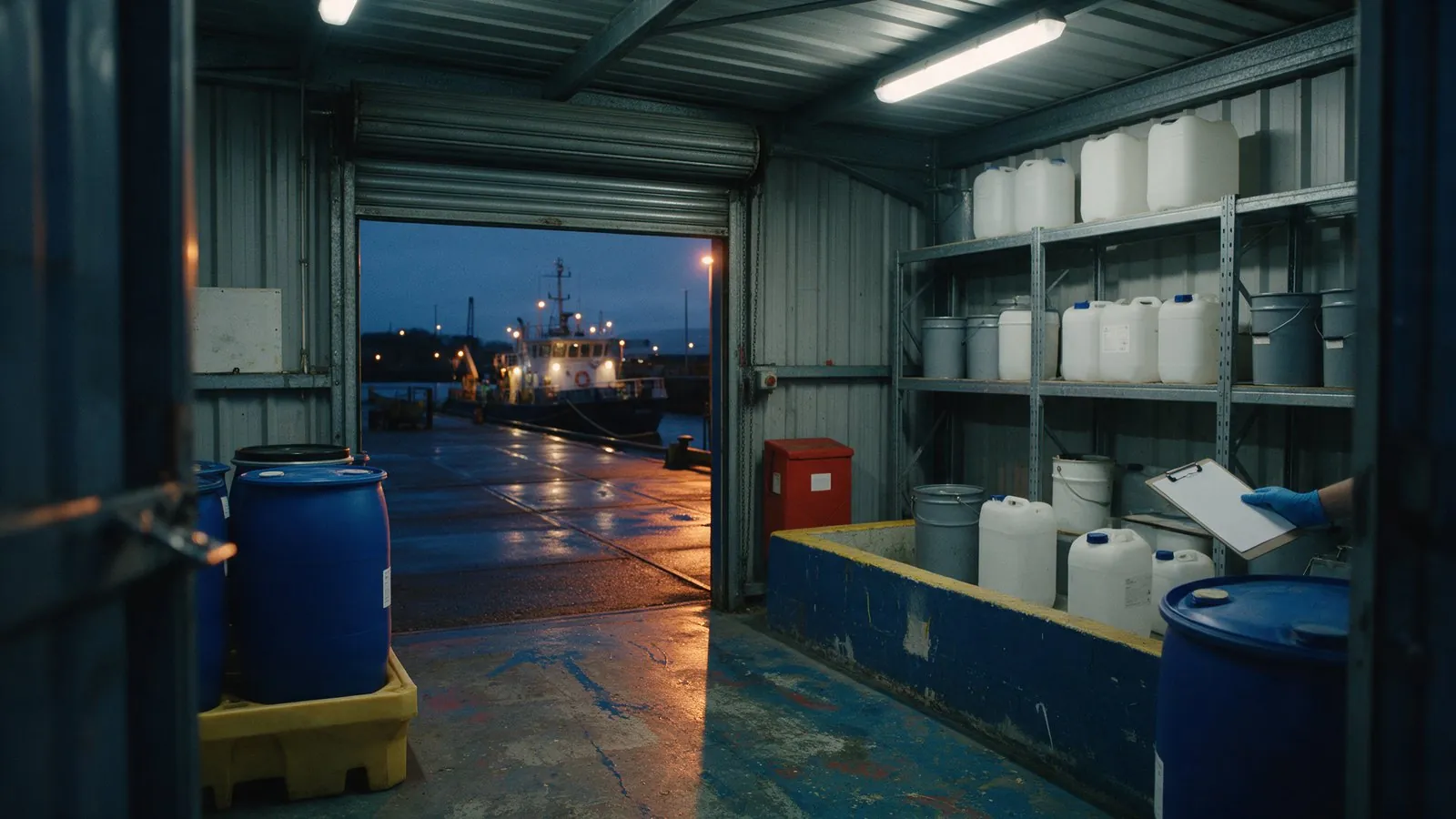
After a hazardous chemical is delivered in Malaysia, the buyer must keep the supplier's label intact, label any container it is decanted into unless it is used immediately, store it away from incompatible chemicals, and keep a chemical register with a current safety data sheet (SDS) for each product under the USECHH Regulations 2000, with risk-assessment and health records kept for thirty years. Work on board a ship falls outside the OSH Act 1994.
Key takeaways
- Under regulation 8 of Malaysia's CLASS Regulations 2013, a hazardous chemical label shows six elements: product identifier, supplier identification, signal word, hazard statement, hazard pictogram and precautionary statement, in Bahasa Malaysia and English (containers of 125 ml or less may carry a shorter label).
- Under regulation 21 of the USECHH Regulations 2000, a chemical decanted into another container and not used within a normal work shift must be relabelled; if it is used within the shift, the container must still carry the chemical or trade name.
- DOSH's Guidelines on Storage of Hazardous Chemicals (2005) recommend keeping incompatible chemicals apart, a bund around outdoor storage holding at least 110% of the capacity of any single container, and stacks no higher than three metres without racking.
- The USECHH chemical register holds the current SDS for each chemical; chemical health risk assessment reports and personal exposure monitoring records are kept for at least thirty years, and health surveillance records for thirty years from the last entry.
- The OSH Act 1994 excludes work on board ships governed by the Merchant Shipping Ordinances, so a vessel's chemical rules come from the ISM Code, MLC 2006 and, for oil cargo and fuel oil, SOLAS regulation VI/5-1.
On this page10
Which chemical records must a buyer and a vessel keep in Malaysia, and for how long?
For its hazardous chemicals, a Malaysian buyer keeps four core things: intact labels, a current SDS at each place of use, a chemical register, and the assessment, monitoring and health surveillance records, some for thirty years, plus scheduled-waste and import records where they apply. A vessel keeps the equivalent under its safety management system, plus a material safety data sheet for oil cargo and bunkered fuel.
| What to keep | Who keeps it | How long | Rule |
|---|---|---|---|
| Supplier's label on every container | Supplier fixes it; employer keeps it intact | While the chemical is in use | CLASS reg. 8; USECHH reg. 20 |
| Label on a decanted container | Employer | While it holds the chemical, unless used immediately | USECHH reg. 21 |
| Current SDS close to each place of use | Employer; supplier furnishes it | Current revision; supplier revises after 5 years | USECHH reg. 25; CLASS reg. 13 |
| Chemical register | Employer | Updated from time to time | USECHH reg. 5 |
| Chemical health risk assessment (CHRA) report | Employer | At least thirty years | USECHH reg. 13 |
| Exposure monitoring records | Employer | At least thirty years (personal exposure); at least 5 years (other) | USECHH reg. 26 |
| Health surveillance records | Employer | Thirty years from the last entry | USECHH reg. 27 |
| Scheduled waste inventory | Waste generator | Up to 3 years | Scheduled Wastes Regulations 2005, reg. 11 |
| Inventory of hazardous chemicals, 1 tonne or more a year | Importer or manufacturer | Submitted to DOSH by 31 March each year | CLASS reg. 14 |
| MSDS for oil cargo or fuel oil | Ship | Before loading or bunkering | SOLAS reg. VI/5-1 |
| Chemical risk assessment; each SDS it relies on | Company and ship | Ashore and on board, per the safety management system | ISM Code (safety management system); MLC 2006 Std A4.3; MGN 497 (UK guidance) |
The CLASS and USECHH Regulations are both made under the Occupational Safety and Health Act 1994, and the Department of Occupational Safety and Health (DOSH) sets out both on its chemical management page.
What must a hazardous chemical label show in Malaysia?
A hazardous chemical label in Malaysia must carry six elements, in Bahasa Malaysia and English, under regulation 8 of the CLASS Regulations 2013; containers of 125 ml or less may carry a shorter label. DOSH's Industry Code of Practice on Chemicals Classification and Hazard Communication ties CLASS to the Globally Harmonised System (GHS), so the label uses the GHS elements:
- product identifier;
- supplier's name, address and telephone number;
- one signal word, Danger or Warning;
- hazard statements;
- hazard pictograms;
- precautionary statements.
The Fourth Schedule of the CLASS Regulations 2013 sets the minimum label size:
| Contents of the pack | Minimum label size |
|---|---|
| Up to 3 litres | 52 x 74 mm, if practicable |
| Over 3 and up to 50 litres | 74 x 105 mm |
| Over 50 and up to 500 litres, such as a 200-litre drum | 105 x 148 mm |
| Over 500 litres | 148 x 210 mm |
Under CLASS, a "subsidiary supplier" is one "who repacks, distributes or retails a hazardous chemical", so a distributor repacking a drum into pails labels the pails.
What should you check when hazardous chemicals are delivered?
When hazardous chemicals are delivered in Malaysia, check every container before it goes into the store: the label is present, legible and in both languages, the product identifier matches the SDS, the seal is unbroken, the SDS is current and the pack is undamaged.
"An employer who receives a supply of chemicals hazardous to health for which the chemicals are not labelled or the Chemical Safety Data Sheets have not been provided, shall obtain the relevant information from the supplier and shall not use the chemicals until such information is obtained." (USECHH Regulations 2000, regulation 24)
A four-step receiving check, built from the CLASS Regulations 2013 and DOSH's storage guidelines:
- Label elements. All six appear in both languages with one signal word, and the product identifier matches the SDS (Industry Code of Practice, 3.2.1.1.1).
- Seal. Regulation 7 requires a first seal that, once opened, "is broken and cannot be repaired".
- SDS date. Regulation 13(4) makes the supplier revise an SDS more than five years old.
- Quantity and condition. DOSH's storage guidelines identify chemicals on arrival from the delivery documents, labelling and SDS, then check quantity and condition.
How do you label a decanted chemical in a secondary container?
A chemical decanted at a Malaysian workplace into a secondary container, meaning any container other than the one it was supplied in, must be relabelled if it will not be used within a normal work shift, under regulation 21 of the USECHH Regulations 2000. If it will be used within the shift, the container still needs the chemical or trade name. Only a chemical used immediately needs no new label.
The USECHH decanting rule covers, for a product hazardous to health, a pail of degreaser filled from a drum. Regulation 21 still cites the 1997 labelling rules, which CLASS revoked in 2013, so the safe course is to copy the six CLASS label elements onto a full relabel.
How should hazardous chemicals be stored at a workplace in Malaysia?
Hazardous chemicals at a Malaysian workplace should be stored by hazard class and compatibility, with spills contained. DOSH's Guidelines on Storage of Hazardous Chemicals (2005) recommend a sill or bund around outdoor storage holding at least 110% of the capacity of any single container in it, and a storage plan with a copy for the local fire brigade.
Each SDS gives "conditions for safe storage, including any incompatibilities" in Section 7 and "incompatible materials" in Section 10, as the marine chemical ordering guide explains. The DOSH storage guidelines name pairs to keep apart: acids with hypochlorites generate chlorine gas, and acids with alkalis generate heat.
For flammable liquids, the guidelines advise "a cool dry place, away from sources of ignition and heat", and refer fire-fighting to the Fire and Rescue Department (Bomba). Under section 28 of the Fire Services Act 1988, premises designated by order for their use, size or location need a fire certificate, renewed annually.
How must waste chemicals and empty containers be stored?
Waste chemicals and disposed containers contaminated with chemicals are scheduled waste under the Environmental Quality (Scheduled Wastes) Regulations 2005, made under the Environmental Quality Act 1974. Each container is labelled with the date the waste was first generated and the generator's contact details (regulation 10), and waste may stay on site for 180 days or less, up to 20 tonnes (regulation 9).
What goes in a USECHH chemical register, and which records must a buyer keep?
Under the USECHH Regulations 2000, the employer keeps a register of every chemical hazardous to health, a current SDS near each place of use, a written chemical health risk assessment (CHRA) by a DOSH-registered assessor, documented training, and any exposure monitoring and health surveillance records. CHRA reports, personal exposure records and health surveillance records are kept for thirty years.
Regulation 5(2) sets what the chemical register contains:
- a list of all chemicals hazardous to health used;
- the current SDS for each of them;
- the average quantity used, produced or stored per month or per year;
- the process and work area where each is used;
- the name and address of each supplier.
The register is "updated from time to time" and "accessible to all employees at the place of work who may be exposed" (regulation 5(3)), and DOSH's chemical management page links its guidelines for preparing it. A chemical that only sits in the store still belongs in the register, because USECHH defines "use" to include storage; one hazardous solely because it is flammable falls outside USECHH (regulation 3). Regulation 25 keeps the current SDS "in a conspicuous place close to each location where that chemical is used".
Is the chemical register submitted to DOSH?
The USECHH chemical register is not submitted under the regulation in force: regulation 5 keeps it at the place of work. The 31 March filing that applies today is the CLASS regulation 14 inventory from importers and manufacturers of one tonne or more a year. A 2023 DOSH draft would add a yearly register submission under future USECHH regulations, ChemLinked reported.
What must a vessel keep for the chemicals on board?
A vessel keeps its chemical records under its flag state's rules, not the USECHH Regulations, because the OSH Act 1994 excludes work on board ships governed by the Merchant Shipping Ordinances. Within its ISM Code safety management system, UK guidance MGN 497 recommends a chemical risk assessment kept ashore and on board, a copy of each SDS it relies on and a segregated store. SOLAS adds data sheets for oil cargo and bunkered fuel.
The Occupational Safety and Health Act 1994 has excluded work on board ships governed by the Merchant Shipping Ordinance 1952 and the Sabah and Sarawak Merchant Shipping Ordinances 1960 since it was passed, in its original section 1(3). Since the Occupational Safety and Health (Amendment) Act 2022 (Act A1648) came into force on 1 June 2024 (P.U. (B) 128/2024), that exclusion sits in section 1(3) and paragraph 3 of the First Schedule.
The International Maritime Organization describes the ISM Code, mandatory since 1 July 1998, as "an international standard for the safe management and operation of ships and for pollution prevention". Standard A4.3 of the Maritime Labour Convention, 2006 requires flag state rules to include "measures to reduce and prevent the risk of exposure to harmful levels of ambient factors and chemicals".
SOLAS regulation VI/5-1, as amended by IMO resolution MSC.282(86) from 1 January 2011, requires material safety data sheets before oil is loaded as bulk cargo or oil fuel is bunkered; packaged ship's stores such as drums of degreaser fall under the ship's own procedures.
For those procedures, the UK Maritime and Coastguard Agency's guidance note MGN 497, written for UK ships and used here as good practice, not Malaysian law, warns that common marine chemicals outside the IMDG Code "can react violently together should the packaging become damaged or involved in a fire". It keeps risk assessments under the ship's Safety Management System, with "a copy kept at the company's offices and on board", and says a safety data sheet used in one "should be kept on board the vessel for easy reference".
Under the IMO definition of ships' stores (MSC.1/Circ.1216), quoted in MGN 497, materials for diving, surveying or salvage work are not stores, and dangerous goods that are not stores fall under the IMDG Code. See IMDG cargo versus ship's stores.
How does Era Harvest support chemical buyers in Bintulu?
Era Harvest Supply & Engineering Sdn Bhd, based in Bintulu, Sarawak since 2014, supplies marine, industrial and laboratory chemicals, including degreasers and deck cleaning chemicals, and is an authorised agent for WSS Wilhelmsen Ships Service chemicals. Other brands it supplies include Nalfleet and Nalco. Era Harvest also rents chemical tote tanks through its equipment rental service and supplies PPE such as coveralls, gloves and safety boots.
On the WSS safety data sheet portal, you find an SDS by product name or number for the country whose rules apply, with English always alongside the local language.
Send your chemical list on WhatsApp at 017-351 0071, call 086-313311, or email inquiry@eraharvest.com, and ask for the current SDS for each product so it can go straight into your chemical register.
Sources
- Occupational Safety and Health Act 1994 (Act 514), original text
- DOSH, Occupational Safety and Health (Classification, Labelling and Safety Data Sheet of Hazardous Chemicals) Regulations 2013
- DOSH, Occupational Safety and Health (Use and Standards of Exposure of Chemicals Hazardous to Health) Regulations 2000
- DOSH, Industry Code of Practice on Chemicals Classification and Hazard Communication (2014)
- DOSH, Guidelines on Storage of Hazardous Chemicals: A Guide for Safe Warehousing of Packaged Hazardous Chemicals (2005)
- DOSH, Chemical management: regulations, guidelines and codes of practice
- ChemLinked, Malaysia consults on revision of guidelines for OSH regulation (21 February 2023)
- Fire Services Act 1988 (Act 341), online updated text as at 1 October 2018
- Environmental Quality (Scheduled Wastes) Regulations 2005 (FAOLEX copy)
- Occupational Safety and Health (Amendment) Act 2022 (Act A1648)
- DOSH, P.U. (B) 128/2024: appointment of 1 June 2024 as the commencement date of Act A1648
- International Maritime Organization, The International Safety Management (ISM) Code
- International Labour Organization, Maritime Labour Convention, 2006, as amended (consolidated text, 2024)
- IMO, Resolution MSC.282(86): amendments to SOLAS, including regulation VI/5-1 (2009)
- UK Maritime and Coastguard Agency, MGN 497 (M+F): Dangerous goods including chemicals and other materials, storage and use on board ship
- Wilhelmsen Ships Service, Safety data sheets portal