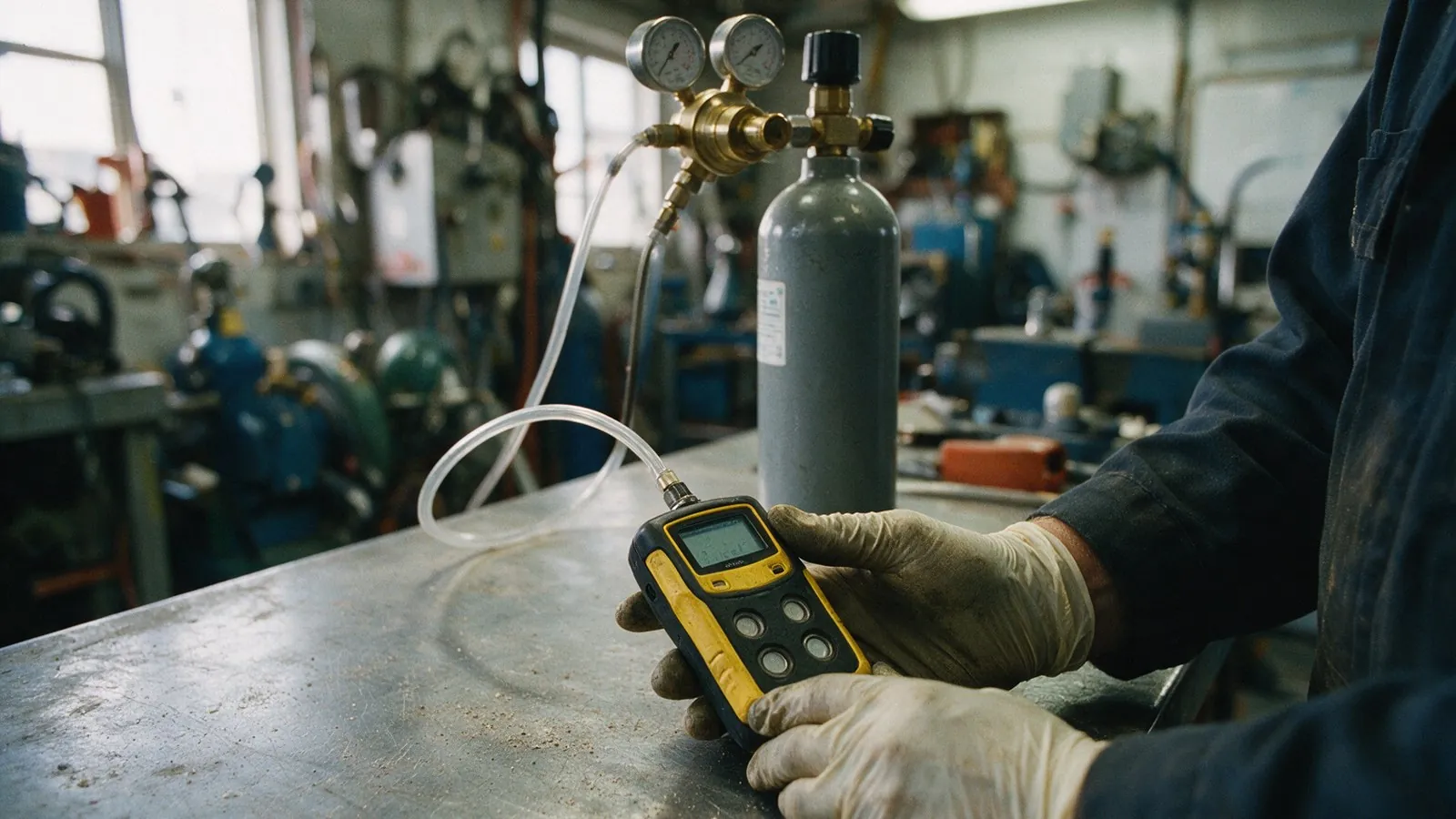
Calibrate a multi-gas detector at the interval its own manual gives — six months for a Draeger X-am 2500 — and bump test it before each day's use. No Malaysian or international rule sets a calendar date of its own: Malaysia's confined space code and IMO's instrument guidelines both hand the interval to the manufacturer. Harsh duty shortens it; the daily check never moves.
Key takeaways
- Malaysia's confined space code requires the instrument used for atmosphere testing to be "calibrated as per manufacturer's recommendation" (paragraph 8.6.5). It sets no interval of its own.
- Draeger's X-am 2500 technical manual gives six months for the Ex, O2, H2S, SO2, NO2 and CO channels, and says the instrument should be inspected and maintained annually by suitably qualified persons.
- A bump test is not a calibration. OSHA, carrying ISEA's recommendation, puts that check "before each day's use"; an instrument that fails one needs a full calibration, and one that fails that should be removed from service.
- SOLAS regulation XI-1/7 requires "suitable means shall be provided for the calibration of all such instruments". The Bahamas, one flag administration, has clarified this may be satisfied on board or ashore.
- Retesting the space is a separate schedule. The Malaysian code says no set time fits every case, but intervals should be conservative and not more than eight hours apart.
On this page9
What does Malaysian law say about calibrating a gas detector?
Malaysia's Industry Code of Practice for Safe Working in a Confined Space 2010 requires a gas detector to be calibrated as its manufacturer recommends, and sets no interval of its own. Paragraph 8.6.5 of the Department of Occupational Safety and Health's code says it is essential to ensure the instrument used is a direct reading instrument, "calibrated as per manufacturer's recommendation", and suitable for measuring the gases required to be tested.
So the schedule a Malaysian site must keep is not a number in the code — it is whatever is printed in the manual of the instrument on the shelf, and two detectors in the same toolbox can carry different intervals. The code supplies the paper trail: paragraph 8.6.1.1(d) requires the atmosphere to be tested from outside the space before any entry, and "the results shall be recorded on the permit to work". Paragraph 8.6.2 adds that it "shall be tested by an authorised gas tester initially".
What interval does the manufacturer's manual give?
Six months is the interval Draeger publishes for the X-am 2500, with a bump test before use and an inspection once a year. Draeger is among the brands Era Harvest supplies.
| Task | What the Draeger X-am 2500 technical manual says |
|---|---|
| Bump test | "CSA requirement: carry out a bump test before use" |
| Calibration / adjustment | "We recommend that you adjust all the channels after 6 months" — six months for the Ex, O2, H2S, SO2, NO2 and CO channels (sections 5.1 and 9.1) |
| Inspection and maintenance | "The instrument should be inspected and maintained by suitably qualified persons annually" (section 9.1) |
| Configurable interval | A settable field: 0 to 180 days, sensor-dependent |
The manual says when six months is not enough: "For critical applications, observe the recommendations in EN 60079-29-2 or EN 45544-4 and national regulations." It ties the interval to "the sensors used and the operating conditions" — which is why a detector in a humid, dusty engine room is not on the same schedule as one kept in a store.
Why do you see 30, 60 or 90 days quoted?
No regulator or manufacturer document cited in this guide sets a universal 30 to 90 day calibration interval. What shortens an interval is measurable: OSHA lists the causes of drift as exposure to high concentrations of the target gases, solvent vapours and corrosive gases reaching electrochemical sensors, catalytic hot-bead LEL sensors meeting "volatile silicones, hydride gases, halogenated hydrocarbons, and sulfide gases", extreme temperature and humidity, and handling causing "enough vibration or shock over time".
Sour service bites hardest in oil and gas work. Draeger's manual warns that catalytic poisons such as "volatile silicone, sulphur, heavy metal compounds or halogenated hydrocarbon" can damage the CatEx sensor, and that "if the CatEx sensor can no longer be calibrated to the target concentration, the sensor must be replaced" — where a calibration becomes a parts job.
Bump test, calibration check or full calibration — which is which?
A bump test, a calibration check and a full calibration are three different operations, and only a full calibration adjusts the instrument. The United States Occupational Safety and Health Administration defines them in its bulletin on calibrating and testing direct-reading portable gas monitors, which incorporates recommendations developed by the International Safety Equipment Association.
| Operation | What it does | How often |
|---|---|---|
| Bump test | "A qualitative function check in which a challenge gas is passed over the sensor(s)" — it "does not provide a measure of the instrument's accuracy" | Before each day's use |
| Calibration check | "Verifies that the sensor(s) and alarms respond within the manufacturer's acceptable limits" | Before each day's use, as the alternative |
| Full calibration | "Adjusts the instrument's reading to coincide with a known concentration" of gas | At the manufacturer's interval, and after any failed bump test |
If an instrument fails a bump test or a calibration check, the operator should perform a full calibration on it before using it.
— Occupational Safety and Health Administration, SHIB 09-30-2013, Calibrating and Testing Direct-Reading Portable Gas Monitors
The bulletin is equally clear about the end of the line: "If the instrument fails the full calibration, the employer should remove it from service." The two schedules do not cover for each other: a detector bump tested every morning for six months has not been calibrated, and a detector whose six-month calibration is current has not been checked today.
What do the rules require for a detector used on a vessel?
A ship must be able to calibrate the instrument it carries, not merely own one. SOLAS regulation XI-1/7, added by resolution MSC.380(94) and in force since 1 July 2016, requires every ship to which chapter I applies to carry a portable atmosphere testing instrument capable of measuring oxygen, flammable gases or vapours, hydrogen sulphide and carbon monoxide before entry into enclosed spaces, and closes: "Suitable means shall be provided for the calibration of all such instruments."
IMO's selection guidelines, MSC.1/Circ.1477 of 9 June 2014, hand the interval back to the manufacturer in one line — paragraph 16: "The manufacturers' instructions should have clearly defined calibration requirements." Paragraph 18 asks that the manual explaining how to calibrate, operate and maintain it be in the working language of the ship.
What a ship has to show is a record, not just a routine. Under the Bahamas national requirements circulated by the Indian Register of Shipping in 2017, a valid calibration certificate should accompany the in-use instrument at all times, and where one goes ashore the company must ensure an alternative instrument is aboard meanwhile. IMO also adopted resolution MSC.581(110) on 27 June 2025, superseding resolution A.1050(27); the Indian Register of Shipping's circular on the revision notes that ships should carry at least two sets of gas detection equipment with sufficient spares and calibration means.
How often must the space itself be retested?
A confined space is retested far more often than its detector is calibrated — before the entry permit is issued, then at intervals the Malaysian code says should be no more than eight hours apart. Appendix F of the confined space code puts it plainly: "No set time can be applied for all circumstances, but periods between tests should be set conservatively, not more than 8 hours apart."
The code also fixes the order of the first test: paragraph 8.6.1.1(c) requires that "when testing for atmospheric hazards, the first test is for oxygen, followed by flammable gases and vapours, and finally for toxic gases and vapours". It asks for no significant delay before the first entry, and a retest after any significant break in occupancy. IMO describes the same two-stage job at sea: testing "before entry and at appropriate intervals thereafter until all work is completed" (paragraph 3).
Calibration drift is what connects the two schedules, and the code's thresholds show how little of it matters. A hazardous atmosphere is oxygen below 19.5% or above 23.5% by volume at sea level, flammable or explosive gas above 10% of its lower explosive limit, or toxic gas at or above its permissible exposure limit.
Who calibrates a gas detector in Bintulu, and what does the service cover?
Era Harvest services breathing apparatus, SCBA and multi-gas detectors from Bintulu, calibrating them against certified gas standards for oxygen, carbon monoxide and hydrogen sulphide, quarterly, annually or on demand. Detector calibration and SCBA servicing are handled under fire fighting equipment; proof load testing, NDT and lifting-gear calibration sit under testing, inspection and recertification — the same discipline on a different item, and the subject of our guide to lifting sling inspection and recertification.
Instruments are rarely the only thing on a site with an interval against its name: the yearly extinguisher service and the testing intervals for hose reels and hydrants run on the same kind of schedule. The correct test-gas mixture also has to be on site for the daily bump test — a supply item, not part of the service call. Putting a fleet on a schedule turns on three things: the model, the sensors fitted and the date of the last calibration. Send those with your enquiry.
Sources
- DOSH Industry Code of Practice for Safe Working in a Confined Space 2010
- Draeger X-am 2500 Technical Manual 90 33 366 (Ed. 08)
- OSHA SHIB 09-30-2013, Calibrating and Testing Direct-Reading Portable Gas Monitors
- IMO MSC.1/Circ.1477
- BG Verkehr Circular 04/2015 (ISM/MLC)
- Indian Register of Shipping Technical Circular 011/2017
- Indian Register of Shipping Technical Circular 002/2026
- DNV, Revised IMO recommendations for entering enclosed spaces aboard ships